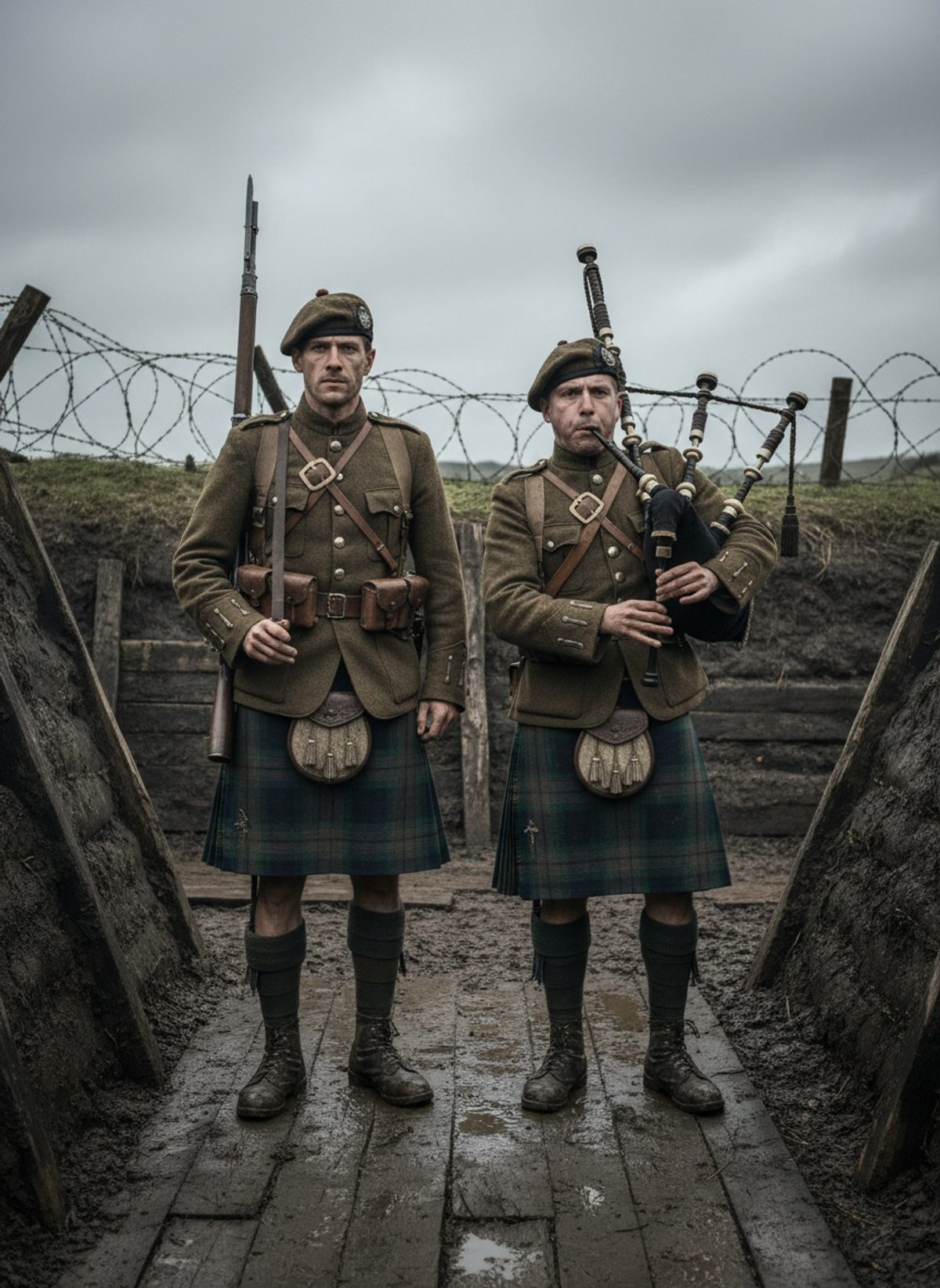
The air was crisp and biting, laced with the sweet decay of autumn leaves. Beneath the steel-grey skies of northern France in 1914, a chill wind whipped across the muddy landscape, carrying with it the scents of damp earth and the distant smoke of war. In the distance, just beyond the shattered remains of a once-thriving village, the eerie wail of bagpipes drifted unsettlingly in the air, a sound as both otherworldly and tangible as the mist that clung to the sodden fields. This musical echo of the Highlands heralded the advance of the Scottish Highland regiments, whose presence would etch itself indelibly into the fabric of the First World War.
As the men marched, their kilts swirled around their knees, vibrant tartans defying the somber tones of their surroundings. It was a sight to behold, a living tapestry of color and tradition amid the muddy and uniformed masses of the trenches. With every step, they carried not only their gear but also centuries of heritage and pride. Above them, the ever-present bagpipes sang in defiance of modern warfare’s droning machinery, reminding all within earshot that this was a regiment of distinct character and courage.
To the German soldiers who faced them, the arrival of the Highland regiments must have seemed like a scene lifted from the mists of myth and legend. Clad in their distinctive kilts, armed with modern rifles, and led by the piercing call of bagpipes, these men seemed to exist outside the norms of contemporary warfare. The Germans had prepared for industrial conflict, a clash defined by machine guns and artillery barrages, where the individual was increasingly overshadowed by the machine. Yet here were the Highlanders—warriors whose traditions seemed representative of an earlier epoch—advancing as if on a battlefield where bravery and martial spirit mattered as much as firepower.
Throughout the early days of the war, the Highland regiments swiftly built a reputation on the battlefield. Tales of their ferocity and fearlessness circulated among both allies and enemies. The Highlanders charged with a tenacity that left a lasting impression on any who witnessed or faced them. For some soldiers in the German ranks, the sight of these kilted figures advancing at pace, bayonets glinting in the dim light of a war-torn world, was as haunting as it was fearsome. Accounts emerged later of Germans referring to the kilted soldiers as “the ladies from hell,” a moniker rooted in both admiration and the surreal sight of these skirted warriors.
Read next: Roosevelt Was Shot Before the Speech. He Gave It Anyway.
In an era where the very nature of combat was being altered by technology, the Highlanders’ adherence to tradition seemed almost an act of rebellion against the relentless march of progress. They represented a paradox of valor—fighting with modern weaponry yet garbed in attire that connected them across centuries to warriors who had secured Scotland’s place in history. It was this blend of the old and the new, of timeless courage married to the impersonal violence of mechanized war, that gave the Highland regiments their formidable visage.
Beyond the grim trenches and the horrors of no man’s land, these Scottish soldiers brought with them cultural resilience. The sound of their bagpipe music, wafting over the scarped wastelands between opposing forces, served as both a morale booster for comrades and a psychological weapon against foes. For the Germans, unaccustomed to such martial tones emanating from the ranks of their opponents, the music of the bagpipes could seem uncanny, almost ghostly, heralding an imminent and relentless attack with the certainty of an ancient war cry.
Amid the grinding stalemate that characterized the Western Front, stories of the Highlanders' exploits could lighten even the most dour spirits, injecting a sense of fierce pride into their own ranks while sowing apprehension among enemy soldiers. These Scots did not simply fight; they evoked the image of warrior clans of old, unyielding in their resolve and steadfast in their standing for their homeland. They carried a tradition that bridged Highland glens and muddy trenches, a hallmark of identity that refused to be overshadowed even by the relentless guns of modernity.
The legacy of the Highlanders in World War I is more than a tale of military regalia and bagpipes. It is an enduring reminder of the power of heritage, a testament to the human spirit's drive to assert individuality and tradition in the face of overwhelming change. In those moments, where bullets flew and artillery pounded, the visual and auditory presence of the Highlanders was a defiance to the homogenization that war attempts to impose upon its participants. Their story resonates beyond the bounds of the conflict, offering a unique perspective on how tradition can be both an anchor and a sword.
Decades have passed since the bagpipes last called soldiers into the breach on the battlefields of Europe, yet the spirit of the Highlanders persists, etched deeply into the collective memory of those who witnessed their charge. Theirs is a tale of courage and identity that calls to future generations to not only remember those who fought but also to draw inspiration from their unwavering commitment to preserving the unique spirit of their forbears. This dedication to tradition and honor in the face of war’s brutality may well be the greatest legacy of the kilted regiments who shook the German resolve with their indomitable spirit on those distant, ravaged fields.