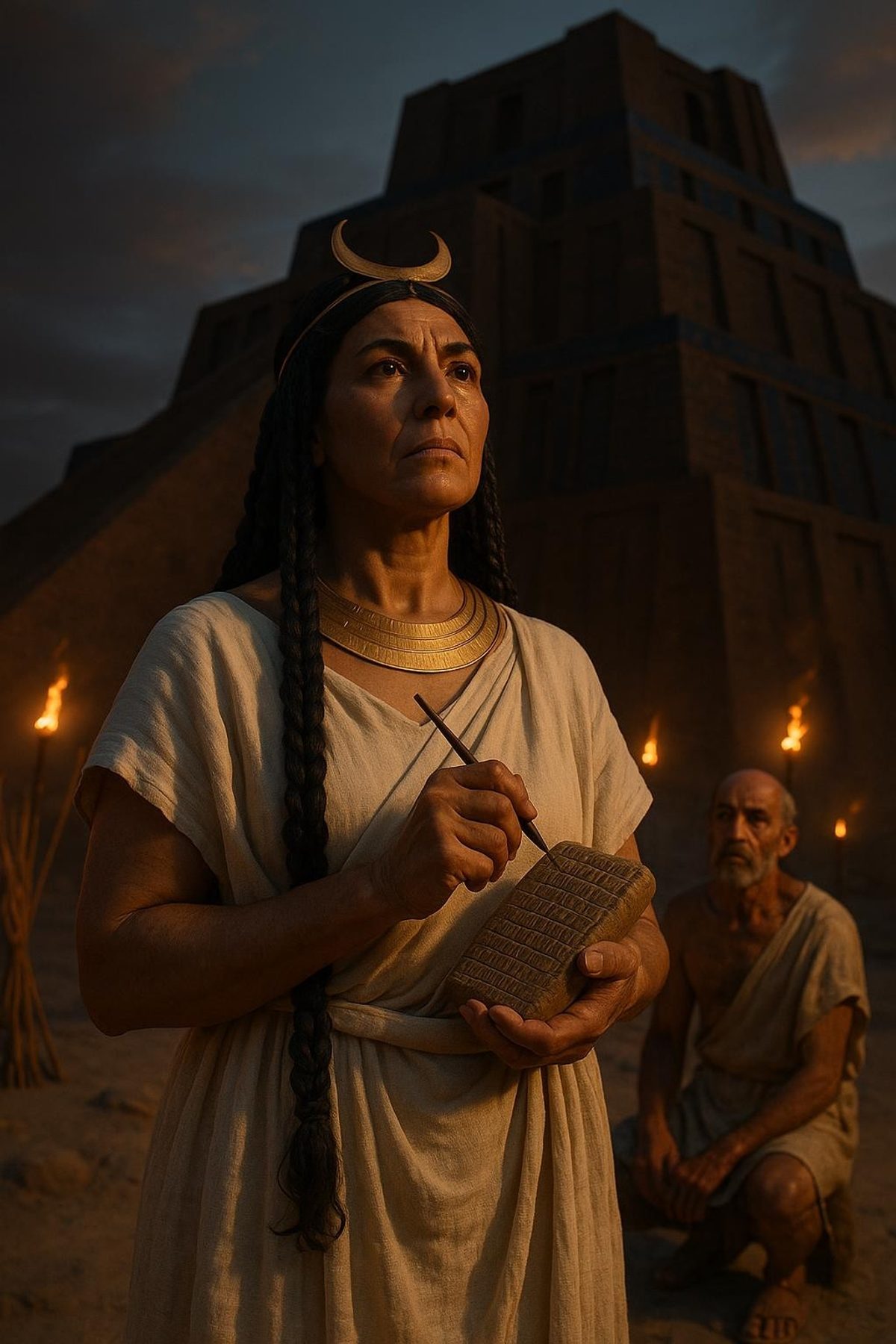
Sunlight danced across the stone altar as Enheduanna stood facing the imposing ziggurat of Ur, the heart of Sumeria's religious life. Her voice, steady and resolute, rose in sacred verse to the heavens, her words dedicated to the moon god Nanna. It was a moment that would ripple through millennia, not just for its devotion, but for its audacity. Her name — Enheduanna — was carved alongside those words, the first author in recorded history to claim her own work.
The Daughter of Sargon the Conqueror
Born into the ambitious world of Sargon of Akkad, Enheduanna was no ordinary child. Her father was a trailblazer, the first ruler to unify Mesopotamia under one empire. Known for his conquests, Sargon was "king of Akkad" and "governor of Enlil," esteemed monarch over the vast lands of the Mesopotamian plain. His military campaigns were legendary, notably defeating Lugal-zage-si and extending his dominion from the heartlands to the coast, capturing 34 cities to bind them into a single empire.
In this politically charged atmosphere, Enheduanna emerged. Appointed the entu priestess of the moon god Nanna by her father, she was placed at the pinnacle of Ur's religious hierarchy. This role was both profound and strategic. By merging the divine interests of Sumerian and Akkadian theology, Enheduanna's appointment was a masterstroke of statecraft — a gesture meant to weave Sargon’s new world with the rich tapestry of Sumerian tradition.
The Voice of a Divine Poet
In the shadow of the ziggurat, Enheduanna honed her voice, crafting hymns and poems that transcended mortal experience. Words infused with spirituality were not just offerings; they were bridges between the divine and the earthly, serving as a vital conduit for religious practice in ancient Mesopotamia. One of her most celebrated compositions is the *Exaltation of Inanna*, where she speaks as the first-person narrator, channeling her devotion through the goddess she venerates.
Read next: Pepi II Was Six Years Old. Egypt Obeyed Him for 94 Years.
Enheduanna's hymns did more than narrate divine stories; they articulated a sophisticated and unprecedented expression of spiritual and rhetorical power. Her Sumerian Temple Hymns, a collection attributed to her, were not merely poetic; they were functional tools of worship that lent structure to religious rituals. Today, there is debate among Assyriologists about the authorship of these works, with some believing later scribes attributed them to her as part of constructing a narrative legacy for Sargon’s dynasty. Nonetheless, the cultural lineage she inspired remained vital for centuries, rediscovered only with modern archaeological efforts.
A Name Chiseled into Time
It was in 1927 that the world was reintroduced to Enheduanna. Sir Leonard Woolley, an English archaeologist, unearthed a remarkable alabaster disk at the site of Ur, inscribed with her name, affiliation, and her unique status as Sargon's daughter. This was a seismic rediscovery, suggesting that the signals of her authorship marked an early milestone of literacy and self-authorship in human history.
Beyond royal lineage, the act of signing her own work catalyzed a new paradigm. Naming her creations was an assertion of intellectual property and identity; it identified poetry as the work of an individual consciousness rather than an anonymous, divine inspiration. This practice established a benchmark for textuality, heralding a future where authorship would dwell at the heart of literary creation.
Into the Annals of Feminist Scholarship
In more recent history, Enheduanna's legacy has resided at the nexus of feminist thought and classical studies. Her position as both a political figure and a recognized author elevates her presence as a pioneering exemplar of female intellectual achievement. This has fostered a re-evaluation of gender roles in ancient history, challenging perceptions about women's contributions to the cultural and intellectual fabric of early civilization.
Analyzing the persona of Enheduanna, scholars today consider her rhetorical strategies alongside classical paradigms, examining the intersection of her literary expression and her liturgical authority. Her compositions offer not just glimpses into her world but a lens to understand the power dynamics and cultural exchanges between the Akkadian and Sumerian civilizations.
The echo of Enheduanna's voice serves as a whisper through the ages, a reminder of the time when words became a legacy. It is a reminder of the profound impacts of textual identity and the untold stories that were written long before the ink of more modern civilizations dried. In her hymns and her name, she carved her place in the annals of history, inviting us to ponder how many other stories remain uncovered, waiting to be unspooled by a thoughtful decipherment of the past. Her tale is not simply an ancient one; it’s a timeless narrative about the power of voice, identity, and the resonance of a singular life etched into the corridors of human history.