Circa 2400 BCE. Sand grains, golden in the Egyptian sun, swirled gently against the worn stones of Giza's ancient paths.
The Trailblazer of a Forgotten Age
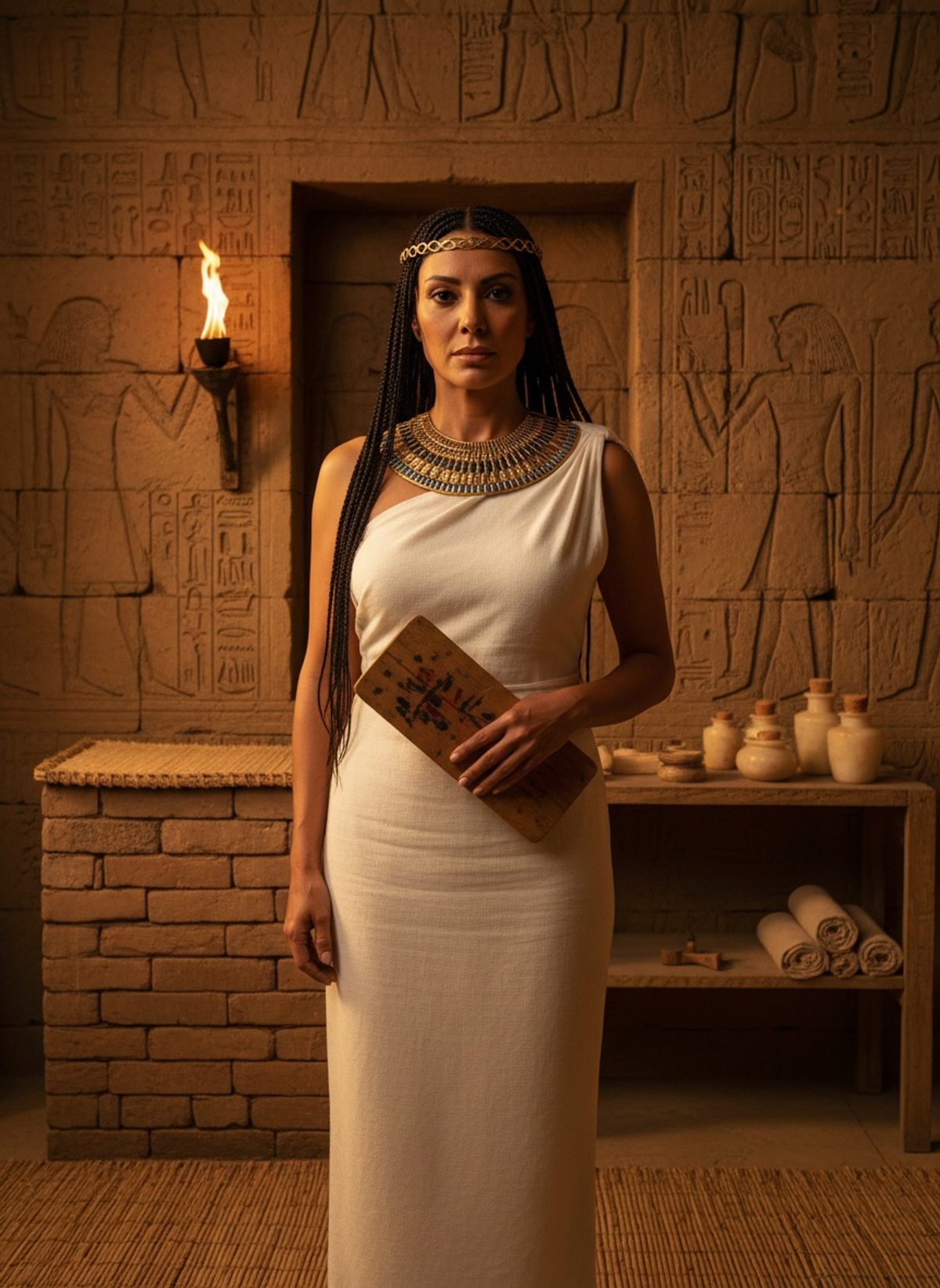
In the shadow of mighty pyramids, amidst the bustling life of the ancient Old Kingdom, stood Peseshet, a remarkable woman whose name echoes through millennia as the first named female physician in recorded history. In a society where the divine right of pharaohs went unquestioned and the afterlife was a guiding principle, Peseshet emerged not from the annals of myth but from fact, engraved in the limestone of a mastaba belonging to a high-ranking official named Akhethetep. Believed to be her son, although such familial ties remain speculative, Akhethetep's resting place bore testimony to a woman whose titles were carved with reverence: the Lady Overseer of Female Physicians.
What is most striking about Peseshet is not only her achievement in becoming a notable figure in the male-dominated realm of ancient Egyptian medicine but also the broader societal implication of her existence. While many today may regard ancient Egypt as a realm of mystery, what cannot be ignored is the advanced nature of its civilization, where women like Peseshet achieved heights that would take women in other parts of the world millennia to reach. She presided over the training of midwives, likely in the city of Sais, where the teachings in medicine and healing arts were passed down with sacredness reflective of life and death's delicate balance.
Peseshet was more than a healer of the body; she was a custodian of life at a time when childbirth meant standing at the precipice between worlds. She would have faced the terrors and hopes that came with midwifery, ensuring that mothers and children alike stood a chance in a world that knew the cruelty of mortality. Over four millennia before women were officially allowed into the hallowed halls of modern medical institutions, Peseshet's role underscores the often overlooked narrative of women's contributions to early sciences.
Read next: Enheduanna Faced the Usurper. She Picked Up Her Pen.
Echoes of Stone: A Legacy Unearthed
Though inscribed in stone, Peseshet's name was nearly lost to history until her story piqued modern curiosity. The mastaba of Akhethetep at Giza, a monument standing resolute through fiery sunsets and serene dawns, holds the key to her existence. In this silent stone, her titles were preserved, painting a picture of a career that was both rare and revered. Her connection to high-ranking men like Akhethetep and possibly Kanefer, who some speculate could have been her husband, hints at a life interwoven with the political and spiritual spheres of the time.
The understanding of ancient Egyptian medicine was advanced and systematic, showcasing an organized approach to health and wellness. Physicians were known for their specialized knowledge, including treatments using herbs, surgical procedures, and an understanding of anatomy that included practices recognizable even today. In this milieu, Peseshet stands out, not simply for her gender but for the authority she wielded. Her title, rather than a mere honorary recognition, was indicative of real responsibility and influence, particularly during the Fourth Dynasty's reign when such positions were integral to the state.
As history unfolded, her figure seemed to shift almost into legend, slightly obscured by time and the sands that endlessly caressed Giza's monuments. Indeed, confusion over her legacy arose when Kate Campbell Hurd-Mead named a similar figure, Merit-Ptah, who shared strikingly similar attributes. Perhaps Hurd-Mead was inspired by the prestige Peseshet garnered, a name conjured to convey the forgotten stories of pioneering women. Yet it is Peseshet whose existence is grounded in archaeological discovery, a testament to her real-life contributions.
Why Peseshet's Story Matters Today
In a world constantly revising its historical narratives to reflect a more inclusive truth, Peseshet’s story is a beacon showing that the journey toward societal equality in professions like medicine has roots far deeper and older than many recognize. Her existence is a vivid reminder of the ebb and flow of women’s roles throughout history, proving that even in ancient worlds dominated by patriarchal traditions, women carved out places of respect and authority.
The mastaba at Giza does more than recount funerary customs or titles of bygone eras; it questions modernity's assumptions about progression. While contemporary women fight for rightful recognition in various fields, the story of Peseshet calls for a broader recognition of the intricate tapestry that is gender history. She embodies the idea that eras of great civilization were often marked by the inclusion and recognition of female prowess in roles central to social well-being.
Why does Peseshet matter to us now? Because her story is not just about a woman who reached beyond limitations but about how our civilizations have always depended on the invisible hands of women, whose skills and knowledge quietly or sometimes boldly advanced the course of human society. Recognizing Peseshet is a step toward reclaiming these narratives, ensuring that future generations are taught that pioneering figures existed even in our distant past, helping us collectively understand that history's heartbeat has always thrived on diversity.