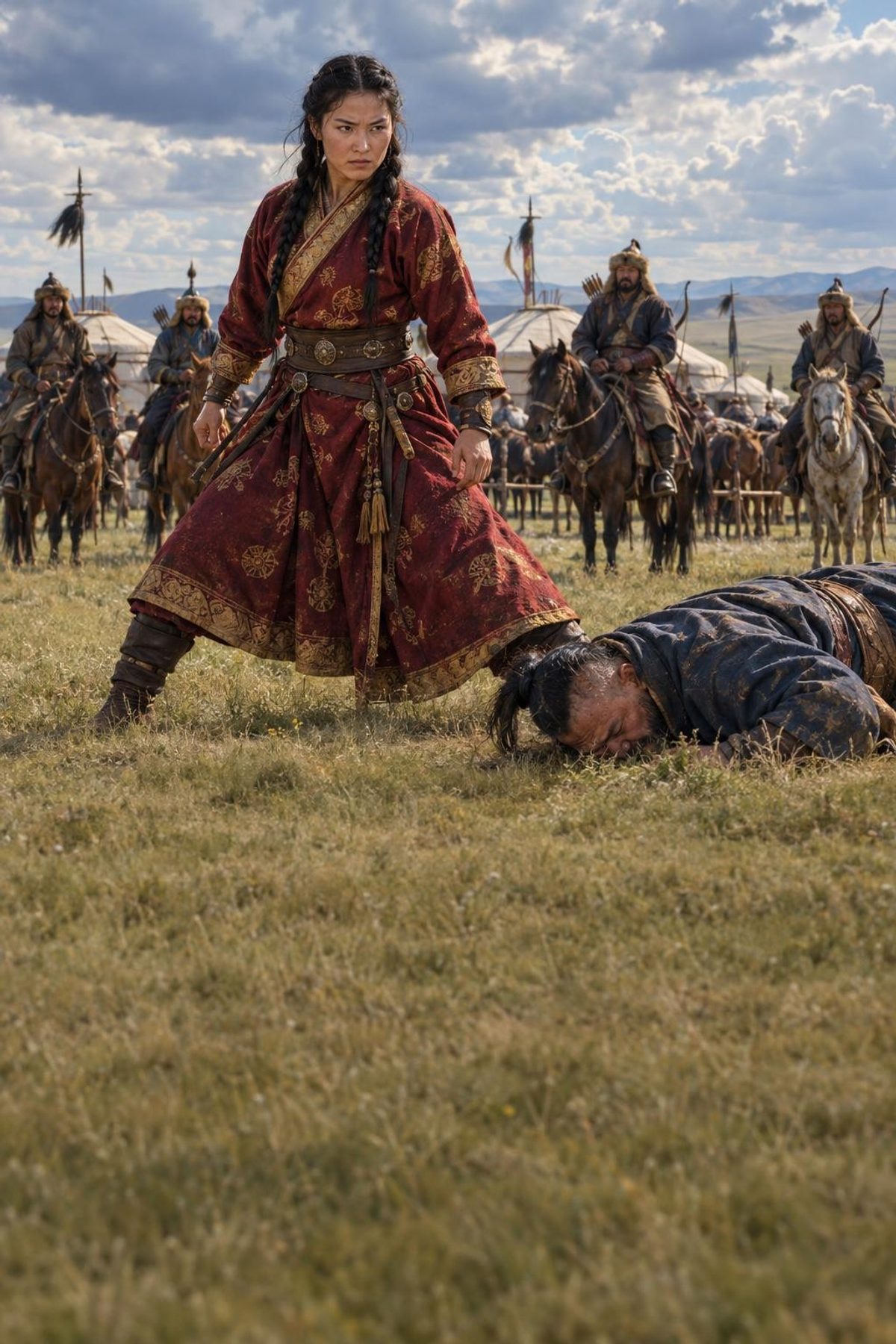
The dusty wind of the Mongolian steppe swirled around the wrestling ring as Khutulun grappled with a broad-shouldered man attempting to claim her hand in marriage. Men and women alike watched with bated breath, the anticipation thick in the air. The princess’s grip was like iron, unyielding as she swiftly outmaneuvered her challenger, sending him sprawling to the earth in a cloud of dust. The crowd erupted, a sea of hooves thundered in applause, echoing Khutulun’s yet another victory.
The Princess, the Warrior
Khutulun was more than just the favorite daughter of Kaidu, the Khan of the Chagatai Khanate. Born around 1260 into the illustrious lineage of the Mongol Empire, she was renowned far beyond the plains of Central Asia.
Her father, Kaidu, a powerful ruler stretching his dominion from western Mongolia to the reaches of the Oxus River, often sought her counsel over that of his sons. Trained in the art of warfare from an early age, Khutulun was no stranger to battle, having fought alongside her father in his numerous campaigns, demonstrating prowess in riding, archery, and hand-to-hand combat.
Her fame in wrestling, however, eclipsed all else. In Mongol society, wrestling was more than sport; it was a demonstration of courage, strength, and skill. Khutulun took these contests to another level, setting a unique condition for her suitors.
Read next: Empress Matilda Escaped Oxford Castle Across Frozen Thames in 1142
Anyone wishing to marry her first had to defeat her in wrestling. Those brave enough to accept and ultimately lose were to forfeit their horses to her. With this fearless wager, Khutulun amassed a herd said to number 10,000 horses, each representing a defeated opponent.
Witnesses to her prowess included the Venetian traveler Marco Polo, who wrote with astonishment about Khutulun, recounting how no man ever bested her. Rashid al-Din Hamadani, a Persian historian, also chronicled her feats, weaving her tale into the annals of medieval lore. Yet, tantalizing whispers suggested multiple narratives of her personal life.
From potential betrothals to a warrior caught trying to assassinate her father, to unrequited love for Ghazan, a Mongol ruler in Persia, Khutulun’s life was as enigmatic as it was formidable. Nevertheless, she remained steadfast, her own free will guiding her destiny more surely than any suitor's might.
The Heir Apparent That Wasn’t
Beyond the arena, Khutulun stood at the heart of Mongol politics. When Kaidu sought to name a successor, he saw no one more fitting than his daughter, a testament to her leadership and tactical acumen. But the tribal hierarchy dictated otherwise.
Despite Kaidu’s wishes, the leadership passed over her, pointing to her brother Orus as a more traditional choice. Her refusal of the khanate could be viewed as strategic, allowing her to wield power behind the scenes and continue her military pursuits unencumbered by the trappings of the formal leadership.
After Kaidu’s death around 1301, Khutulun took it upon herself to guard his tomb, symbolically protecting his legacy. Her loyalty echoed throughout her clan, yet it sparked rivalry with her brothers, particularly Chapar and Duwa. The tension reflected the broader conflicts within the fractured Mongol Empire as allegiances shifted and power bases were challenged. These internal struggles eventually set the stage for her demise around 1306, a period marked by the turbulence of succession disputes and factional wars.
Khutulun’s story intertwines with the narrative of the Mongol Empire, a microcosm of its splendor and strife. Her influence persisted not through ruling titles but through her unassailable spirit. Her life encapsulated the fierce independence and societal shifts of her time, making her both a symbol and an anomaly in a male-dominated lineage of conquerors.
Read next: Godfrey of Bouillon Refused a Crown in Jerusalem in 1099
Like a comet blazing across the steppe skies, Khutulun’s legacy seemed to fade into obscurity. Yet, it resonates through time, captured in art and mythology, celebrated in cultures profoundly distinct from her own.
Western portrayals of her story, from François Pétis de la Croix’s fables to Puccini’s opera "Turandot," have mingled fact with fiction, immortalizing her as a character of defiance and allure. These adaptations stripped away the specifics of her wrestling prowess but preserved her essence—a woman whose fierce disposition challenged the norms of an empire.
Khutulun’s life, both legendary and real, continues to intrigue, offering a lens into the complexities of gender, power, and identity in medieval Mongol society. Her story matters because it invites us to explore narratives that defy conventional chronicles of history.
In her determination and strength, Khutulun embodies the untold stories of those whose lives echo softly yet profoundly through the corridors of time. Her ferocity and independence serve as a compelling reminder of the myriad ways women have shaped the world in shadows and daylight alike.