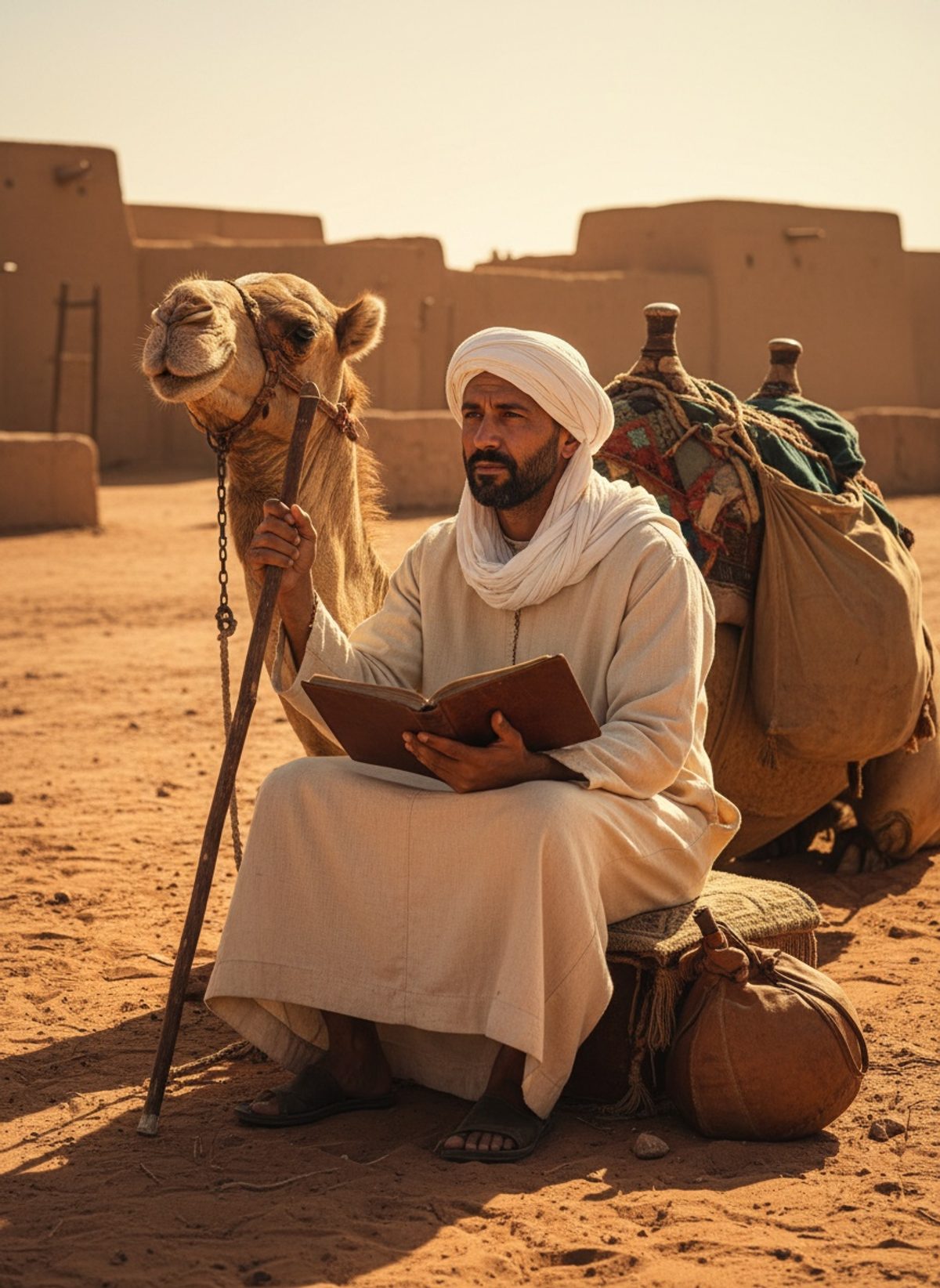
The North African sun beat down relentlessly on the bustling port city of Tangier, casting long shadows on the cobblestone streets. Seagulls squawked overhead, their cries piercing the salty air. It was the 14th of June in the year 1325, and a young man named Ibn Battuta stood on the brink of an extraordinary journey. Unbeknownst to him, the path ahead would not only fulfill his spiritual longing but also transform him into one of the greatest travelers in human history.
At just 21 years of age, Ibn Battuta left behind the familiar comfort of his home and the warm embrace of his family, driven by an unquenchable thirst for adventure and discovery. With a heart full of anticipation and pockets lined thinly by a student's means, he set off with a single goal: to complete the holy pilgrimage to Mecca, known as the Hajj. The journey, typically taking sixteen months, was fraught with challenges, yet this pilgrimage would become merely the first chapter in an odyssey that spanned nearly three decades.
As Ibn Battuta made his way eastward, he traversed the vibrant territories of North Africa. The shimmering sands of the Maghreb unfolded before him as he journeyed through the Sultanates of Abd al-Wadid and Hafsid. Footsteps led him to cities like Tlemcen and Béjaïa, each a tapestry of culture and commerce. By the time he reached Tunis, his reputation as a learned scholar had begun to precede him. Staying there for two months, he found camaraderie and earned respect within the scholarly circles.
His stop in Tunis also marked the first of many marital endeavors on his travels. Not long after marrying, disputes drove him away, signaling a pattern that would repeat throughout his journeys. It wasn't just matrimonial ties that he forged and broke, but connections with cultures and people in countless lands. In early spring 1326, the coastal city of Alexandria greeted him. The bustling port was a mesh of different languages and faces, each carrying the stories of lands far and wide, a mirror to Ibn Battuta's own budding tales.
Read next: He Held the Noose. He Cut It Down Himself.
In Alexandria, two ascetic men, Sheikh Burhanuddin and Sheikh Abu ’Abdallah Abul-Hasan al-Shadhili, offered him prophecies and blessings that would echo in the years to come. Burhanuddin, in particular, urged Ibn Battuta to visit his holy brethren in far-off India and China—a suggestion that promptly paved the way for the next leg of his journey. Departing Alexandria, he wound his way through the Islamic heartlands, each city a pearl in the spiritual necklace of his voyage.
Ibn Battuta reached Mecca in the autumn of 1326, adding the revered achievement of the Hajj to his ever-growing list of experiences. Yet, unlike many pilgrims, this did not signal the end of his travels. Instead, it fueled his desire to continue exploring. The Arabian Peninsula unfolded in its vast arid beauty, and soon Ibn Battuta found himself charting new territories far beyond the familiar shores of North Africa.
His adventures took him through the Red Sea and across the searing sands of the Arabian Desert. The city of Jeddah glistened like a jewel on the coast, and soon thereafter, Ibn Battuta set foot in lands as diverse as Yemen and Oman. Each stop along the way offered new insights and challenges, from navigating the intricacies of local politics to experiencing the diverse culinary traditions, all recorded meticulously in his travelogue.
Continuing eastward, the Indian subcontinent called to him with its rich tapestry of kingdoms and cultures. Arriving in India, Ibn Battuta thrived in the court of the Delhi Sultan Muhammad bin Tughluq, who appointed him as a qadi, or Islamic judge. The Sultanate's intrigue-filled court provided both opportunity and peril, yet Ibn Battuta's eloquence and adaptability steadied his tenure. While he judged legal matters by day, tales of his escapades by night expanded his lore.
His time in India was punctuated by a shipwreck, casting him ashore on the sun-baked Maldives. Here, once again utilizing his legal knowledge, he served as a judge-prophet, wielding influence over both the people and their island affairs. Yet, destiny prodded him onward, and soon he braved the vast seas that led to the wealthy lands of the far East.
Read next: Rodrigo Díaz de Vivar Held Valencia for Christ and Died Undefeated
In China, the lands of the flourishing Yuan Dynasty dazzled him—cities brimmed with ingenious inventions, and markets pulsated with life. His writings showed an astute comprehension of the east's intricate social fabric, a testament to the openness and keen observation that characterized his journeys. From the opulent courts of China to the bustling ports of Java, Ibn Battuta witnessed the grandeur and folly of human achievement.
By 1354, winds of homecoming beckoned. The Moroccan coast lay over 5,000 miles away, yet his heart yearned for Tangier. Arriving back in his homeland, Ibn Battuta found a city and family changed by time. His cherished travelogue, dictated upon his return, became The Rihla, a vivid tapestry woven from the fibers of enchantment, peril, and discovery.
Ibn Battuta's exploration spanned 117,000 km, dwarfing that of famed explorers like Marco Polo. Traveling through swathes of the globe's lands—about 44 of today's countries—he connected cultures that seemed separated by vast distances and unfamiliar languages. His journeys embodied an inquisitive spirit that transcended personal experience, contributing instead to a shared human narrative.
As the echoes of his footsteps faded into history, the legacy of Ibn Battuta remains a testament to the indomitable human spirit's quest for knowledge. His travels remind us that the world, for all its wonders and mysteries, is bound by an overarching tapestry of human connection. Curiosity, resilience, and openness to the unknown fashioned his epic voyage, promoting a deeper understanding across realms once divided by distance.