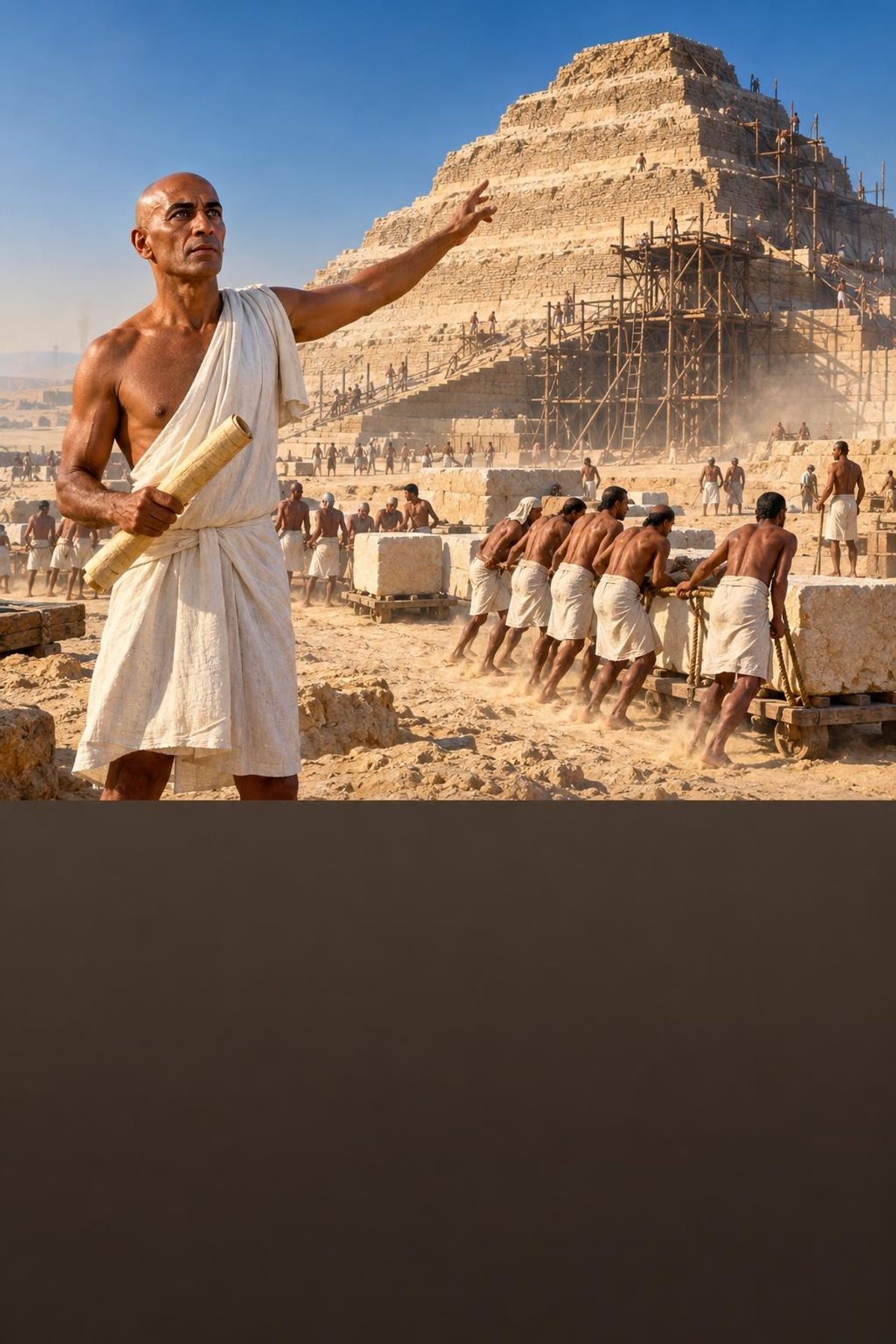
The scorching Egyptian sun seared the sands of Saqqara, beating relentlessly on Imhotep's bare back as he stood amidst a cacophony of hammers striking stone. The sharp, rhythmic clang echoed across the desert like a primordial symphony, announcing an audacious endeavor that would soon change the face of architecture forever. Amidst this burgeoning orchestra of innovation, Imhotep, an architect with the soul of a poet, envisioned a pinnacle of human achievement—a tower piercing the heavens from the grave-bound earth.
Vision from the Sands: An Unprecedented Dream
The landscape of Egypt in 2650 BCE was dominated by mastabas—flat, rectangular tombs of mudbrick sprawling across the sands, simple shelters for the afterlife's inexorable journey. To transform these rudimentary monuments into something unprecedented required a visionary spark, one that came from Imhotep, a man whose life was as enigmatic as it was extraordinary.
As the chancellor to Pharaoh Djoser, Imhotep held a unique position of influence and innovation. Although the historical manuscripts provide scant details, surviving inscriptions confirm his monumental role in crafting an architectural masterpiece that bridged the spiritual with the tangible. The Pyramid of Djoser, as it would later be known, defied tradition and reason, its form emerging not from blueprints or precedents but from Imhotep's imaginative defiance of the conventional.
The heart of his vision lay in the seemingly simple act of stacking stone on stone, each mastaba a building block of ambition. By stacking six mastabas upon one another, each one smaller than the last, Imhotep conceived a structure that rose 62 meters into the sky—a step pyramid, clad in limestone, luminous under the Egyptian sun. It was not just a burial ground but a celestial staircase, a symbol of ascension and divine interface.
Read next: Theodore Roosevelt Argued for Women's Equal Rights at Age 21
This creation, standing tall above the sands of Saqqara, was the world's first large-scale stone construction, pioneering a new language of architecture. Stone was hewn, shaped, and transported, an arduous task in an era devoid of machinery, yet executed with a precision that left millennia of future architects in awe. Imhotep's genius lay not only in his innovative design but in his ability to orchestrate a herculean labor force, blurring the lines between art and engineering.
The Rise of a Demigod: Reverence Beyond the Grave
Though Imhotep lived as a man, he was revered posthumously as a god, worshiped for millennia for his wisdom and healing prowess. This elevation, unmatched by his contemporaries, was born from an enduring legacy that outshone even the power of Pharaohs he served. From scant inscriptions during his life to veneration in the New Kingdom, Imhotep was enshrined as a demigod, a status that imbued his works with a divine aura.
Imhotep's deification took root in Memphis, where a thriving cult developed around his myth, drawing parallels to preeminent deities such as Asclepius, the Greek god of healing. His posthumous reputation morphed to include attributes of medical sagacity, attributed to him more than two millennia after his death. While the evidence of his clinical acumen remains speculative, the myth survived as part of his divine epitome, raising questions of a potential ancient medical text having been lost to the sands of time.
Sometime after his death, bronze statues and temples were erected, and rituals involved offerings and prayers to Imhotep as healer and sage. This was a rare honor for someone not of royal descent, illustrating how profoundly his contributions to architecture and wisdom had touched the Egyptian consciousness. His name was invoked for guidance, becoming a beacon of intellect and enlightenment in a civilization where the line between mortal ingenuity and divine inspiration blurred.
Read next: Hesy-Ra: The First Named Physician in All of History
Unlike the Pharaohs he served, the location of Imhotep’s tomb remains hidden, a phantom buried beneath the shifting sands of history. Despite various expeditions, this resting place, like much of his tangible life, eludes detection. Yet, his true tomb might be perceived as the legacy etched into the stones of Saqqara—the Step Pyramid, a structure embodying his eternal ascent.
The Imprint of Genius: Why Imhotep Matters
Imhotep’s step pyramid at Saqqara was more than a mere funerary structure; it was a revolution—a daring shift from ephemeral to eternal, from clay to stone, an embodiment of human vision and creativity. Without blueprints to guide him, Imhotep carved a path that architects and engineers would follow for centuries, laying the foundational principles of design, aesthetics, and structural engineering that underscore much of today's architectural endeavors.
In an age where divine prescripts often shadowed intellect, Imhotep thrived as a polymath whose work transcended earthly bounds. His marriage of function with mythology, tangible with spiritual, set a precedent for future generations to explore the possibilities that lie beyond the visible spectrum. He became an immortal bridge between human potential and the cosmos, a symbol of innovation unbounded by time's relentless march.
The story of Imhotep reminds us of the power of human imagination when unleashed from the constraints of known boundaries. It speaks to the resilience and ingenuity that continues to propel societies forward, echoing through the corridors of time with lessons on innovation and legacy. In every towering skyscraper and breathtaking structure today, the spirit of Imhotep resides—a testament to the enduring influence of a man who saw what was not yet there and dared to build it from the dreams that dwell beneath the sands.