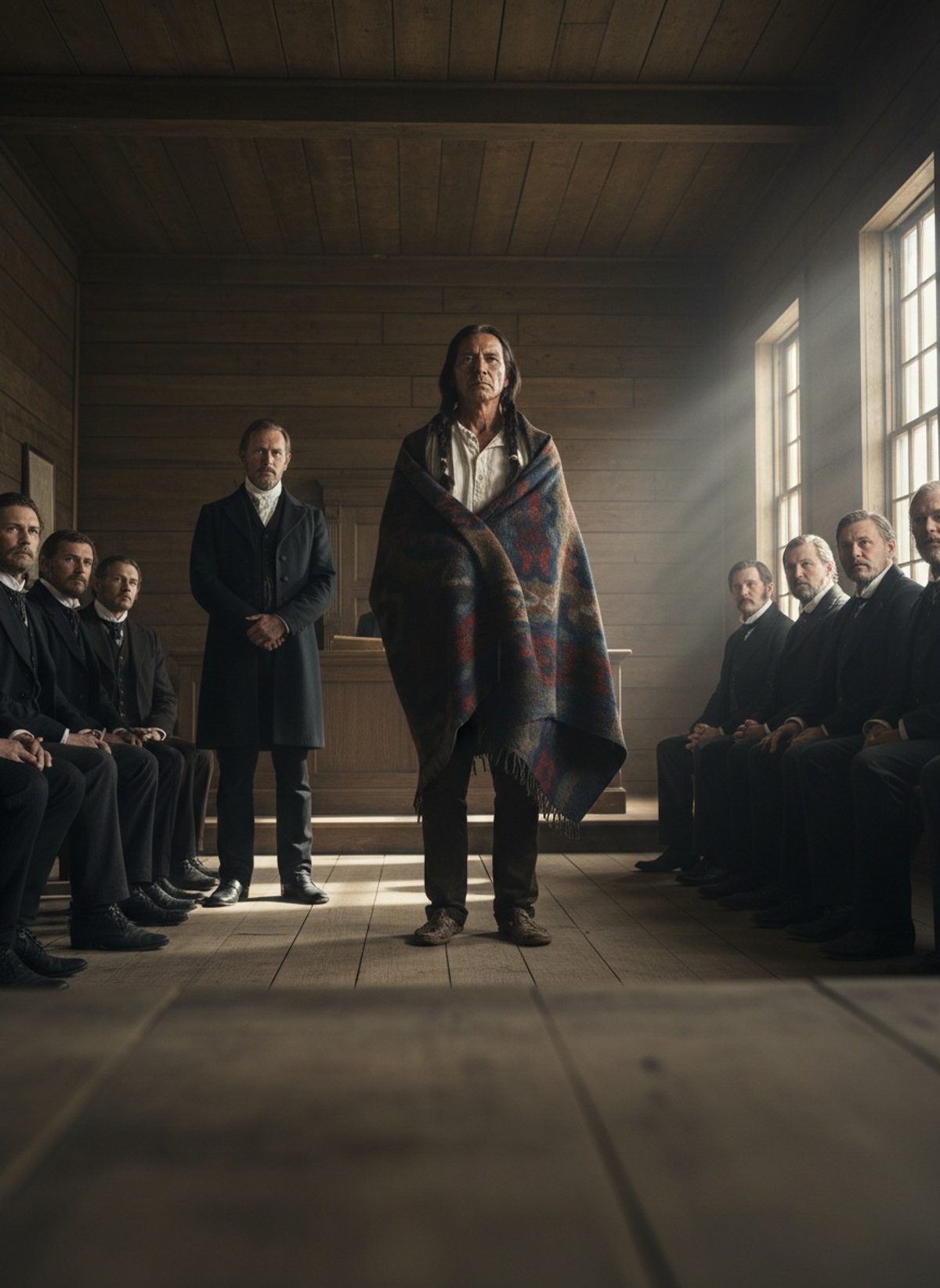
May 12, 1879. The heavy wooden doors of the Omaha federal courthouse creaked open, allowing in a burst of sunlight that momentarily brightened the somber room within. A crowd had gathered, their eyes fixed on the shackled figure being ushered inside — a Native American chief by the name of Standing Bear, his presence there a grave testimony to the struggles faced by his people.
The Path to Court: A Journey of Loss and Determination
Standing Bear's journey to that courtroom had been fraught with personal loss and endless perseverance. Born around 1829, Standing Bear hailed from the Ponca tribe. The Ponca, once a thriving tribe along the banks of the Niobrara River, saw their numbers dwindle due to disease and territorial encroachment. By the time of the Lewis and Clark Expedition in 1804, their population had suffered severely from a smallpox epidemic, leaving barely 200 survivors.
For generations, the Ponca people farmed maize and navigated the Nebraskan plains. They shifted their villages seasonally, like migratory birds following the warmth, always aware of the shadows cast by encroaching European-American settlers and hostile tribes. In young Standing Bear's lifetime, the churning wheels of history uprooted his people again and again. The Kansas-Nebraska Act of 1854 forced Native tribes, including the Ponca, to relinquish their lands, severing their ancestral connections.
By 1862, homes were being pushed aside for the swiftly sprouting settlements of white settlers, who built a town named Niobrara on the powdery summer cornfields of the Ponca. Yet, their new lands were barren and unyielding. Famine gripped the Ponca, and what assistance the government once promised—mills, schools, protection—never came. In desperation, the Ponca accepted relocation to Indian Territory in present-day Oklahoma, unaware of the hardships that awaited them.
Read next: Thespis Stepped Forward. The World Changed.
Burying His Son, Defying an Order
The trek to the Indian Territory in 1877 was marked by desolation. Treacherous conditions, rampant disease, and scarcity plagued the Ponca. Yet it was a father's promise that brought Standing Bear back to Nebraska. His son, Bear Shield, caught in the throes of illness, expressed a dying wish to be buried in his homeland. Honoring this wish, Standing Bear and a small contingency embarked on the arduous journey north.
The trip was perilous and the risks were high. Returning to their homeland meant breaching the governmental decree that had forced them to leave. But compassion demanded risk, and Standing Bear was bound by the promise reportedly made to Bear Shield.
Upon arrival, Standing Bear was apprehended for deserting the reservation. The local authorities, inflamed with direction from the federal government, stepped in, symbolically shackling Standing Bear to demonstrate the iron grip of law over compassion. But Standing Bear's detainment was not the end; in truth, it was the beginning of a landmark legal battle.
The Courtroom Drama: A Battle of Humanity
Inside the courthouse, the air sizzled with anticipation. At its heart was Standing Bear, undeterred by the clumsy addendum of civilization’s chains. His eyes, heavy with wisdom and defiance, scanned those seated in the room. He understood the tidal significance of this trial—not just for himself, but for all Native people shackled under unjust laws.
Representing Standing Bear was a group of lawyers, driven more by conscience than compensation. The case hinged on one powerful question: was Standing Bear, and by extension all Native Americans, a 'person' under U.S. law? This seemingly simple inquiry rippled out, echoing through the halls of history.
Standing Bear himself addressed the court, a bold move met with silence punctuated only by the scribble of a stenographer's pen. He raised his hand and declared, "That hand is not the color of yours, but if I pierce it, I shall feel pain. If you pierce your hand, you also feel pain. The blood that will flow from mine will be of the same color as yours. I am a man. God made us both.”
These words pierced the courtroom’s atmosphere, challenging the entrenched perceptions that had long dictated policy and perception. Here was a simple truth, offered not by legal jargon or clever rhetoric, but by the heartfelt plea from one individual to another.
The Legal Triumph: A Verdict Rendered
After days of intense arguments filled with grand oratory and rhetoric, the judgment finally arrived. Judge Elmer Dundy rendered a decision that would resound through the legal corridors of America: Native Americans were indeed persons under the law. This legal recognition conferred upon them the fundamental right of habeas corpus, a protection against unlawful detention.
The outcome was unprecedented, a lifeline thrown to those drowning under systemic disregard. Standing Bear was free, a declarative message that the government's ironclad grasp was not unbreakable. The reverberations of the ruling went beyond Standing Bear himself, advocating quietly yet powerfully for the rights of indigenous people everywhere.
An Enduring Legacy: The Continuing Struggle
Standing Bear walked away from that courthouse not just a free man, but a beacon of what humanity and persistent resolve could achieve. Yet, despite this victory, the road toward justice and equality for Native Americans remained long and winding—as rugged as the trails the Ponca had traversed.
Standing Bear returned to his community, forever marked by the weight of his battle and triumph, inspiring others to stand for their rights. His determination planted seeds of change, yet the broader tapestry of Native American rights continued to be woven, tattered along the way but resolute in its expansion.
This story serves as a reminder of the transformative power of individual voices that rise against the currents of injustice. Standing Bear’s saga underscores not only the vital recognition of Native American rights in the legal domain, but also the eternal struggle for equality and dignity—a narrative that continues to unfold in the ongoing quest to honor promises made and humanity acknowledged.