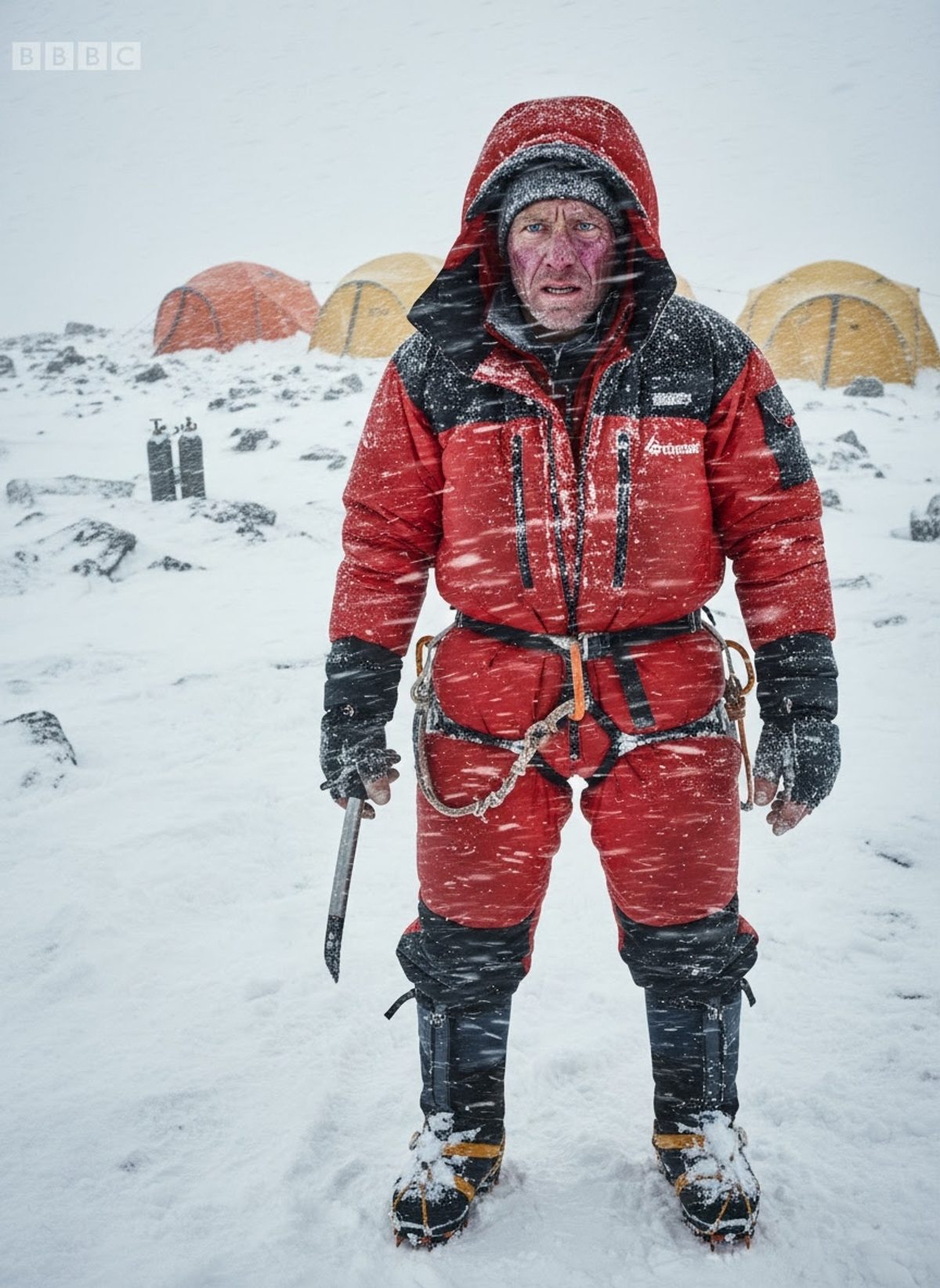
The jagged pinnacles of the Himalayas cut across the sky, piercing through the relentless winds and swirling snow of the death zone on Everest's South Col, a place where human survival dangles by the thinnest of threads. On May 10, 1996, this perilous environment nearly claimed the life of Beck Weathers, an American pathologist on the brink of the ultimate adventure.
Just beneath the summit, he lay comatose, as the jagged breath of a monstrous blizzard swept away hopes of his survival. But in a narrative twist fit for legend, Weathers defied fate and the mountain itself.
The Blinding Altitude
Weathers was no stranger to testing his limits against nature's formidable challenges. A man who turned to mountaineering to combat personal demons, he was driven to scale Everest as part of a quest to conquer the Seven Summits. However, the mountain had other plans. Despite the physical preparation and a will of steel, Weathers was grappling with the challenges of radial keratotomy surgery, a procedure intended to correct his vision but drastically impaired it at high altitude.
The climb was led by renowned mountaineer Rob Hall, and Weathers was one of eight hopefuls in Hall's group that fateful May. As they climbed, Weathers's vision deteriorated significantly, leaving him partially sightless on the Balcony, an exposed, pitiless section at 27,000 feet.
Read next: Jimmy Carter Swung a Hammer at 95 With 14 Stitches in His Face
His hopes lay with his guide's return, but as the cruel irony of Everest would have it, Hall was pulled toward the peak in a deadly priority call. Thus began a grim game of patience and peril, one that Weathers faced mostly alone when Hall did not return.
Night of the Blizzard
The late afternoon saw a blizzard descend upon the mountain with ferocity unheard of. Wind howled like banshees, swallowing up cries for help and obscuring paths marked with care and caution. With little hope of seeing again on his own, Weathers was instructed to descend alongside guide Michael Groom. Yet the whiteout obliterated visibility, transforming the trodden path into a labyrinthine warren of deadly snowdrifts.
Eleven climbers, including Weathers, were stranded, lashed by the storm's fury, unable to find the safe haven of Camp IV. By midnight, as the roar of the storm momentarily abated, only six could muster the strength to move. Weathers was left, barely conscious, left to the mercy of the mountain when attempts to evacuate him and others proved futile. The remnant climbers were forced into a haunting decision: return to camp without those assumed beyond the reach of rescue.
A Resurrection in Frost
As dawn unfurled on May 11, Everest's cruel beauty was laid bare. The still air was a deceiver, crystal clear yet empty and cold as death itself. Beck Weathers lay frozen, one hand as brittle as porcelain, his face burnt black by the frost. Stuart Hutchison, another climber, returned with Sherpas to assess those lost in the storm. Deeming Weathers beyond salvation, they bore the crushing news back to Camp IV, where a pall of grief took hold.
Read next: David Thompson Mapped 2 Million Square Miles of North America on Foot
Yet where certainty's shadow loomed, a spark ignited. Just hours after being written off, Weathers defied the mountain, and perhaps fate itself, by clawing his way back from the brink. He awoke from his hypothermic coma, awakening to a dizzying landscape of snow and survival. In pain but powered by an indomitable will, he rose and staggered through the white labyrinth to Camp IV encased in ice yet miraculously alive.
The Flight to Life
Despite the remnants of that otherworldly night clinging to him, Weathers' struggle for life was far from over. At Camp IV, his fellow climbers beheld the spectacle: a man virtually thawed from an icy embrace, hand and nose encased in devastation as haunting as it was heroic. It took the orchestration of another miracle to airlift him from peril.
A daring rescue was mounted. Using a Nepalese Army helicopter adjusted to reach 20,000 feet—an unprecedented feat at that altitude—Weathers was carried away from Everest, a phoenix emerging from icy death. Flown to Kathmandu and then to the United States, he underwent extensive surgeries. Yet beyond the physical scars lay reconciliations yet tender. Weathers faced the matter of mending not just his body, but his life and relationships strained by a chase too close to oblivion.
The tale of Beck Weathers is one of endurance beyond measure. It stirs above the jagged serenity of Everest, the world's highest peak, reminding us that against all odds, the flame of human will can sometimes burn through even the coldest of nights. Stories like Weathers' venture beyond survival; they beckon us to contemplate the depth of human resilience and the extraordinary instances where humanity touches the impossible and drags it back to reality.