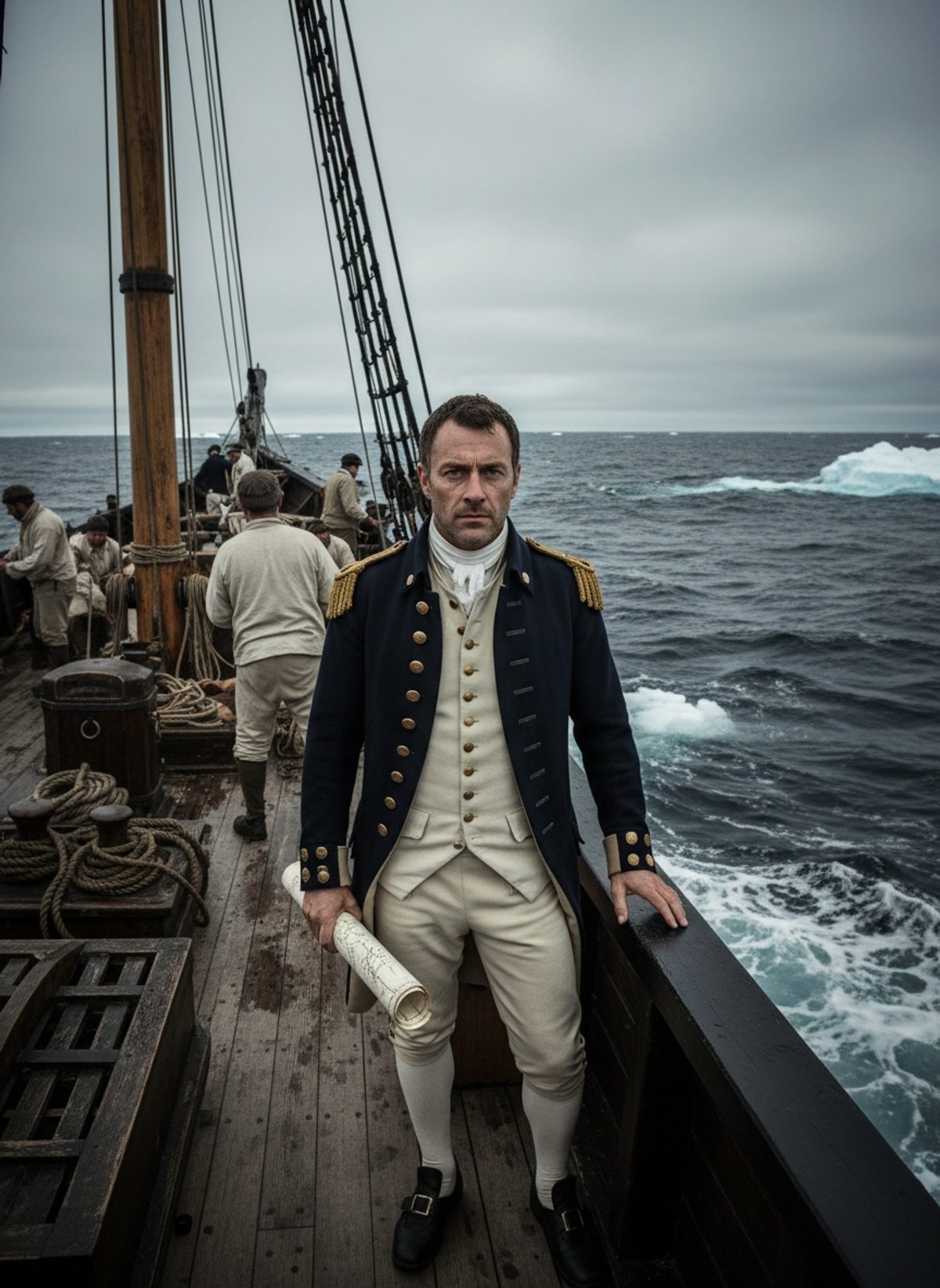
The biting wind sliced through the frosted air like a thousand tiny daggers as it howled over the deck of the HMS Resolution. The Southern Ocean, a churning, icy leviathan, crashed relentlessly against the ship's hull. Gales whipped water into icy mist, shrouding everything in a ghostly fog, while every timber of the vessel groaned and creaked against the merciless cold. It was January 1773, and Captain James Cook was about to chart the edges of the known world, guiding his ship into waters no European had dared venture.
The Determination to Go South
Captain James Cook was an extraordinary and determined man. Born to a humble farming family in Yorkshire, he had risen through the ranks to command one of the most significant exploratory missions of the era. The objective was audacious: to seek out a hypothesized southern continent, Terra Australis Incognita, thought necessary by geographers of the time to balance the lands of the Northern Hemisphere. Cook, helming the Resolution, possessed an insatiable thirst for discovery, and with it, the steadfast resolve to bring the unseen into the realm of the known.
No European had crossed the Antarctic Circle, an imaginary line encircling the globe at approximately 66.5 degrees south of the equator. It was a territory depicted only in whispered tales of intrepid whalers and sailors. The potential riches or dangers remained entirely speculative, yet that very uncertainty stirred something profound in the hearts of explorers. Cook was undeterred, driven by an exploration spirit and the curiosity innate to humanity.
The Ice That Claimed the Horizon
As dawn cracked on the horizon, bringing with it a dim, diffuse light that barely pierced the swath of grayness overhead, anticipation throbbed aboard the ship. The men shivered in their stiffened breeches and coats, eyes straining for any glimpse beyond the oppressive, ice-filled haze. The ocean, an endless expanse of fractured ice, stretched like an endless puzzle of white and shadow. No ship had ventured this far, and with the looming specter of frostbitten peril, fear was a silent but constant companion.
Read next: The Day a Scots Botanist Mapped Eden at the End of the World
Then, inch by hard-fought inch, Cook pressed the Resolution further into the icy wilderness. It was a voyage that tested every ounce of human endurance, where the chill seemed to seep into bones and spirits alike. The familiarity of northern seas now starkly contrasted the alien feel of this Southern expanse. Each crack and groan of the ice field threatened disaster. Yet Cook, intrepid and tenacious, edged onward.
The Unseen Boundary
Amidst this landscape, a significant moment unfolded. The fog thickened as the Resolution finally crossed the Antarctic Circle. It was a historic event: Cook had taken his vessel and crew into the heart of speculative mystery, staking a claim for Europe on a map few believed could exist this far south. The feat lay not only in physical prowess or in the daring to venture so far but in the unraveling of the myth that a vast continent did not exist where leaf, land, and life were instead supplanted by ice and desolation.
Cook's meticulous maps brought clarity and precision to the blank spaces scholars had left on their charts. Here, at the world's roof, he documented facts that would steer explorers more than fifty years later. The realization that the Antarctic continent lay beneath the impenetrable fortress of ice added a new dimension of intrigue and possibility to the earlier visions of Terra Australis.
The Pain of Retreat
But as omnipresent and vast as the icy vistas stretched, so too did the limits of possibility for the Resolution and her crew. Icebergs loomed with treacherous potential, enigmatic monoliths that could easily crush vessels against their titanic flanks. The sea’s relentless siege coupled with dwindling provisions forced a pause in a journey teasing more than a single heart with the promise of uncharted glory.
With resignation heavy in his heart, Cook ordered the ship to turn northward. His records would forever imprint the ethereal frontier onto paper, even as the Resolution steamed away from what could not yet be conquered. Cook captured the moment eloquently in his log: it existed, but it lay beyond his reach. This acknowledgment painted the Antarctic’s allure, punctuating a unique chapter in nautical discovery.
Beyond the Edge of Imagination
For Cook, the enterprise was not in vain. His crossing of the Antarctic Circle highlighted humanity's enduring relationship with the great unknown. This moment would be the prologue to the explorers who followed, including those who sought not just knowledge but the morose beauty lying cloaked in cold beneath the Southern Cross.
The intricacies of Cook's journey straddle the border of reality and myth, an adept dance between existence and illusion where icy barriers define the known world. Although it would take several decades before adventurers set their feet upon the frozen Antarctic shores, Cook's brush with their impervious ambiance redefined his own era's understanding of Earth's capabilities.
In the end, Captain James Cook stood not only as a navigator of exceptional skill, but also as a visionary, charting into the veil of that which could not be seen. It is a tale of endurance in the face of absolute uncertainty, a reflection of the journey we all face when peering into the uncharted territories of our spheres—the boundaries that often bind and, simultaneously, beckon us onward.