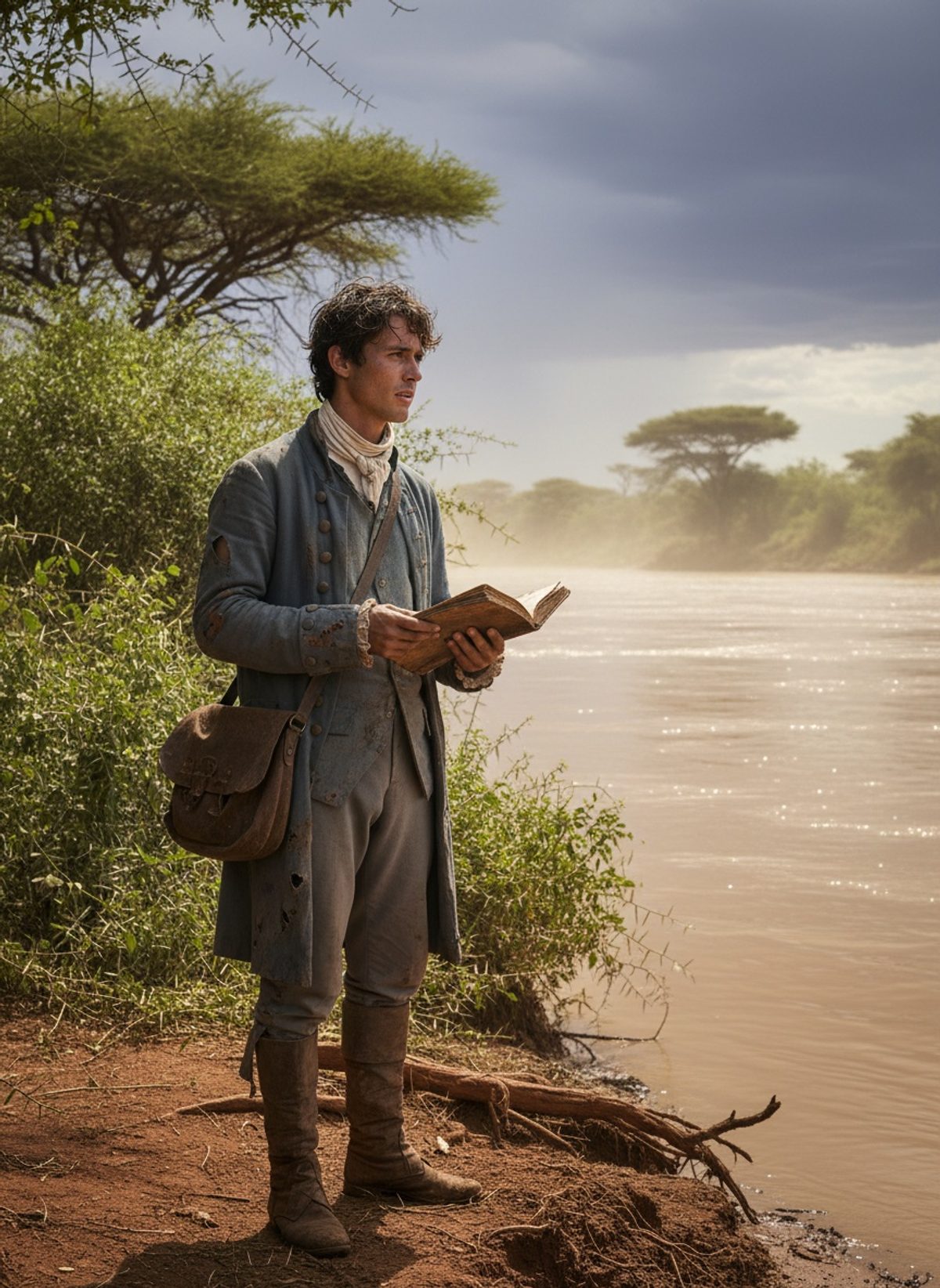
The African sun hung low in the sky, casting long shadows that danced across the parched reddish earth. The air was thick with the scent of acacia and the distant chatter of monkeys, while a gentle breeze carried hints of the cool river beyond. In the oppressive heat of the West African summer, the landscape seemed to stretch endlessly, interrupted only by the stoic presence of a solitary figure. Here, in this vast and foreign wilderness, Mungo Park was on the brink of completing a monumental feat — and he was utterly alone.
The soft sandy banks of the Niger River came into view as Park trudged forward, his steps heavy with exhaustion. This river, with its serpentine course, had eluded European explorers for centuries, fueling legends and spawning countless expeditions. To the people of West Africa, the Niger was no mystery; it was a life-giving artery, but its precise path remained a geographical conundrum to outsiders. In this moment, as the water glimmered like molten gold in the fading light, the young Scottish surgeon could scarcely believe he had finally found what he had so desperately sought.
Park's expedition, sanctioned by the African Association, had begun with high hopes and considerable anticipation. He was tasked to unravel one of geography's great secrets — to report back on the illusive river that traded stories insisted flowed east into regions unknown. Having made landfall on the west coast of Africa in 1795, his journey into the uncharted was fraught with unimaginable challenges. The lush coastlines quickly gave way to unyielding savannahs and forests that seemed alive with both splendor and peril. Among the most treacherous of his experiences were encounters with bandits and the constant threat of disease.
Park's passage was marked by adversity at every turn. He was robbed of his belongings, deprived of the tools that connected him to the known world. Held captive by local warlords, he had to rely on his resourcefulness and quick wit to negotiate a path forward. At times, desperation crept in, as hunger gnawed and the unrelenting sun beat down without mercy. He had nothing but his determination and a dwindling supply of quinine to stave off the fever that lurked, waiting to claim unwary travelers.
Read next: The Day a Scots Explorer Walked Into the Source of the Niger
Yet, it was nature, with its capricious moods, that proved to be Park's greatest adversary and unexpected ally. The landscape changed with alarming frequency, from dense jungles to arid plains that stretched for miles. The middle of Africa harbored a quiet danger: the enveloping silence of the Sahel, save for the occasional braying of a distant animal. Underneath the indifference of the relentless sun, life in all its forms adapted and thrived, exhibiting a tenacity Park came to both admire and share.
In the end, it was the promise of the Niger that spurred him onward, a beacon calling him through the ever-encroaching veil of despair. Every step was testimony to his endurance and a testament to the enduring spirit of discovery that coursed through his veins as a legacy of the Enlightenment, an era where the thirst for knowledge pushed boundaries both physical and intellectual. While his horse lay dying beneath the shade of a baobab, and his provisions had long since vanished, it was perhaps Park's Scottish grit that sustained him, a fire kindled from the stories of adventurers past.
The sight of the river was not accompanied by fanfare or joyous celebration; it was a moment of serene triumph. Standing there, gazing upon the flowing waters of the Niger, Park bore witness to a hidden artery of the earth. This feeling of discovery, so intimately personal, was mingled with the awareness of the significance it bore. This was not merely an academic achievement; Park had penetrated a shroud of mystery that had enveloped an entire continent in European imagination.
News of his journey and the eventual publication of his account sparked a flurry of interest in Europe, shedding light on a continent that had been cloaked in myth and misinformation. His detailed observations provided insight into the lives of the people he encountered, conveying a symbiosis between the river and those who dwelled on its banks. Park's narrative extended beyond geographical discoveries; it touched on the shared humanity and vibrant cultures that existed outside the purview of European understanding.
Park returned to Britain in 1797, a hero who had unlocked one of Africa's geographical puzzles. However, the pull of the Niger proved irresistible, and he would embark once more to thread its length, ultimately meeting a fate shrouded in its own kind of mystery. Yet the legacy of his exploration remains a vivid reminder of a moment when human spirit transcended the confines of maps and imagination, driven by an unwavering commitment to seek and to know.
Today, Mungo Park's story resonates not just as an account of exploration, but as a testament to resilience and curiosity in the face of overwhelming odds. It is a glimpse into an era where individuals stood on the precipice of the unknown, compelled by a desire to uncover the world's secrets. The day a Scots surgeon wandered into the heart of Africa is a reminder that history is often crafted by those driven to look beyond the horizon, defying the tangible to chase the intangible dreams that define our existence. For in finding the Niger, Mungo Park connected worlds — each as real and vital as the river itself — forever imprinted on the canvas of human endeavor.