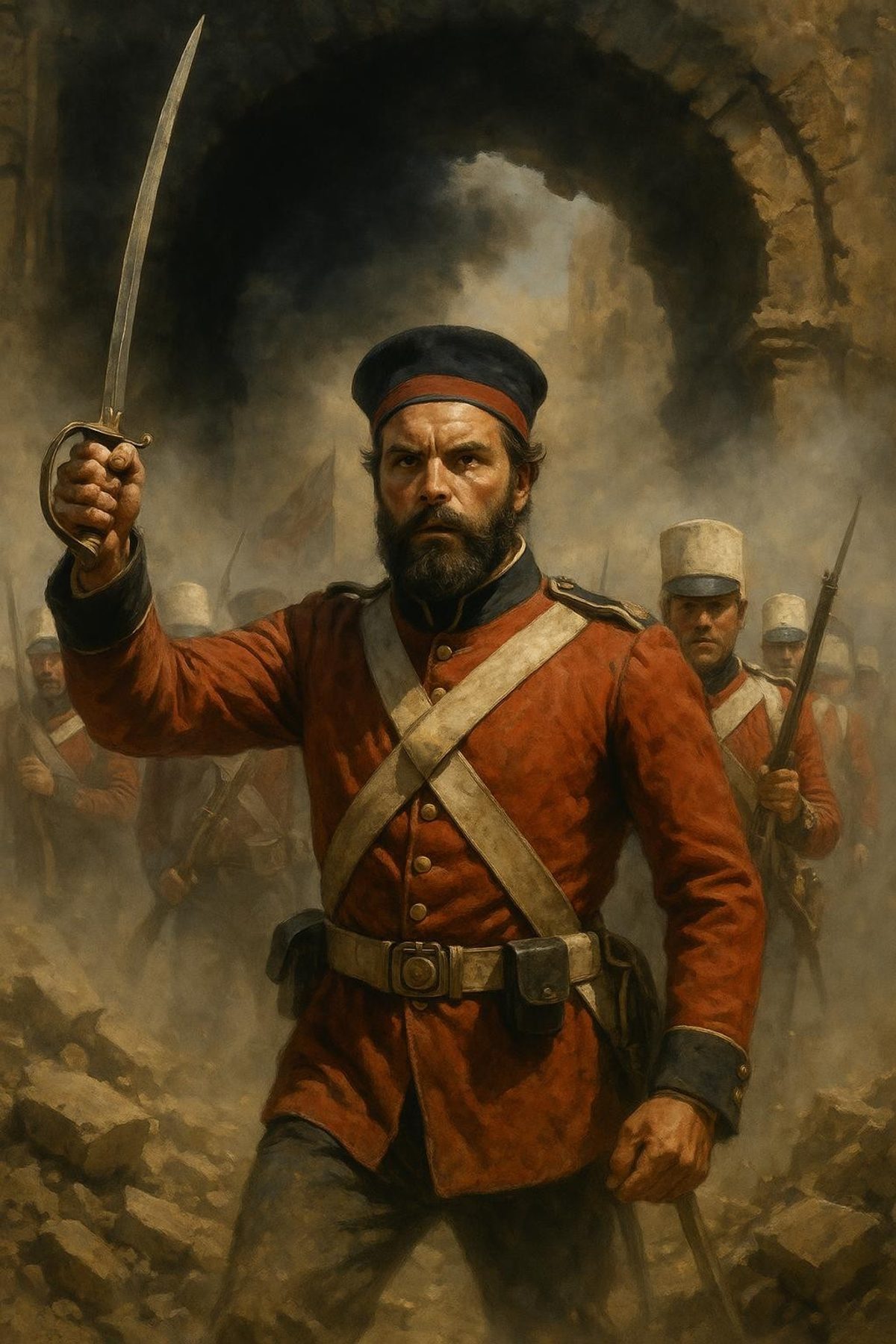
The searing sun hung relentless in the Indian sky, casting long shadows over the rugged terrain of the Delhi ridge. It was an unforgiving September day in 1857, where the oppressive heat mingled with the acrid smell of gunpowder. Occasionally, a dry wind would tousle the sparse, parched foliage, as if in sympathy with those crouched by the crumbling walls of a city besieged. Here, beneath the relentless blaze, lay the fate of an empire teetering on the edge, and at its heart was John Nicholson, a man whose very name inspired awe and dread in equal measure.
Whispers of Mutiny
The Empire's hold on India had never seemed so precarious as it did in the summer of 1857. What had begun as a sepoy mutiny in Meerut had exploded into a full-scale uprising, with Delhi as the fiery epicenter of revolt. The city had slipped into the hands of rebelling Indian soldiers, challenging the might of the British Empire in a manner previously unthinkable. Against such a backdrop, every breeze carried whispers about the impregnable ridge overlooking the city—a ridge that had become the lifeline for a small contingent of British forces and loyal Indian soldiers, desperately clinging on.
This ridge was more than just a strategic vantage point; it was the last shred of British authority in a region engulfed by rebellion. For months, the defenders had weathered assaults and artillery, waiting, planning, under conditions as exhausting as they were dangerous. It was thus that John Nicholson took command, a man whose reputation for both brilliance and brutality had traveled far beyond the sandstone walls of the city and into the annals of colonial lore.
The Lion of the Punjab
John Nicholson was no ordinary military leader. Dubbed "The Lion of the Punjab" by those who served under and with him, his presence struck fear into the hearts of many. Tall, broad-shouldered, and with a beard that bristled with authority, he embodied the very essence of Victorian military righteousness. His relentless drive and strategic acumen had seen him rise through the ranks, earning a fearsome reputation that preceded him. It was no wonder then that he was the one chosen to spearhead the bold maneuver to reclaim Delhi.
Read next: When Richard Burton Walked Into Mecca and Lived
But to those who served beside him, he was more than just a leader; he was a force incarnate. His methods, although unyielding, bore results, and his steely resolve and indomitable spirit were often the only balm for weary soldiers plagued by doubt. As September wore on, the time for hesitation had passed. With every passing day, imperial command understood that holding the ridge was not enough—the heart of the rebellion needed to be cut out. For that task, there could only be one man at the forefront.
Through the Kashmir Gate
The assault on Delhi commenced under a wave of calculated chaos. Under the cover of darkness, and the pall of anticipation, Nicholson led the assault column forward. It was through the Kashmir Gate that the fate of the city—and that of the besieged empire—would be decided. Bricks crumbled and splintered under fire as the explosive charges blew the ancient gate asunder, paving a path strewn with mortar dust and debris.
With a rallying cry, Nicholson charged through the breach. Amongst the crack of muskets and the boom of cannon, time seemed suspended. Amid the swirling smoke, a musket ball found its mark, felling the giant of a man in the midst of the melee. Yet, in true Nicholson fashion, he refused to retreat. Even as life ebbed from him, his bold spirit stood undaunted, and his presence spurred his men to carry forth the siege with renewed vigor.
The City Falls
Hours blurred into brutal confrontation, but the siege prevailed. Against all odds, the rebels within Delhi were overrun. The city, for all its defiant spirit, capitulated to the Empire's relentless advance—as Nicholson lay dying, word of triumph reached his ears. An empire that had teetered on the brink just weeks before now stood firmly, albeit bloodied, once again. But this victory was bittersweet. For those who fought alongside him, the triumphant cries mingled with the mournful shouts for the man who had, against insurmountable odds, made it possible.
John Nicholson would not leave the ridge alive. In his final moments, the man who had towered over the battlefield whispered for one last time. Whether his thoughts lingered on the Empire he had fought so ardently for, or the men he had led into the blistering conflagration, remains a mystery. But those who served him knew this triumph was inevitably his, a monument wrought from fire and iron.
A Legacy Etched in Stone and Memory
History remembers John Nicholson as more than just a soldier. His fierce devotion to duty and the Empire's span across continents are captured not just in dusty tomes but in tales that flow from generation to generation. While he may not appear in every textbook, his actions during those turbulent days on the Delhi ridge are etched into the very fabric of imperial history—a stark reminder of the human cost behind empire-building, and the complex legacies left to shadow its path. At the intersection between valor and atrocity lies John Nicholson, a figure who loomed larger than life, even as his story flickers eternally in the fringes of our collective memory.