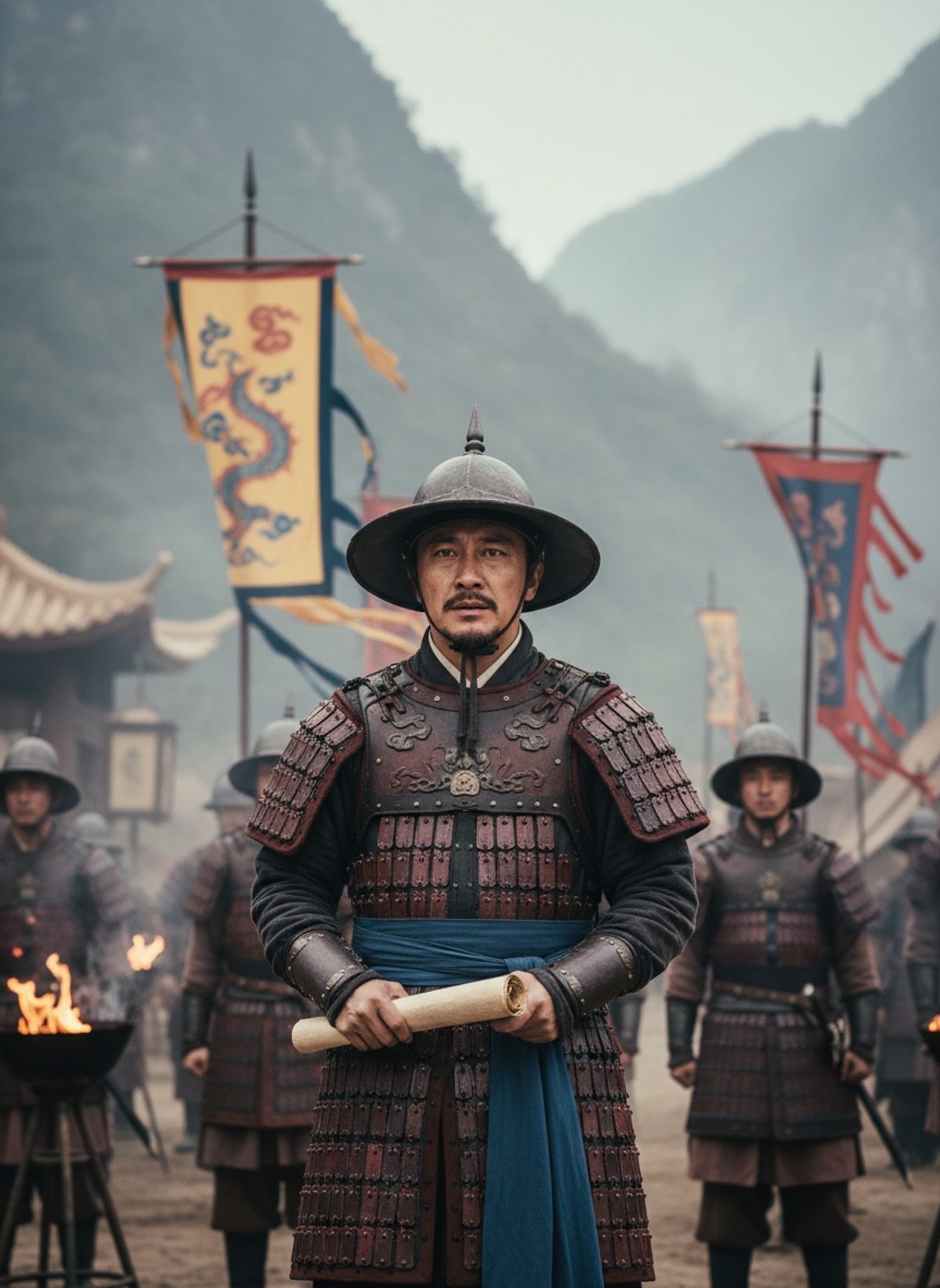
The clanging of swords echoed through the cold morning air as Yue Fei’s army clashed with the Jin invaders near the heart of occupied China. The fierce whistle of arrows split the sky, and the heavy thud of shields meeting blows shook the earth beneath their feet. Yue Fei, a steadfast figure in the midst of chaos, surveyed the battlefield with the experienced eye of a seasoned general. Victory seemed almost within grasp, the familiar taste of it making his heart stir with a flicker of hope. The enemy was fractured and weary, and Yue Fei felt certain that another strategic push would deliver the remains of the Song Dynasty back into the hands of its rightful rulers.
Born on March 24, 1103, in Tangyin County, Yue Fei’s early years were marked by hardship. His family, once mere tenant farmers, toiled under the weight of poverty and displacement following a disastrous flood. Yet, from these humble beginnings emerged a young man whose name, meaning "to fly," predestined him for greatness. His rigorous training under the tutelage of his teacher, Zhou Tong, and his father’s insistence on faithfulness and duty, sharpened his resolve and instilled a deep sense of loyalty to his nation.
Yue Fei’s military career began in 1122 when he joined local forces to combat the foreign threats that loomed over the Song Dynasty. He was a natural warrior, each campaign sharpening his tactical prowess and endearing him to the troops he led. But beyond military brilliance, Yue Fei was seen as a beacon of integrity in a world rife with corruption and betrayal. An emblem of unyielding loyalty, he became a living monument of dedication to the Southern Song cause.
His chance to truly alter the fate of his homeland arrived during the Jin-Song Wars, a series of conflicts that threatened to annihilate the Southern Song Dynasty. Leading his men in countless battles, Yue Fei’s strategic acumen led the Song army toward repeated victories against the Jin invaders. By 1140, his campaigns had pushed the enemy northwards, rekindling hope among the demoralized populace. Though the enemy was formidable, Yue Fei’s army remained undefeated, bearing down on the Jin forces strangled by continuous military pressures.
Read next: Zhang Juzheng Held the Empire Together. Then It Turned On Him.
Yet, just as Yue Fei prepared to seize the moment, yet another challenge loomed—not from the enemy but from within. The Song Emperor, weakened by factional strife and influenced by courtly intrigue, unexpectedly ordered a halt to the advance. In a turn of events that remains in the annals of Chinese history as one of its great tragedies, twelve edicts were sent to Yue Fei in a single day, commanding his immediate retreat. The abruptness of the command left him stunned, a thunderbolt out of a clear sky that shattered his ambitions and the years of hard-fought gains.
True to his character, Yue Fei obeyed, a decision mirroring his lifelong commitment to duty even in the face of personal conviction. He withdrew reluctantly, knowing full well the consequences of leaving a campaign uncompleted when victory was so tantalizingly close. As his army retreated, the Jin were granted a respite they couldn’t have achieved on the battlefield, effectively stalling Yue Fei’s relentless advance toward reunification.
The emperor’s command was influenced by ministers such as Qin Hui, whose machinations and political maneuverings cast a long shadow over the Song court. With the call for peace with the Jin, the narrative twisted in unexpected and unsettling directions. To silence dissent and quell potential unrest, Yue Fei was arrested upon his return. Charges of treason, fabricated from shadows and whispers, were levied against him. Despite the lack of evidence and the implausibility of the accusations, Yue Fei was executed on January 28, 1142, effectively removing the greatest military threat to the peace treaty, albeit with an act so unjust it infuriated those who revered him.
After Yue Fei's death, the legend of his loyalty proliferated, transcending the confines of mere historical recounting to imbue Chinese cultural consciousness. Over the centuries, his name became synonymous with steadfast loyalty and unwavering patriotism. Emperor Xiaozong recognized his virtue by awarding him the posthumous name Wumu in 1169. Nearly seven decades later, Emperor Ningzong elevated him to nobility with the title King of E. The wrongful execution of Yue Fei became a poignant national memory, woven into the fabric of Chinese history as a symbol of loyalty versus betrayal.
Not limited to the pages of history, the story of Yue Fei was codified in the arts, immortalized in literature, music, and folklore. His life and death served as moral instruction, and his image a perpetual reminder of the gravity of integrity and betrayal. His heritage proved enduring, influencing thinkers and leaders across generations. Yue Fei’s story is fundamental to understanding the complexities of loyalty, patriotism, and political machination in the halls of power. He is celebrated not only for his strategic sagacity but as the moral giant who epitomized the virtues of honor and dedication to ideals far beyond self-interest.
The tale of Yue Fei echoes through the corridors of history as a sobering reminder of the fragility of valor when faced with the labyrinthine twists of human ambition and fear. His life demands reflection on the price of integrity battled against expedience, and it stands as a testament that true loyalty may cost everything yet gains the immutable respect of posterity. In recounting his story, one grasps the timeless struggle of justice within the web of human enterprise—a narrative as resonant today as it has ever been amidst the annals of old.