The city of Cairo in the early 11th century stirred with the vibrant pulse of Islamic scholarship. Streets buzzed, echoing with the rhythmic call of traders in bustling bazaars. But away from the noise and under the blazing Egyptian sun sat a palace, where silence reigned supreme.
Within its dim chambers, Ibn al-Haytham, a visionary mathematician, was quietly at work. Surrounded by shadows, he peered into the secrets of light, armed only with rudimentary tools and an insatiable curiosity. This setting was the proving ground for a profound challenge to ancient optical beliefs.
A Quiet Revolution in Optics
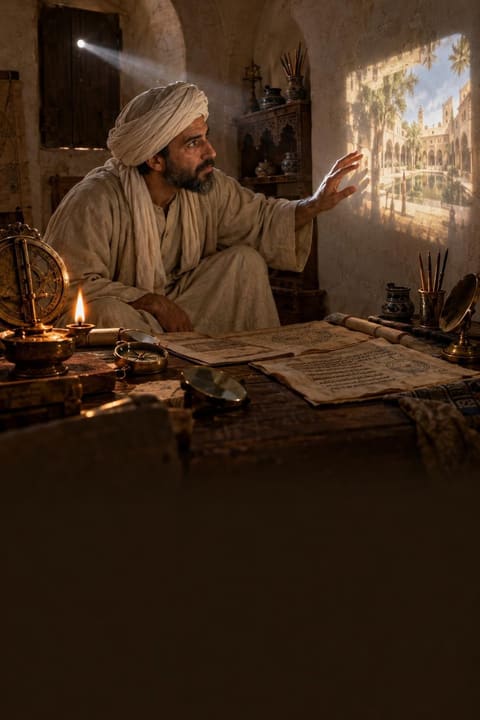
At the heart of Alhazen's darkened room, the revolutionary Camera Obscura bloomed into being. Imagine an enclosed space, shutters closed tight against the blazing day. A slender ray of sunlight pierced through a pinhole, casting an inverted image of the outside world upon a wall.
This was not mere child's play; it was a eureka moment. For centuries, scholars upheld that vision involved invisible rays emanating from the eyes. Alhazen shattered this tenet with tangible proof: it is light that travels into the eye.
Read next: Mary Anning Found an Ichthyosaur Skull at Age 12 in 1811
By mapping the journey of light through this experimental chamber, Alhazen elucidated the nature of reflection and refraction, paving the way for future optical innovations. His analysis of light's behavior in a controlled environment was a ground-breaking departure from the mystical traditions that dominated the past.
Unlocking Alhazen’s Problem
Years into his solitary exploration, Alhazen seized on a new puzzle: light's dance across curved surfaces, confounding yet beautiful. Known today as Alhazen's problem, this optical challenge asked where a point on a curved mirror would reflect to another given point. Previous intellectuals, dating back to the likes of Hero of Alexandria, touched on this conundrum, but none provided a complete answer.
Using geometry, he demonstrated that reflection in spherical mirrors could be traced mathematically. His solution, found within the pages of "Kitab al-Manazir", now revered as the Book of Optics, was a triumph of intellect over mystery, relying on the properties of conic sections long before the complex algebraic techniques of the modern era became known.
Yet, his accomplishment was not just an abstraction. By showing that light could be manipulated and understood, Alhazen laid groundwork that would later fuel the dreams of inventors such as Galileo and da Vinci, revolutionizing telescopes, cameras, and countless optical devices.
Read next: Zu Chongzhi Computed Pi More Accurately Than Anyone for 900 Years
A World on the Brink of Change
Alhazen stood at a nexus of change, a time when the Islamic Golden Age fostered great scientific flourishing. His work was both the product of and an impetus to this dynamic period. Islam's thirst for knowledge drew scholars to places like the House of Wisdom in Baghdad, where ancient Greek works were not just preserved but actively expanded upon.
The implications of his findings reached far beyond the borders of Egypt and the scholarly elite. By ensuring that the scientific method was integral to his approach, his work transcended both time and geography, fostering a legacy that invited further exploration and discovery by future generations.
The Everlasting Aura of Truth
Alhazen's story carries an enduring resonance. In a society that no longer accepts mystery as an answer to curiosity, his methodical dismissal of ancient misconceptions about vision resonates as a timeless quest for truth. His journey, from controlled darkness to brilliant revelation, serves not just as a historical lesson on optics but as a broader reminder of our need to question, explore, and understand the forces that shape our reality.
Alhazen’s brilliance bridged earthly curiosity with transcendental truths, showing us the way from darkness to light. Long before the advent of modern technology, his pioneering work quietly illuminated a path forward, leading to discoveries that forever changed the way we see—and perhaps how we choose to see—the world around us.