Caroline Herschel is a name many have never encountered. Yet, during the Georgian Era, she charted paths not just through the night sky, but also through the rigid social structures that threatened to hold her back.
From Domestic Chores to Celestial Discoveries
Born in Hanover, Germany on March 16, 1750, Caroline Lucretia Herschel's life seemed destined for domestic drudgery. Stricken with typhus at a young age, Caroline's growth was stunted, leaving her at just 4 feet 3 inches tall. Her mother saw her as future servant, better fit for household tasks than exploration or education. Yet, it was within these constrained confines that her keen scientific curiosity first flickered to life.
Her father, Isaac Herschel, a self-taught oboist, aimed to nurture his children’s intellectual curiosity whenever he could. Although his attempts were predominantly successful with his sons, Isaac would sometimes sneak educational opportunities to Caroline when her mother wasn't around. This foundation of learning, however modest, would serve her well when she joined her brothers in England in 1772.
Moving to Bath was a turning point. Her brother William, a musician and astronomy enthusiast, enlisted Caroline's help in managing his household. In exchange, he offered her lessons in music and mathematics, and introduced her to the universe's grand array of stars and celestial mysteries. It was in this new environment of wonder and learning that Caroline’s astronomical aspirations truly took flight.
Read next: Ibn Sina Wrote the Canon of Medicine at Age 32
Charting New Territories in a Man’s World
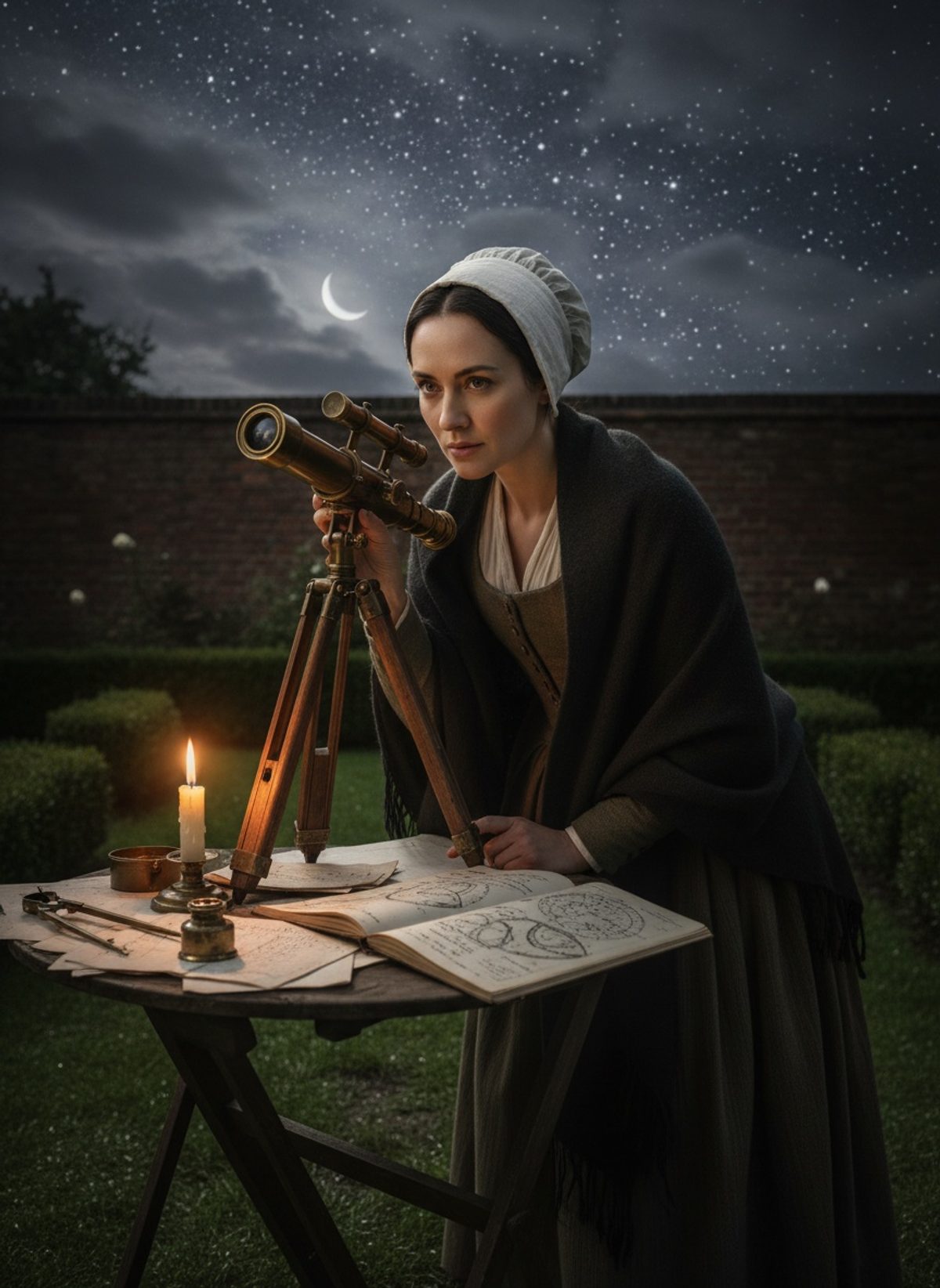
It wasn't long before Caroline transitioned from assisting her brother to becoming a prominent astronomer in her own right. With her self-built Newtonian reflector telescope, Caroline frequently surveyed the skies late into the night. Her dedication bore fruit on August 1, 1786, when she discovered her first comet, thoroughly shaking the male-dominated scientific world.
Caroline’s achievement marked her as the first woman to discover a comet, a significant feat in a field that often dismissed women's contributions. Undeterred by the gender norms of her time, she forged onward, continuing to make celestial discoveries that crowded her notebooks with the details of her observations. Over the following decade, she uncovered a total of eight comets and three nebulae, astounding a community that was initially skeptical of her capabilities.
One discovery, the periodic comet 35P/Herschel-Rigollet, would eventually bear her name, a testament to her dedication and skill. Her precise observations and methodical approach soon caught the attention of the broader scientific community, and in time, the recognition she so richly deserved followed.
Recognized but Unheralded
In 1797, Caroline Herschel began an astronomical catalog of nebulae, a task painstakingly detailed and artistically demanding, securing her place as a pioneering woman in science. In a world where few women were given the opportunity to formally publish, Caroline became the first woman to see her findings appear in the Philosophical Transactions of the Royal Society, reflecting not just her diligence but the undeniable value of her work.
The British crown itself recognized her contributions to astronomy. In what was an unprecedented move, the royal family allocated her an annual salary for her astronomical work—the first woman in Britain to be compensated by the government for a scientific endeavor.
Read next: Huang Daopo Brought Cotton-Weaving Technology to China in 1295
Despite her successes, Caroline continued to face the pervasive attitudes of her era. Her contributions were often overshadowed by her brother William’s more public achievements, a fact she herself acknowledged but accepted as the price for her chosen path. Yet, she steadfastly continued her work, blazing a trail for the many women astronomers who would follow.
A Lasting Legacy Written in the Stars
On January 9, 1848, Caroline passed away, leaving a legacy both profound and oft-overlooked. She had opened wider the gates of the scientific community to women, not just through her discoveries, but by rewriting the roles females could occupy within it. Caroline was deeply honored later in life, receiving a gold medal from the King of Prussia on her 96th birthday, two years before her passing, to celebrate her lasting contributions to science.
Pioneering in a field that was not prepared to embrace her gender, Caroline Herschel’s life was as remarkable as the night sky she so diligently charted. Through her eyes and the lens of her modest homemade telescope, she changed the way astronomy was pursued, setting the groundwork for future discoveries while battling against societal constraints.
Hers is the story of resilience and passion, shining brightly despite the darkness of her era. Her tale teaches us that the stars are closer than they appear, should we only dare to look.