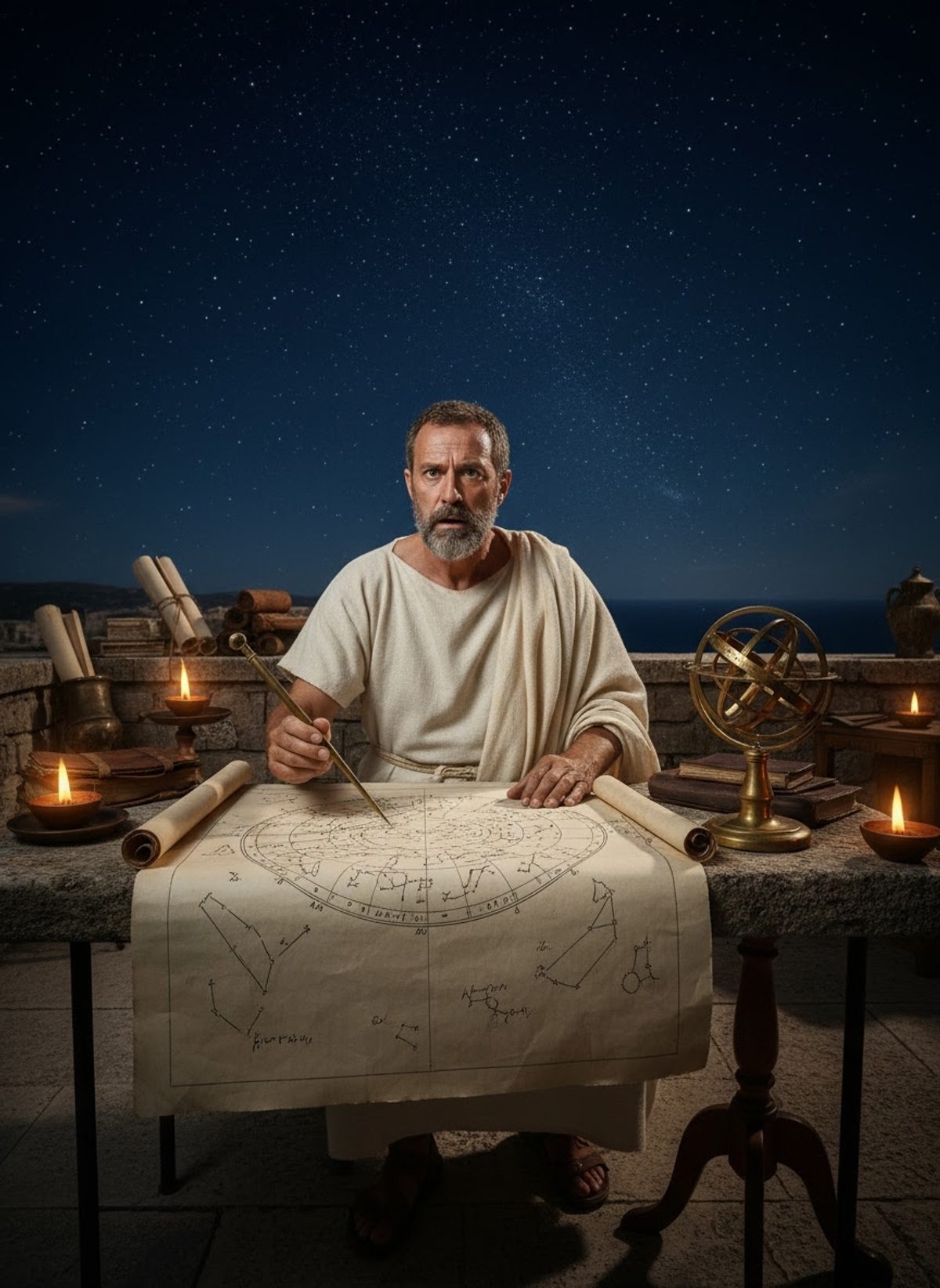
He was born in a small city thousands of years ago. Yet Hipparchus changed our view of the sky forever.
The Night Sky Changes
Around 134 BCE on the island of Rhodes, something unexpected caught the attention of the Greek astronomer Hipparchus. As he gazed at the heavens with his handmade instruments, a new star twinkled in the night sky, blazing where none had been before.
This unprecedented cosmic event prompted Hipparchus to pore over existing star charts with a scrutinizing eye. To his astonishment, the emerging truth was that the familiar stars had subtly drifted from their positions on recorded charts. It was as if the sky itself was slipping away, the steadfast celestial canopy shifting when it should have remained immutable.
With meticulous care, he set about documenting these minute variations. Even with the limited tools of the era, his keen observations led him to a groundbreaking conclusion: the entire sky was not static, as had been thought for generations, but dynamic.
Read next: Wang Chong: The Scholar Who Proved Thunder Was Physics, Not Gods
His calculations revealed that an imperceptible, gradual movement was at play. The notion of the Earth's axis wobbling was born—something he aptly named the precession of the equinoxes. However, this revolutionary proposition challenged existing beliefs and would languish in disbelief for centuries, far ahead of its time.
The Man Behind the Discovery
Born around 190 BCE in Nicaea, Bithynia, Hipparchus was well-versed in the legacy of the ancient Babylonian astronomers and the Greeks before him. He was no mere stargazer; Hipparchus was a mathematician and geographer, methodical in his pursuit of knowledge. Establishing himself on Rhodes, he worked between 162 and 127 BCE, dedicating his life to the stars. The rich repository of observations gathered in Alexandria and Babylon, possibly combined with Hipparchus's unique insights, informed his work.
Beyond precession, Hipparchus's contributions were numerous. He is considered a pioneer in fields such as trigonometry, having developed techniques and tables that would form the basis for later advancements. His star catalog, the first known comprehensive one from the Western world, was a monumental achievement that enabled later astronomers to carry on his work.
Despite writing at least fourteen books, only his commentary on Aratus's poem survives intact. Yet his legacy has endured through referenced works by later scholars like Ptolemy and Strabo. The scale of his accomplishments earned him the posthumous title of "father of astronomy," as coined by Jean Baptiste Joseph Delambre in 1817.
Tools of Genius
While only scant physical traces of Hipparchus's work survive, clues to his methodology live on through records of his instruments. His invention of the armillary sphere is one such achievement, potentially developed to assist him in mapping the stars. This ingenious model of the celestial sphere provided the framework for understanding stellar positions. Hipparchus is also credited with early designs of the astrolabe, a multipurpose instrument used for stargazing and timekeeping.
It’s remarkable to consider how Hipparchus, relying solely on these rudimentary devices and pure observational skills, achieved so much. His calculation and understanding of the Earth's axial precession displayed a profound depth of thought, one that would await recognition and acceptance by a scientific community not yet ready for such radical ideas. His vision and framework laid a foundation for future advances that would redefine humanity’s place within the cosmos.
Read next: William Harvey Traced the Blood's Full Circuit Through the Body
The Slow Turn of Science
The notion of axial precession was revolutionary, yet it did not receive immediate acceptance. Hipparchus's findings were too radical, too advanced, for his time. For over 1,500 years, they lay dormant, underappreciated and unrecognized by subsequent generations. It was not until the later renaissance of classical learning that his insights were fully embraced, verifying that the Earth itself had been quietly turning all along, reshaping the view of the heavens.
Through his observations, Hipparchus illuminated the gradual dance of the stars that drew not from mythology but mathematical precision. His courage in presenting an idea ignored and later forgotten is a testament to scientific perseverance, one that quietly continued without requiring the spotlight.
Why Hipparchus Matters
It's easy to marvel at how far we've come in understanding the universe. Yet, the story of Hipparchus reminds us that curiosity and precision can transcend any era. He dared to contradict accepted beliefs, trusting his observations and his mind above all else.
His legacy reminds us to question, to be relentless in the pursuit of knowledge, and to recognize that our understanding of the world, much like the night sky, is never truly static. Though few believed him in his time, Hipparchus laid the groundwork for an evolving appreciation of the universe, a pursuit continuing to develop with each shift of the stars.