1811. The winter winds howled through the crumbling cliffs of Lyme Regis, shaping the jagged stones with its relentless force.
The Cliffs of Hidden Time
In the early 19th century, the small coastal town of Lyme Regis in Dorset offered more than its rugged beauty and quaint harbor. For young Mary Anning, the seaside represented an ancient world frozen in stone. Despite a lifetime shadowed by poverty, her curiosity and determination forged paths into realms of discovery untouched by many.
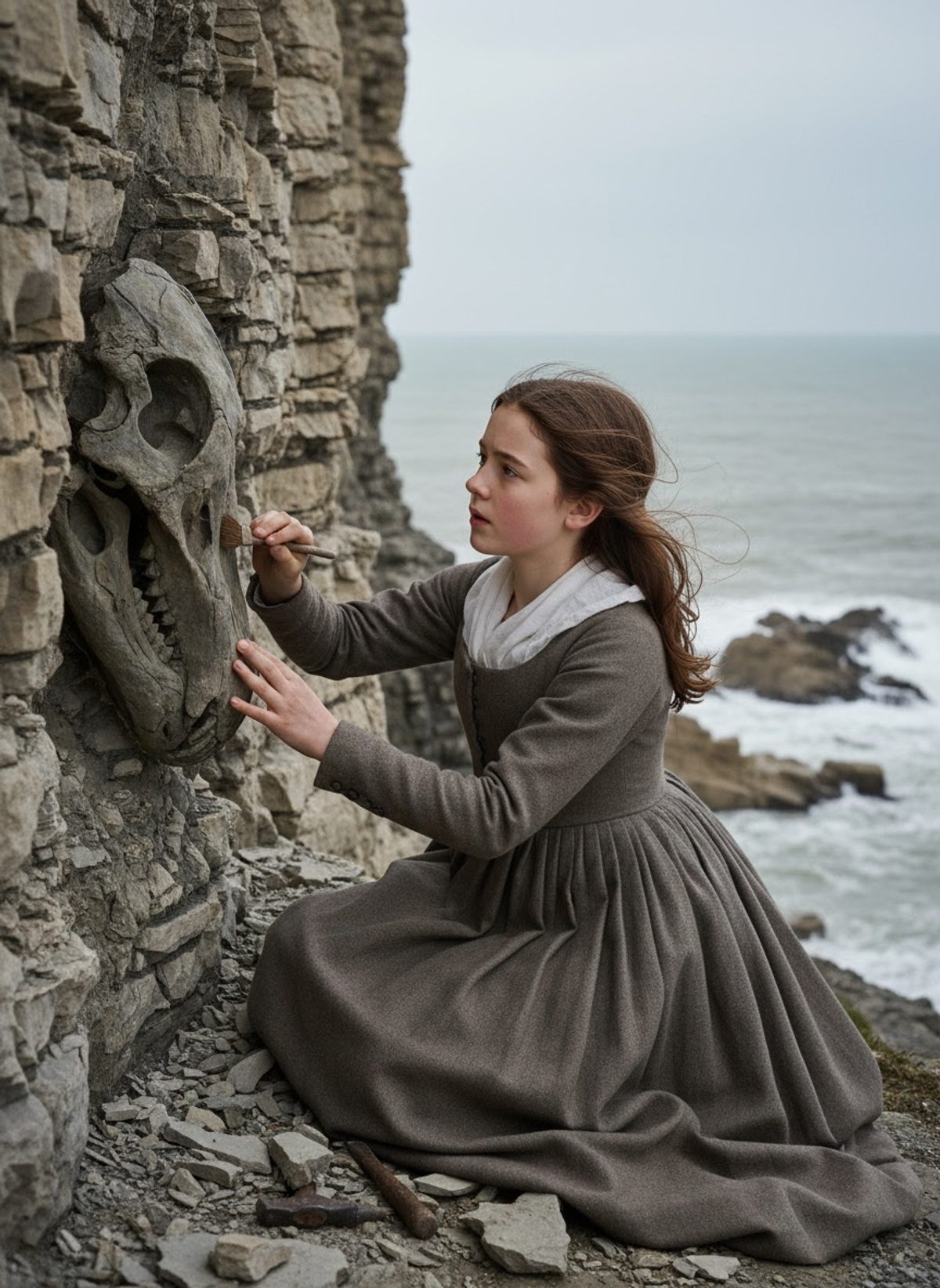
Mary's father, Richard Anning, a cabinetmaker, supplemented his income by collecting and selling local fossils to tourists. From a young age, Mary accompanied him on these cliffside expeditions. She developed a keen eye for spotting fossils amid the Blue Lias and Charmouth mudstone, laying the foundation for groundbreaking revelations to come.
Fossil hunting in Lyme Regis wasn't merely a curiosity. It was a race against time and tide. Landslides that exposed fossils also threatened to swallow them back into the sea. The Annings lived close enough to these cliffs that storms often flooded their home, underscoring a life lived on the edge, both physically and financially.
Read next: Hipparchus Mapped 850 Stars and Predicted the Sky Would Shift
A Discovery That Shook the Earth
On a cold day in 1811, twelve-year-old Mary and her brother Joseph ventured out on one of their usual fossil hunts. It was Joseph who initially discovered the outline of a skull. But it was young Mary who patiently unearthed the rest of the creature over several months. The 17-foot skeleton of what would later be identified as an Ichthyosaur lay embedded in time, waiting for someone with Mary's intuition and dedication to bring it to light.
The discovery was unprecedented. The creature resembled nothing known to science at the time—a fact that sparked intrigue and skepticism among 19th-century naturalists. This colossal sea monster, an air-breathing marine reptile, indicated a prehistoric era even stranger than scholars had imagined.
Mary’s lack of formal education stood in stark contrast to the male-dominated scientific community of Regency England. While her discovery garnered interest, acknowledgment of her contributions was hard-won. Yet, the sheer significance of the Ichthyosaur, and later, other finds such as plesiosaurs and a pterosaur, forced science to reconsider the Earth's history. Mary Anning had not only unearthed bones but opened debates about natural history and extinction.
The Financial Struggle
Mary Anning's homespun expertise grew, but so did her financial struggles. Despite the revolutionary nature of her finds, she remained on the fringes of scientific recognition and prosperity. The geological elite of the time often purchased fossils extracted from Mary’s own hands, with little financial or scholarly credit bestowed upon her.
The gender constraints of her era prevented her from joining Britain's Geological Society. Nonetheless, her value within these circles subtly grew, as geologists sought her advice on anatomy and fossil collecting. As her legacy would show, Mary's discoveries compelled people of science to examine extinction and evolution long before such concepts became mainstream.
Read next: Ibn al-Haytham Proved How Eyes See Light in a Dark Room
Illustrating the Past
Despite all odds, Mary Anning's work did not go unnoticed by everyone. Her friend, the geologist Henry De la Beche, painted "Duria Antiquior," a visionary reconstruction of prehistoric life, based largely on fossils Mary unearthed. This painting, one of the first fleshed-out depictions of ancient life forms, propelled a broader acceptance and understanding of the deep past. De la Beche sold prints to aid Mary financially, recognizing her role in opening a window to bygone worlds.
Though she communicated her keen observations mainly through correspondences, parts of her writing appeared in the Magazine of Natural History in 1839. It was a small yet significant instance of Mary’s voice entering the scientific domain. These contributions, humble as they appeared, continued to nurture the unfolding narrative of paleontology.
A Legacy Etched in Stone
As science gradually caught up to her discoveries, so too did the respect for Anning’s contributions evolve, albeit posthumously. Mary's life—marked by struggle and punctuated by profound discoveries—tells more than the tale of an individual; it is the story of science blossoming from unexpected places, of knowledge forged amid adversity.
Her chance finding at age twelve initiated an era of rigorous exploration into the Earth’s deep past. She illuminated the ancient seas while changing the paleontological landscape, showing that determination and skill often trump institutional barriers. Today, her legacy serves as a touchstone, inspiring scientists and dreamers alike to look beyond the surface, to see the stories written in stone beneath our feet.