Most people have never heard of Shen Kuo. They should have.
The Discovery Beneath the Cliffs
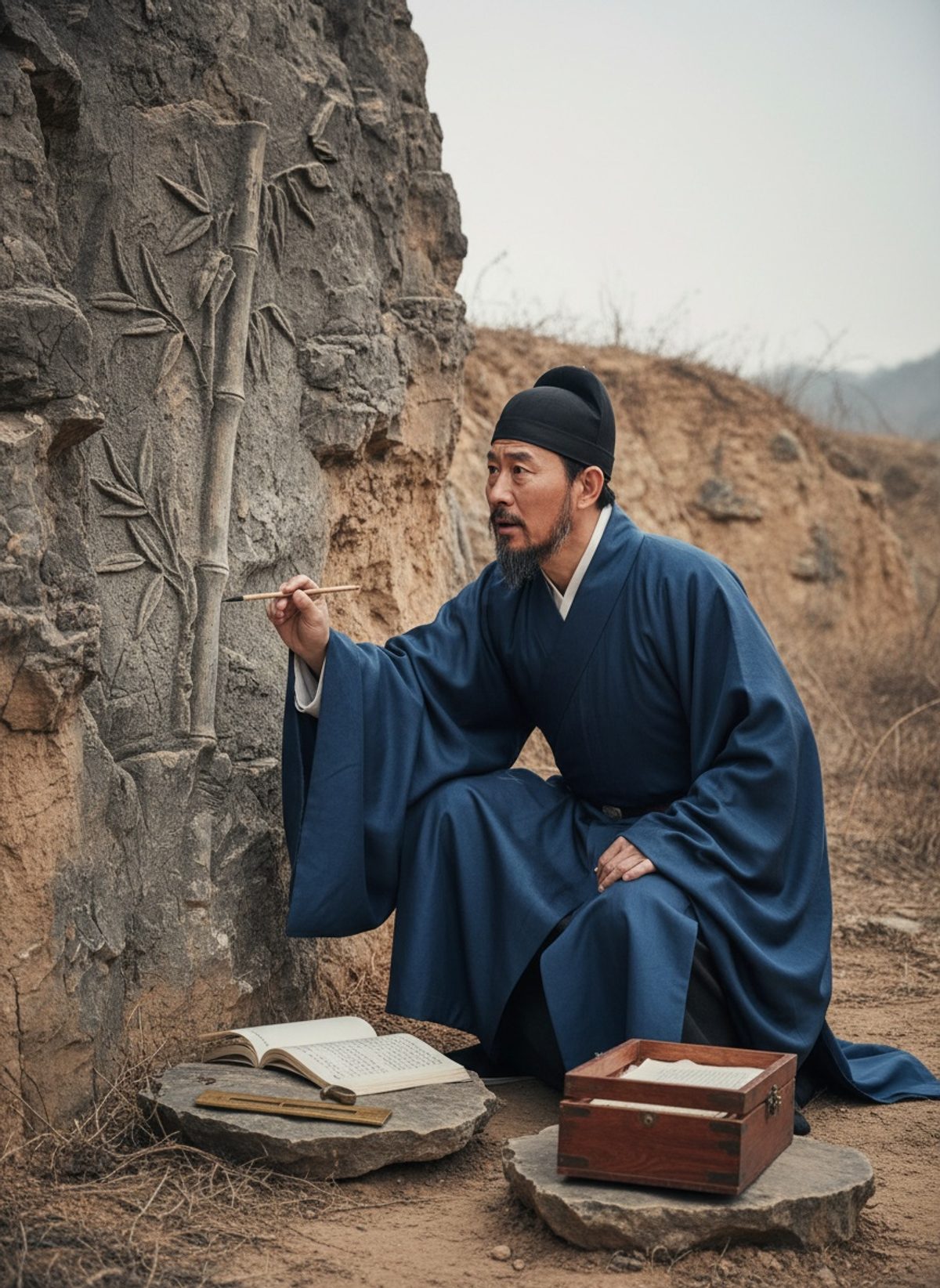
In 1088 AD, beneath the expansive skies of Song Dynasty China, a curious discovery unfolded at an eroding cliff in what is now the northern regions of the country. Shen Kuo, a Chinese polymath and statesman, stood contemplatively at the site where once-rippling landscapes were now barren and parched. As a master of various disciplines, Shen was naturally observant, accustomed to piecing together fragments of knowledge across different fields. Yet what he discovered at this cliff surprised even him.
Entombed within the sedimentary layers of the cliff were ancient traces of bamboo, calcified into stone over countless millennia. This unexpected find puzzled the brilliant scholar.
Bamboo was a plant synonymous with lush, verdant environments, starkly contrasting with the stark, arid northern terrain where no such plant could possibly survive. Shen, possessing an inquisitive mind, recognized that these fossilized remains, nestled within the hostile environment, whispered secrets from an ancient epoch when the climate in this part of China was far more accommodating.
Read next: Tycho Brahe Measured the Stars Without a Telescope
Shen's encounter with the fossilized bamboo marked a defining moment not just in Chinese history, but in the history of climate science. His mind woven with threads of logic and evidence, Shen posited a radical hypothesis: the climate, it seemed, was not a constant, but something that shifted and morphed over time, altering the landscapes and ecosystems with it. His deduction, embracing a nascent concept of climate change, was astonishingly prescient—a thought Western science wouldn't echo until centuries later.
A Legacy of Inquiry and Ingenuity
This revelation was just one of the many remarkable leaps in understanding credited to Shen Kuo, whose legacy in scientific innovation covered vast swathes of knowledge. Born in 1031, Shen was imbued with a relentless curiosity that saw him venture into diverse disciplines such as astronomy, mathematics, and geology, to name a few.
Throughout his vibrant career as a civil servant, he held various prestigious positions, including the head official for the Bureau of Astronomy and the Assistant Minister of Imperial Hospitality, illustrating the intellectual heft he carried at the Song court.
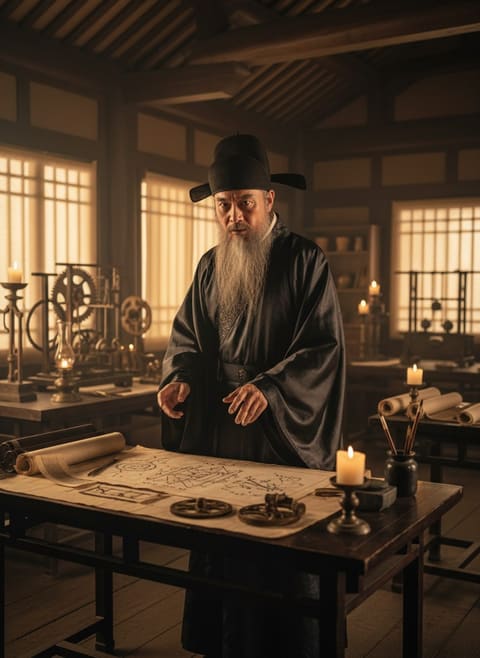
Despite the political turbulence and factional struggles he faced during his career, Shen's commitment to knowledge never waned. As part of his astronomical pursuits with Wei Pu, Shen meticulously charted the orbital paths of celestial bodies. Political adversaries curtailed their intensive five-year project, reflecting the complexities and shifting loyalties at court. Undeterred, Shen innovated designs for astronomical instruments such as the armillary sphere and advanced various timekeeping devices like an improved water clock.
The breadth of his achievements was astounding. Shen was a pioneer in describing the magnetic compass needle, a tool indispensable for navigation, and made significant strides in understanding magnetic declination. Meanwhile, in his Dream Pool Essays, he preserved crucial insights about optics and early movable type printing, among numerous other scholarly contributions. Like the petrified bamboo layers he once studied, Shen Kuo's work left an enduring imprint, waiting dormant through time to awaken future generations.
Connecting the Past with the Future
The bamboo fossils were more than botanical relics; they were symbols of change across temporal horizons. Long before the term 'climate change' entered the vernacular, Shen's observations challenged static perceptions of the natural world. His hypothesis of gradual climate evolution hinted at the planet's inherent dynamism, planting seeds of what modern science ultimately labeled as geomorphology.
Read next: Ibn Sina Wrote the Canon of Medicine at Age 32
Shen recognized that the elements and forces of nature perpetually sculpted earth and sky. Inland marine fossils showed him ancient coastlines that now lay miles from the sea—a testament to geological shifts over unfathomable expanses of time.
The juxtaposition of fossils and current terrain underscored to Shen and eventually to society at large the transformative processes that shaped the Earth. It was this acknowledgment—that the world exists in a state of flux—that resonated through his work, ideas that science only formalized centuries later.
The echoes of Shen Kuo's life and discoveries remind us that inquiry and observation are timeless endeavors. He saw beyond the veil of the apparent, recognizing and theorizing monumental forces at play long before the machinery of industrial progress and evidence-based science made these interpretations common. Shen's work teaches us the critical importance of paying attention to the subtle stories written into the material fabric of our world.
His exploration of the natural order foreshadowed our current understanding of climate dynamics—a reminder of the intellectual bravery required to think boldly in the face of established perceptions. As our planet grapples with contemporary environmental challenges, Shen Kuo's pioneering spirit stands as an inspiration, urging us to observe our world rigorously and act with wisdom and foresight.