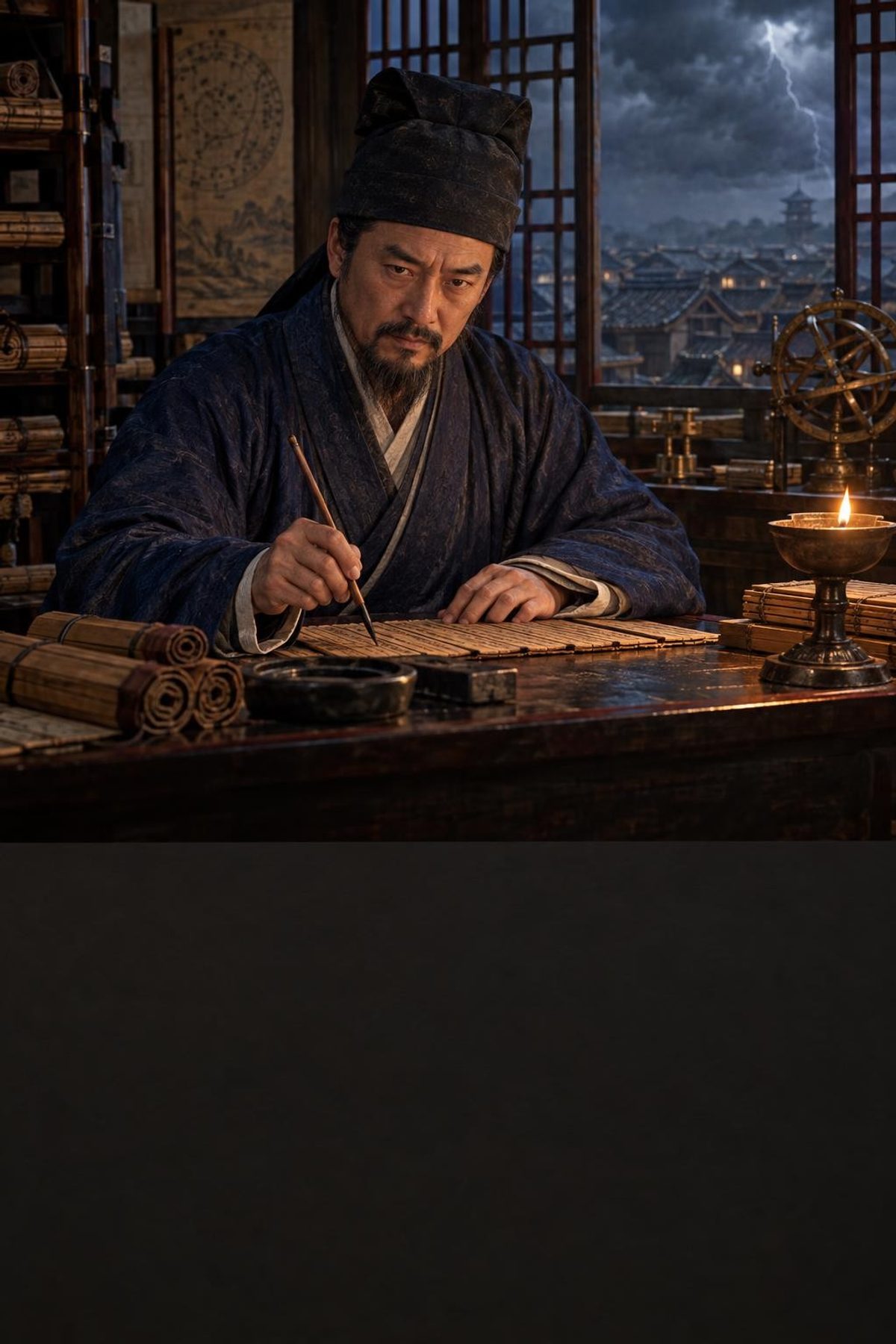
He was born into poverty. Yet Wang Chong dared to challenge the very foundations of his world with nothing but keen observation and an uncompromising mind.
Questioning Heaven's Wrath
In the bustling streets of Luoyang, the Eastern Han capital, a young Wang Chong could often be found poring over texts at a bookstall. The year was 80 AD, and unlike his contemporaries, Wang did not see thunder as the voice of Heaven delivering divine punishment. Such beliefs were woven into the fabric of Han society, shaping politics and superstition alike. Traditional thinkers cloaked in confining robes declared thunder a manifestation of divine displeasure.
To Wang, these views were akin to stories told to frighten children. He was determined to unravel the mysteries of the natural world with logic and keen observation, directly challenging the entrenched scholars and their heavenly assertions.
His tool was not a laboratory filled with instruments, but a pen and his experiences watching storms unfold. As torrents of rain lashed against the land and bolts of lightning shattered the night sky, Wang Chong observed, pondered, and wrote.
Read next: Shen Kuo Mapped China's Climate From Fossilised Bamboo
For him, thunder was not ethereal but an earthly phenomenon, birthed from the clash of heat, moisture, and air. It was science, a concept unheard of in that era, that drove him to question and ultimately refute the accepted truths of his time.
From Humble Beginnings to Radical Thinker
Born in modern Shangyu, Zhejiang, Wang Chong hailed from a family that scraped by on modest means. A commoner's life did not promise much in the way of scholarly success, yet Wang's keen intellect was apparent from the start.
Encouraged by his parents, his journey led him to Luoyang where illustrious scholars gathered. Without the money to purchase the texts required for his studies, he stood at the stalls, committing each passage to memory—a feat that soon saw him master the Chinese classics.
As Wang matured, so did his disdain for those who basked in the glow of unearned prestige. Wealth and power meant little without the substance of knowledge to back them. This mindset did not win him friends among the elite, and his critical eye often placed him at odds with accepted customs. Eventually, his fierce independence and unwillingness to kowtow led him back to his home commandery, where he withdrew into a semblance of isolation, devoting himself to writing.
What emerged from this period of relentless writing was the Lunheng, or "Critical Essays," a compilation of approximately eighty-five essays that dissected the cultural and scientific paradigms of the day. Its pages offered a rare glimpse into a world that valued superstition above all else, illuminating with clarity Wang's materialistic understanding of nature.
A Pen Mightier Than The Elements
The essays in the Lunheng showcased Wang's resistance to the cosmic powers attributed to natural phenomena. Among the many revelations within its chapters, his discourse on thunder stands out. Rather than succumbing to the prevailing ethos of divine retribution, Wang postulated that thunder was a result of natural interactions, reasoned from simple yet profound observations.
Here was a man, far removed from the privileged circles of power, arguing against millennia of tradition. His courage to dissent was evidence of an independent mind prepared to grapple with the world's mystifying symphony. Similarly, his other observations—like the water cycle—were intuitive leaps that no one else dared consider, rippling outward to inspire future generations of thinkers.
Wang Chong's career was notably brief but filled with instances of clashing against institutional stubbornness. Positions he acquired were often relinquished or lost because his worldview clashed with those in authority. Invitations to participate in the court under Emperor Zhang were politely declined. Ironically, his insights were largely ignored during his lifetime, leaving much of his recognition to posterity.
Read next: Caroline Herschel Found Eight Comets With a Homemade Telescope
Echoes Across The Ages
While Wang Chong worked in relative obscurity during his life, his thoughts seeded future dialogues that eventually broke the chains of superstition. The prominence of the Lunheng blossomed over the centuries, influencing eminent figures such as Cai Yong, who dared to acknowledge Wang's unconventional beliefs decades later.
In a world where the line between myth and science was scarcely drawn, Wang's essays were radical. His approach to understanding the universe through secularism was almost a precursor to the Enlightenment philosophies that would sprout in the European context much later. His emphasis on reason over divine fiat laid early groundwork for an intellectual curiosity that disregarded customary constraints.
Beyond Thunder: The Power of Skepticism
To modern minds, the notion that thunder could be anything other than a physical phenomenon seems obsolete, yet Wang Chong's courage in making such claims in 1st-century China underscores an enduring truth. Reason alone holds the torch that can pierce the veil of ignorance, a testament to the persistent quest for knowledge that shapes our evolution.
Today, the story of Wang Chong resonates as a poignant reminder of the enduring capacity of the human spirit to pursue understanding despite societal pressure. His life teaches us the value of questioning and the necessity of observing the natural world with open eyes and a sharp mind—proof that even the whisper of a lone skeptic can reverberate through ages, enlightening those who choose to listen.