He was an unrivaled conqueror, a ruthless soldier who never hesitated to fight. But standing amidst the devastation of Kalinga, he traded his sword for a path of peace.
The Price of Conquest
The year was 261 BCE. Ashoka, Emperor of the Mauryan dynasty, had led his forces on a relentless campaign against the eastern kingdom of Kalinga—a wealthy and strategically significant region along the eastern coast of what is now India. Although Ashoka had ascended to the throne around 268 BCE as the third ruler of the Mauryan dynasty, his reign had been characterized by an insatiable thirst for expansion. The Empire stretched from present-day Afghanistan to Bangladesh, but Kalinga was a jewel yet to be captured.
The fierce resistance of the Kalingans was beyond what Ashoka anticipated. With no standing army, Kalinga had mobilized its citizenry to take up arms. The battle was ferocious, resulting in massive carnage on both sides. According to the Edicts of Ashoka—his own inscriptions—over a hundred thousand people were killed, with many more injured or displaced. The thriving fields were soaked with blood, a grim reminder of the war's true cost.
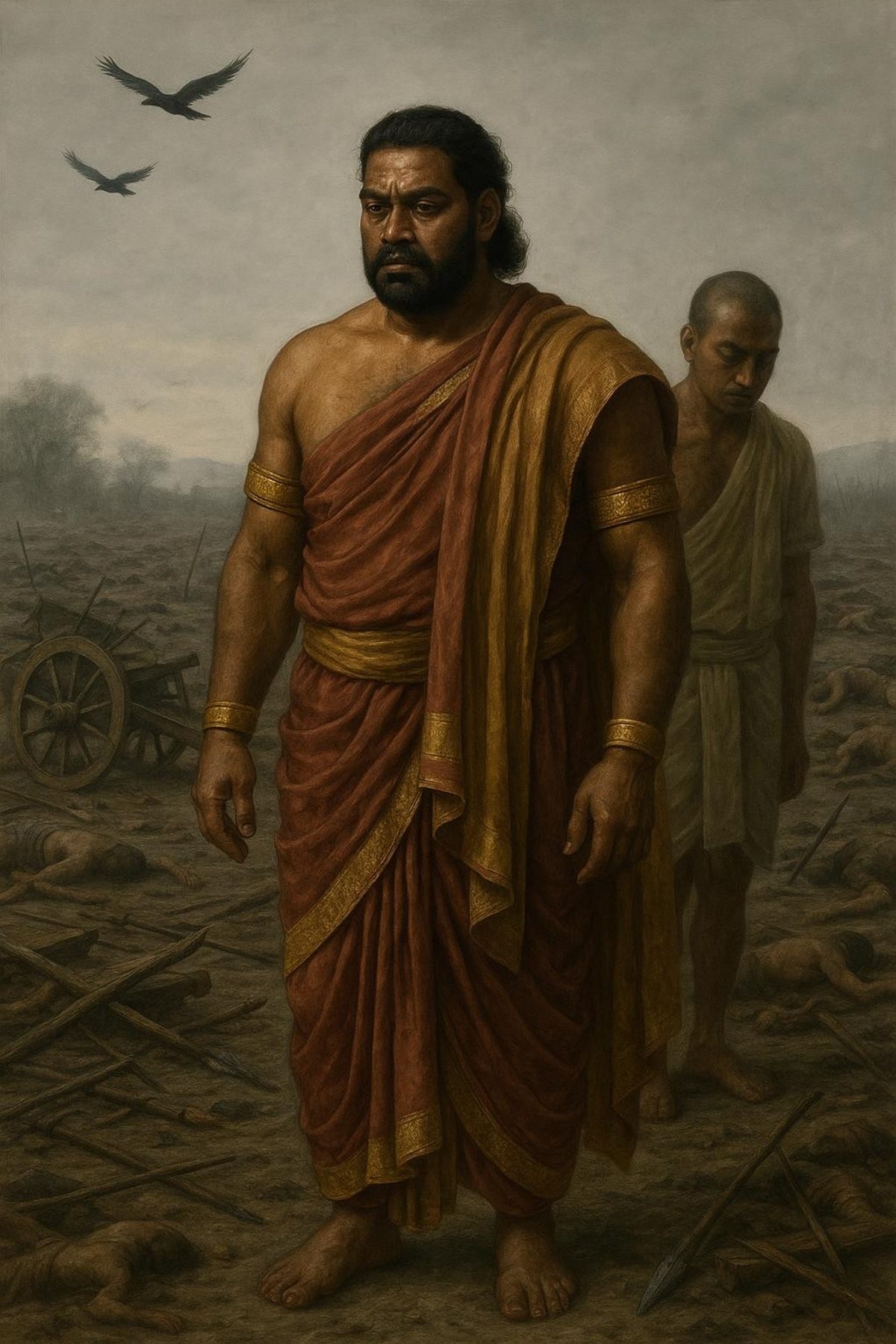
Victorious yet solemn, Ashoka walked the battlefield, witnessing firsthand the horrors inflicted by the conflict he had commanded. The sight reportedly left him profoundly disturbed. The cries of the dying and the mourning of survivors echoed, reverberating in his heart and mind. This was not the glory he sought; instead, it laid bare the depths of human suffering caused under his orders. The grand victory was a pyrrhic one, and its heavy toll pressed upon Ashoka's conscience like an insidious weight.
Read next: She Walked Into the Desert. The Emperor Followed.
A Change of Heart
It was during this nadir that Ashoka experienced a transformation, a pivot as significant as it was rare for a king of his stature. Up until that moment, military conquest had been the currency of power, a measure of a ruler's strength. Yet, gazing upon the wreckage of war and its human cost, Ashoka resolved to renounce violence and embrace a philosophy of non-violence and care—the principles of *dhamma*, denoting righteous conduct.
Ashoka's conversion was not immediate, but a gradual realignment of his governing philosophy. Influenced possibly by the principles of Buddhism, with which he grew increasingly aligned, Ashoka's subsequent years were marked by efforts to spread the teachings of compassion and moral righteousness across his realm. The once-ambitious conqueror embarked on a new mission to heal rather than to harm.
Inscriptions found across the Indian subcontinent reveal this profound shift. Known today as the Edicts of Ashoka, they provide glimpses of an emperor who communicated his aspirations for a society built on peace, ethical conduct, and public welfare. These messages, engraved on pillars and rocks, are among the earliest examples of written communication with his subjects. In them, Ashoka addresses not only his people but future generations, extolling the virtues of harmony and the futility of violence.
He became a patron of Buddhism, supporting monastic communities and facilitating the Third Buddhist Council. Monasteries and stupas sprung up under his patronage, and Buddhist missionaries, dispatched through royal support, carried the banner of peace far beyond the Mauryan borders into ancient Asia. Ashoka's endeavors illustrate a historical narrative of repentance and renewal, unprecedented for a ruler whose reign had been bathed in blood.
The Ashoka of Legend
Ashoka's life and reforms would later transform into legend, intricately interwoven with Buddhist texts that chronicled his reign as an epoch of virtue. These narratives, though composed long after his death, served to craft an idealized image of Ashoka as the paragon of a dharma-oriented ruler. The Buddhist chronicles reimagined him as "Dharmashoka"—Ashoka the Righteous—conveying stories rich in moral lessons and spiritual milestones.
For centuries, Ashoka remained a semi-mythical figure, his tale nearly swallowed by time's veil. It was not until the 19th century, with the decipherment of the Brahmi script, that Ashoka's historical presence resurfaced for modern scholars. The remnants of his edicts scattered across the vast landscapes of his once-great empire provided tangible evidence of a king whose radical departure from war was not merely fabrications of folklore.
Yet, the potency of Ashoka's story lies in its harmonious blend of historical fact and enduring fable, bridging the realms of a realpolitik and spiritual awakening. His legacy is immortalized across India today, notably in its national emblem—the Lion Capital of Ashoka—and the Ashoka Chakra at the center of the nation's flag, symbols of unity and peace.
In an era where empires pivoted on bloodshed and oppression, Ashoka's introspection and redirection serve as a timeless reflection on morality in leadership. He demonstrates the transformative power of remorse and the capacity for change, even in the highest echelons of power. The echoes of his renunciation resonate through the ages, compelling us to consider the parts of our nature that cherish empathy over conquest.