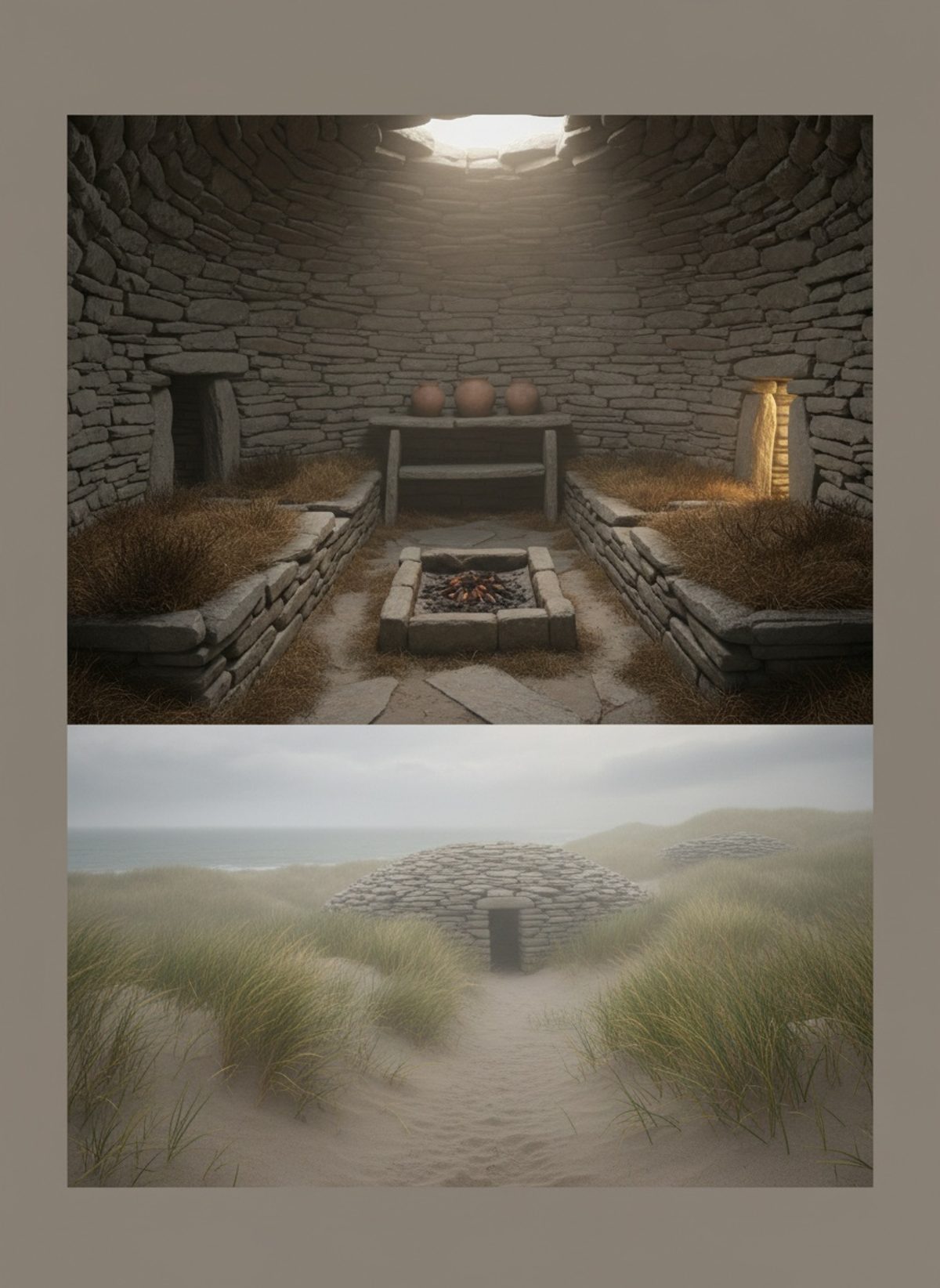
Cool, dark, and unseen. That was Skara Brae for nearly 4,500 years. Only the force of nature could find what time had so carefully hidden.
Under the Shelter of Sand
In the harsh winter of 1850, a fierce storm battered the Orkney archipelago off the northern coast of Scotland. The gale swept the grass and soil off a large mound on the edge of the Bay of Skaill, revealing remnants of stone walls. Beneath the protective embrace of sand that had long sheltered it lay an ancient Neolithic village. This was not just any collection of rocks—Skara Brae was to become known as the most complete Neolithic settlement in Western Europe.
It is difficult for modern minds to comprehend the timeless durability of Skara Brae's construction. Imagine stepping back in time to 3100 BC—the stone hearths still warm, the stone shelves still tidy. Everything was fashioned from stone, which the villagers expertly fashioned to withstand time itself. The simple elegance of their survival techniques, using stone not only for shelter but for their daily necessities, was as much a part of their world as our digital technology is today.
The Discovery and Quiet Excavation
The village lay dormant—an untouched time capsule of history—for centuries until that fateful storm brought it back to light. The initial uncovering was a serendipitous event, but it sparked the curiosity of William Graham Watt of Skaill House. A self-taught geologist, Watt began an amateur excavation of Skara Brae's stone structures shortly after the storm's upheaval. In those early years, only four houses were revealed, and then work halted abruptly in 1868. Regardless, the site’s secret kept its allure.
Read next: Göbekli Tepe: Hunters Built a Temple Before Farming Existed
It wasn't until some 60 years later, in 1924, that another storm prompted further interest. Erosion claimed part of one building, motivating authorities to protect and explore the site. Professor V. Gordon Childe from the University of Edinburgh excavated the village between 1927 and 1930, revealing its wonders more fully. In a remarkable turn of historical oversight correction, it was later discovered that Childe's excavation efforts were actively supported by four women previously misidentified as passive onlookers.
The Peculiar Life of Skara Brae’s Inhabitants
As archaeologists peeled back the layers of earth, the life of Skara Brae’s inhabitants unfolded like a long-lost manuscript. The Neolithic villagers of this stone womb constructed and lived with an impressive ingenuity. They built their homes from carefully fitted slabs, dividing spaces for social activities, resting, and storage—the kitchens of stone embraced beds, dressers, and fireplaces, all carved in stone and locked together without mortar.
The sites displayed a unified design—a central hearth, flanked by sturdy stone beds, and a striking stone dresser taking pride of place opposite the entrance. The innovation of these structures hinted at a sophisticated society, rich in cultural and communal ties, bound together by the necessity and stability that stone provided. Even the walls were braced by mounds of midden, packed to insulate against the chill and gales of their environment.
The Sands of Time
Skara Brae was occupied from roughly 3180 BC to 2500 BC, standing older than even the renowned Stonehenge. Ironically, it was the sand—the very agent of obliteration during its concealment—that later preserved this intricate window into human history. For the people of Skara Brae, the sand dunes were both shelter and tomb, settling over the village as its inhabitants faced the abandonment. Climate, resources, or social shifts—Inevitably, the reasons for Skara Brae's desertion remain as concealed as they are speculated upon by historians.
Read next: Nan Madol: A Coral City Built on 92 Artificial Islands
Slowing the erosion of history, Skara Brae’s gradual burial preserved its details with an unlikely fidelity. Like many great civilizations, the ebb and flow of sand and time conspired both to save and ultimately veil it. Today, insight is gained through ongoing preservation efforts and wary care by Historic Environment Scotland and its partners, ensuring that Skara Brae remains interconnected with our past.
Whispers of Stone in Modern Echoes
Walking through Skara Brae today, one can almost hear the echoes of its Neolithic denizens carried on the Atlantic winds. The robust efficiency of their handcrafted stone environment and the pottery fragments of grooved ware speak volumes about their day-to-day lives. Over 5,000 years ago, a distant people thrived in a way that is both foreign and intimately familiar—a community bound by shared hardships and successes.
In the end, Skara Brae invites reflection on the durability of human ingenuity and the pretenses of permanence. Just as storms reveal and sands preserve, this ancient settlement emerges from obscurity to help us probe the depths of human resilience. It is a sentinel of stone and an eternal relic of our shared past—a warning and a wonder from a world both remarkably far and chillingly near.