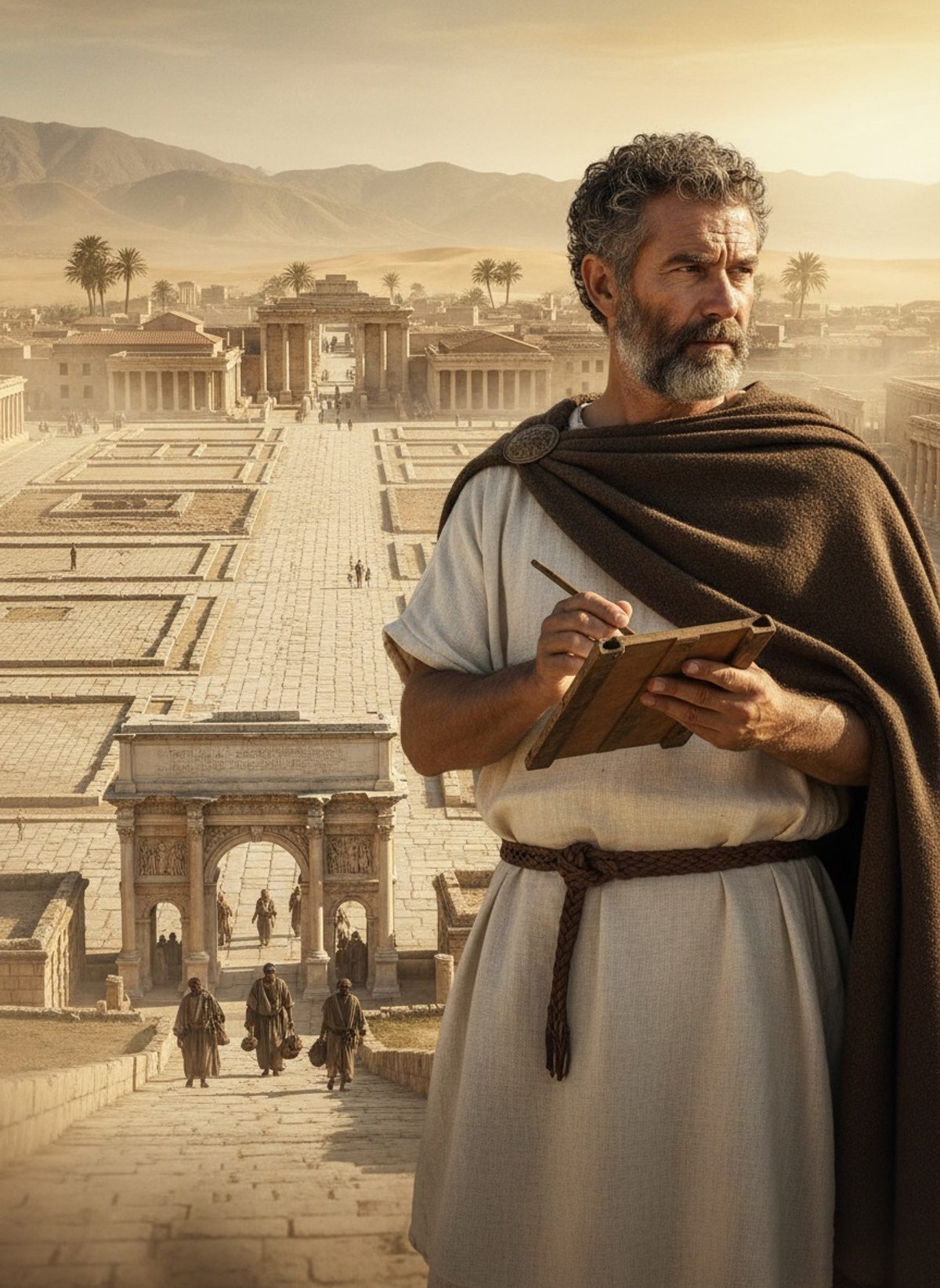
He was an emperor who didn't just expand his domain but built cities from scratch. In 100 AD, Trajan gazed at the barren landscape of the Sahara and envisioned a thriving Roman city.
The Emperor’s Vision: Building a Bastion in the Desert
In the early days of the second century, Roman Emperor Trajan embarked on a project that would leave its mark on history. In what seemed an improbable location within the Aurès Mountains of present-day Algeria, he decreed the creation of Timgad, or as it was formally known, Colonia Marciana Ulpia Traiana Thamugadi. It was to serve as a strategic bastion against the Berber tribes, a typical Roman maneuver to solidify and protect their territories. Yet this city was more than just a military outpost. Trajan dedicated Timgad not only to himself but also to his family, including his mother Marcia and sister Ulpia Marciana, intertwining his legacy with the city’s creation. Building a city here was no ordinary feat; it was an assertion of Roman ambition and architectural prowess.
Roman veterans and colonists, many of whom had never laid eyes on Rome itself, were sent to populate this new outpost. As Timgad rose from the rocky desert, it mirrored the grid-like precision of Rome’s streets, a hallmark of Roman town planning. Roads intersected at right angles, forming a perfect grid that spoke to Roman ideals of order and control. The city boasted a forum, libraries, public baths, and a theater, all constructed to reflect the grandeur of Roman culture and dominance. This meticulously planned city accommodated twelve thousand residents at its peak, a bustling microcosm of Roman life and society.
Cultural and Religious Flourishment at the Edge of Empire
Despite its remote location, Timgad was a vibrant center of Roman culture. The city’s layout and infrastructure reflected the Roman way of life, far removed from the empire’s heart. The citizens reveled in the amenities of Roman civilization—a testament to Rome’s reach and influence. For centuries, Timgad was not merely a military outpost but a thriving, self-sufficient urban expanse in the desert.
Read next: Shen Chong Was Condemned. One Official Refused to Sign.
Starting in the 3rd century, Timgad became a hub of Christian activity as the religion spread across the empire. It grew into a significant center for Donatism, a Christian sect that arose during the time. The city's diocese became renowned, particularly under Bishop Optat, a vocal figure within the Donatist movement. The presence of both Donatist and Catholic bishops, such as Gaudentius and Faustinus, hinted at the religious and cultural dynamism within the city. However, this period of prosperity was not to last.
A City’S Descent: Vandalism and Rebirth
With the dawn of the 5th century came new challenges. The city fell into decline when it was sacked by the Vandals, a stark reminder of the shifting power dynamics of the time. By the end of the 5th century, Berber tribes from the surrounding Aurès Mountains dealt another blow to the city, leading to its destruction. Yet history had not finished with Timgad.
A brief resurgence occurred in 539 CE when Byzantine general Solomon recaptured and rebuilt part of the city. As part of Byzantine North Africa, Timgad existed within a network of defense against the Moors during the Moorish wars. The Byzantine occupation breathed a semblance of life back into the city, but it was not enough to restore it to its former glory. The once-flourishing city was gradually deserted, and by the 8th century, Timgad was left to the mercy of time and the encroaching sands of the Sahara.
Rediscovery: A Glimpse into the Past
For over a millennium, Timgad lay silent beneath the sands, a forgotten relic of the Roman Empire. Rediscovery came in the form of an 18th-century Scottish explorer, James Bruce, who stumbled upon the ruins in 1765. He described them in his book, *Travels to Discover the Source of the Nile*, yet his findings initially faced skepticism back in Britain. It wasn't until 1875, when Robert Lambert Playfair, inspired by Bruce's accounts, explored the site himself, that further details emerged into public consciousness. Playfair meticulously documented the city, spurring a renewed interest in its history.
Read next: Al-Biruni Calculated the Earth's Radius From a Hilltop
In 1881, under French colonial control, systematic archaeological excavations commenced, peeling back layers of sand to reveal Timgad’s remarkably intact grid. Entire streets emerged from the earth, revealing a stunning snapshot of Roman urban planning—a testament to Roman architectural ingenuity and endurance. The uncovered library, baths, and arches provided an extraordinary insight into life in Timgad, serving as tangible links to a world that had vanished beneath the dunes.
The Echoes of an Empire: Lessons from Timgad
Today, the ruins of Timgad stand as a profound reminder of Rome's vast reach and the impermanence of human constructs. Designated a UNESCO World Heritage Site in 1982, Timgad's pristine layout and remaining structures speak to Rome’s commitment to extending its culture to every corner of the empire. They tell a tale of how cultures thrived and flourished, only to be swallowed by the sands of time—nature’s quiet reclaiming of human achievement.
In exploring Timgad’s story, we’re reminded of the complexities of power, culture, and heritage. Through the ruins of Timgad, we glimpse the resilience of human endeavor and the inevitable march of history. It calls us to reflect on contemporary cities, their vulnerabilities, and the legacies they hope to leave behind. In Timgad's silent streets, we find our past echoed back to us—a story of ambition, resilience, decay, and rediscovery.