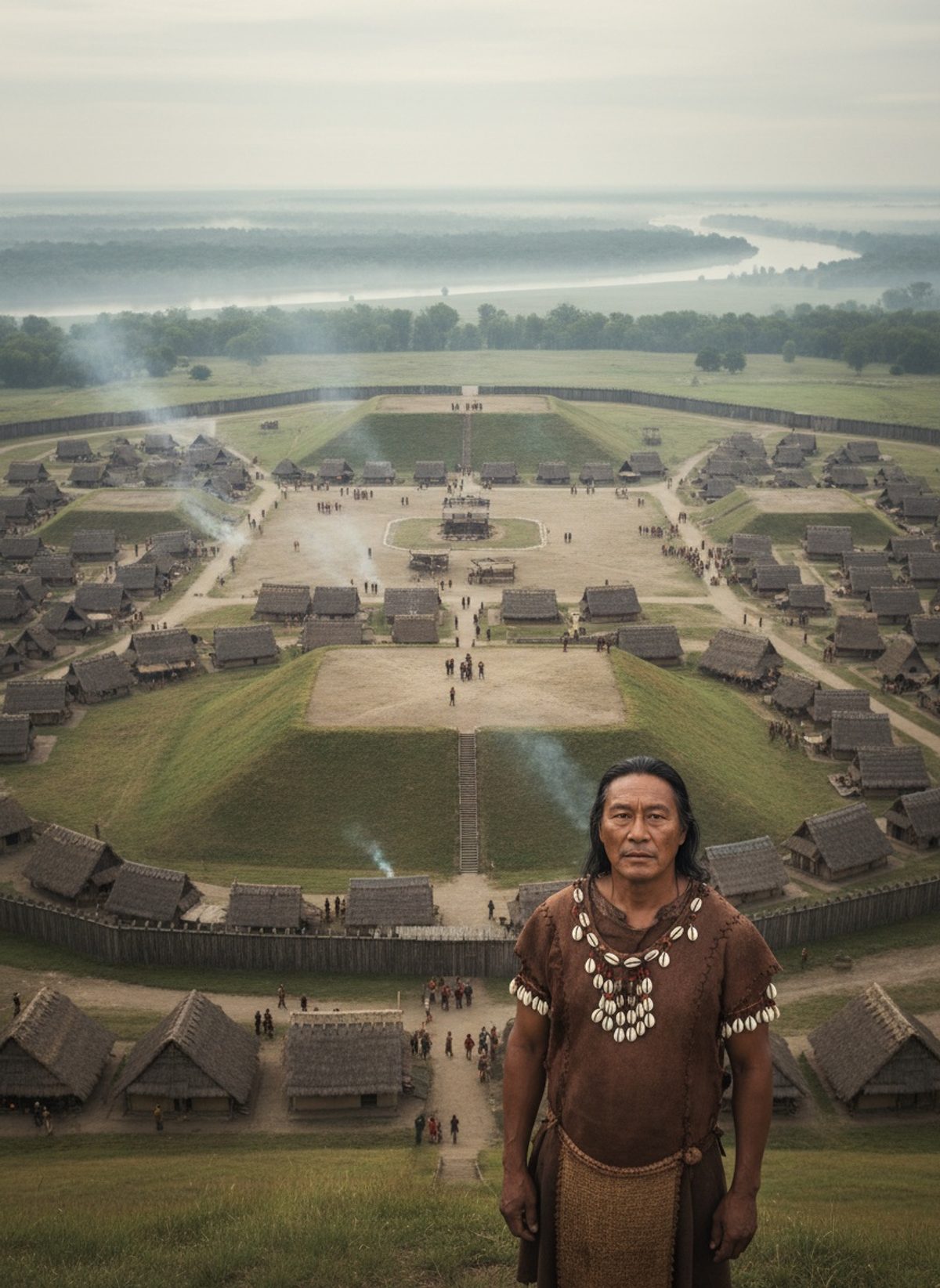
1050 AD. Smoke hung in the early morning air over a bustling city that would rise to become the largest urban settlement in pre-Columbian North America. On the eastern banks of the Mississippi River stood Cahokia, a vibrant hub of trade, culture, and innovation.
The Birth of a Metropolis
Just five centuries before Columbus set sail across the Atlantic, Cahokia began to flourish. Around 600 AD, during the Late Woodland period, settlers began to transform the fertile landscape. Their exertions were monumental, quite literally, as they embarked on creating colossal earthworks distinctive to the Mississippian culture. By 1050 AD, Cahokia was not just an important settlement; it was the nucleus of a sprawling network of trade and influence.
This city was strategically situated near the confluence of the Mississippi, Missouri, and Illinois Rivers. Such a location allowed Cahokia to become a trade node that reached beyond present-day American borders. Copper from the Great Lakes, shark teeth from far-off shores, and rare lightning whelk shells from the Gulf Coast all found their way into the burgeoning market plazas of Cahokia—each exchanging hands under the watchful gaze of city's leaders.
The most commanding structure of Cahokia was Monks Mound, an earthen pyramid that rose majestically over the surrounding landscape. At 100 feet tall, it was larger than the Pyramid of the Sun in Teotihuacan, standing as a testament to the city's ambition and its people's engineering prowess. Near it stood Woodhenge, a wooden circle akin to Stonehenge, likely used as a solar calendar, which highlights an intrinsic understanding of celestial patterns.
Read next: Skara Brae: A Stone Village Buried Under Sand for 4,500 Years
A Flourishing Society
Life in Cahokia was a sophisticated tapestry woven from trade, religion, and social stratification. At its zenith around 1100 AD, more than 15,000 residents called Cahokia home—by some estimates, as many as 20,000, making it larger than London at the time. This demographic coalescence pointed to an advanced urban culture.
Archaeological finds suggest that the Cahokians were not only skilled builders but also keen farmers and innovative artisans. Crops such as maize charmed the landscape, providing sustenance and facilitating upward social mobility. Cultivation practices refined over generations underscored a society intimately connected with its environment.
Furthermore, the pottery, tools, and artifacts found within Cahokia reveal a culture rich with iconography and spiritual life. Symbols found on pottery suggest a complex belief system, one that likely helped to unify and stabilize this cosmopolitan urban center.
The Unraveling of Cahokia
Yet, as swiftly as it rose, Cahokia began to decline. By 1200 AD, evidence points to a troubling shift. Populations started to dwindle and the tireless construction of mounds came to a halt. By 1350 AD, the city was largely deserted, leaving behind only remnants of its once-great civilization.
Archaeologists have posited several theories about the city's sudden departure. Climate shifts could have led to agricultural decline, making it difficult to sustain Cahokia's burgeoning population. Environmental degradation resulting from resource overexploitation is another possibility, as the demands of such a sizable society may have strained local ecosystems.
Read next: Tiwanaku: The City at 13,000 Feet That Fed a Million People
Moreover, social tensions and political strife could have played a role. As with many urban centers, Cahokia's diversity and size might have fostered internal conflicts. Without concrete evidence, the reason for Cahokia's demise remains shrouded in mystery, adding to its enigmatic legacy.
Preserving History in Earth and Memory
Although the city's voice has long since fallen silent, Cahokia is far from forgotten. The Cahokia Mounds now stand as one of the United States' most important archaeological sites—a National Historic Landmark and a UNESCO World Heritage Site. Covering 2,200 acres in Illinois, the area preserves the ingenuity and industriousness of its ancient inhabitants.
Today, Cahokia continues to capture the imagination of historians and visitors alike. It represents a cultural apogee that challenges our perceptions of pre-Columbian America, offering proof that indigenous civilizations forged grand cities and complex societies long before European colonization.
The story of Cahokia is a stark reminder of the fragility of human achievement and the cycles of rise and fall etched into the annals of history. It serves as both a mystery unsolved and as a testament to an American past as complex as any Old World counterpart.