Guo Shoujing might have been an unknown name to many. Yet, his astronomical feats reordered the very fabric of Chinese society.
When the Stars Fell Out of Line
For centuries, the skies had dictated the rhythm of life in China. The cycles of the moon and the changing constellations guided emperors, farmers, and scholars alike. Festivals timed to lunar phases punctuated the annually repeating sequence of work and rest, planting and harvest. But by the late 13th century, a creeping disruption unsettled this celestial harmony. Calendars, sacred tools of emperors, began predicting the cosmos with growing inaccuracy. Farmers sowed seeds on the wrong dates, only to watch crops wither. Misaligned festivals left communities confused. As the calendar faltered, so did the empire.
The astrologers’ failure had consequences that rippled through society, like a stone cast into a pond. Crops relied on correct timing. An incorrect date could mean the difference between abundance and famine. For a harvest-based society like Yuan Dynasty China, the stakes could not have been higher. Food shortages fueled discontent, and the long-standing tradition of harmonizing the calendar with cosmic cycles seemed broken. It was not just a technical inconvenience—it struck at the heart of imperial authority.
The Emperor's Call
In 1279 AD, the situation had reached a boiling point. Emperor Kublai Khan, the formidable ruler of the Yuan Dynasty, recognized the existential threat posed by this cosmic dissonance. The Chingren Khan, as Mongols called him, understood that an empire's strength lay partly in its ability to claim and maintain divine favor—and failing to control time itself was a damning failure of celestial mandate. A new solution was imperative, one that would restore order to the heavens and peace to the land.
Read next: Su Wu Was Given a Flock. He Refused to Kneel.
Enter Guo Shoujing, a scholar whose brilliance in the art of observational astronomy was unparalleled. A man of science amidst an ocean of beleaguered astrologers, Guo was tasked with an audacious challenge: to reinvent the calendar by measuring the sky directly. This mission would not only redefine timekeeping in China but would also transform how humans across the empire perceived their place beneath the stars.
Chasing Shadows Across the Empire
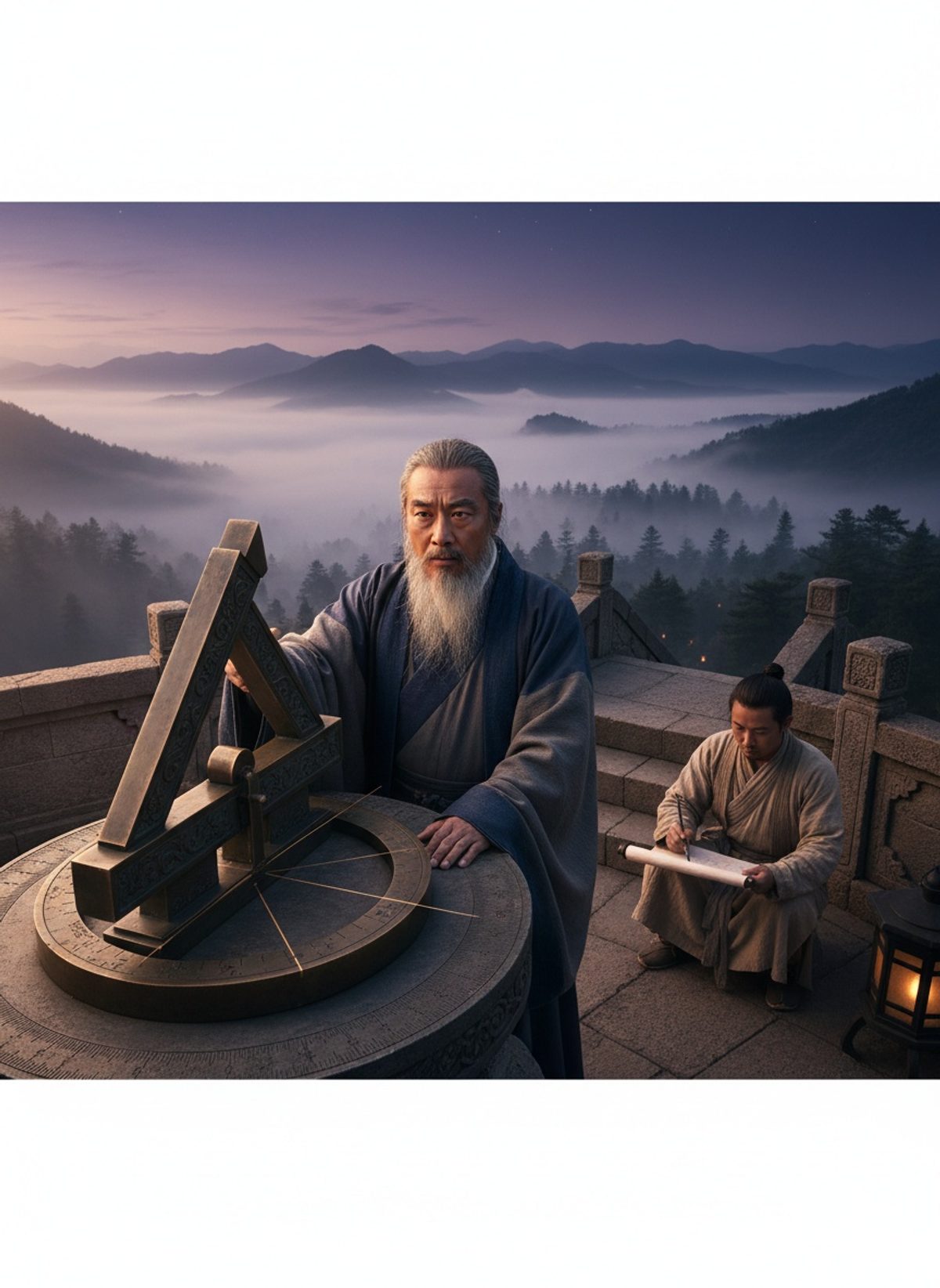
Guo Shoujing set out on a monumental journey that spanned the breadth of the Chinese empire. His quest was to establish a new, accurate calendar based on precise astronomical observations. Armed with an assortment of bronze instruments, Guo climbed twenty-seven carefully selected towers scattered across the vast landscape. From the bustling streets of Dadu—modern-day Beijing—to the remote towers in the countryside, Guo meticulously measured shadows cast by the sun, charted the movements of the stars, and observed lunar phases.
Each location, chosen for its strategic importance in capturing the multiplicity of celestial phenomena, became a node in a network of measurements. Above all, Guo sought to understand the interplay of time and space in a way never attempted before. By measuring sundials and latitudinal variances across these locations, he collected data that would underpin an enlightened reform of the calendar system. It was a feat of intellectual endurance, requiring both immense patience and mathematical prowess.
Rewriting Time
The result of Guo's labor was a calendar unlike any the world had seen. Dubbed the "Shoushi Li" or the 'Season Granting Calendar', it implemented revolutionary changes. Most notably, Guo Shoujing introduced a system that defined the solar year within a mere half-minute of its true length—a stunning feat accurate far beyond anything achieved before and would remain unsurpassed globally for the next three centuries.
This updated calendar scrapped many inaccuracies that had beset previous systems and aligned the solar and lunar cycles with unprecedented precision. It allowed not only for more accurate agricultural planning but also for the proper scheduling of important state rituals and festivals. For the Yuan Emperor, this new cosmic harmony was a testament to the dynasty's renewed mandate of heaven, fortifying his throne's legitimacy and fostering an era of stability.
Harmony Restored
With the successful implementation of the Shoushi Li, Guo Shoujing achieved more than just a technical milestone—he reaffirmed the critical importance of scientific inquiry in the practical governance of the realm. His work demonstrated a rare collaboration between empirical science and imperial power, where the observations of one man could stabilize an empire's assembly in the heavens and earth.
In many ways, Guo's work marked an early triumph of reason over stagnation, suggesting that even in times when politics and tradition seemed immovable, the human capacity for curiosity and innovation could forge paths to progress. By literally rewriting the stars and teaching an empire to follow, Guo Shoujing illuminated a pathway through which the measured understanding of our world orders societies and philosophies alike. It’s a poignant reminder that while empires may rise and fall, the pursuit of knowledge endures.