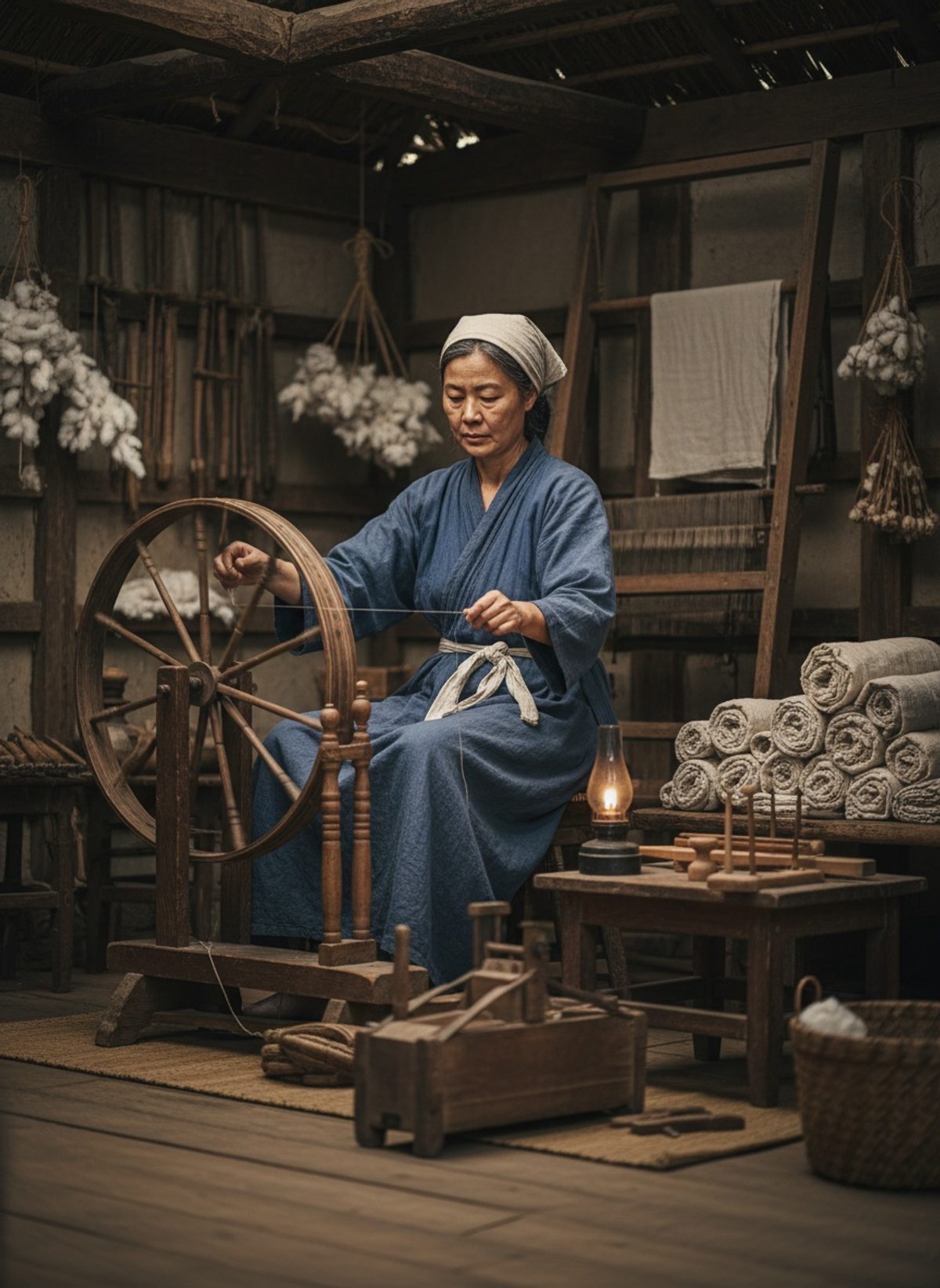
Huang Daopo's name might not ring a bell, but her contribution dressed an empire. Her hidden story, one of triumph and transformation that colored China's textile past, shaped the livelihoods of thousands.
The Journey from the South
Born around 1245 in the bustling region of Songjiang, near modern-day Shanghai, Huang Daopo's early life seemed destined for hardship. A young girl flung into an unwanted marriage, she escaped down the Huangpu River and boarded a ship to Hainan Island at the tender age of ten. This leap into the unknown was both an escape and a destiny interrupted.
In Yazhou, among the indigenous Li people of Hainan, Huang found not just refuge, but a purpose. The Li's mastery over cotton-spinning and weaving intrigued her, offering a stark contrast to her past trials. Embracing this new world, Huang spent nearly three decades absorbing the rich, intricate designs and methods that would become her own.
The Return and Revolution
Huang's return to Songjiang in 1295 was less a homecoming and more a catalyst for change. Her return carried an invisible trove of knowledge gleaned from her time in Hainan—innovative tools and techniques that would redefine an industry. At the heart of her impact were machines like fluffing machines, crushers, and particularly the three-spindle treadle-powered weaving looms, which multiplied efficiency with precision.
Read next: Trotula of Salerno Wrote the Book That Taught Europe Medicine
In Songjiang, the traditional manner of textile production was laborious and slow. Cottonseeds were removed by hand, painstakingly separating them from fluff. Huang's improvements to the ginning process, where the seeds were easily extracted, were nothing short of revolutionary. Using the advanced Jiaoche machine, her methods spun three threads simultaneously, tripling the output.
The Textile Renaissance
Songjiang's transformation was swift and profound. The region started producing not only abundant ordinary cloth but also exquisite mixed cotton and colored fabrics, employing techniques to mix warp and weft fibers. Huang's innovative weaving tools and techniques, such as the enhanced spinning wheel, practically eliminated the potential for yarn to snap, thus improving product quality tremendously.
Huang’s methods didn’t just alter production; they shifted societal norms. By empowering women with these efficient weaving technologies, she facilitated their ability to earn a living. This economic power augmented women's status both at home and in society, weaving a social fabric every bit as strong as the cotton from her looms.
Read next: Santorio Santorio Weighed Himself at Every Meal for 30 Years
Echoes Through Time
Huang Daopo’s influence lived beyond her lifetime. Her technology, celebrated as Wunijing, laid the foundation for a burgeoning textile industry. It served as the economic lifeblood of the Yangtze River Delta, bolstering trade and triggering a cultural renaissance. While Huang lived until around 1330, her real legacy was timeless, encapsulated in every spool of brilliantly spun cotton that emerged from Songjiang.
Today, she stands immortal in memory, marked by the Huang Daopo Memorial Hall in Shanghai's Botanical Garden, a testament with a 2.2-meter statue ensuring her contributions remain etched in history. Despite being nearly forgotten over the centuries, her invisible thread weaves through the very fabric of Chinese textile legacy.
She revealed how knowledge transfer among diverse cultures could spark innovation that reshapes industries and societies alike. In her woven patterns, the history speaks of resilience, showing that sometimes, it’s not what we carry in our hands, but the ideas in our minds that leave the greatest imprint.