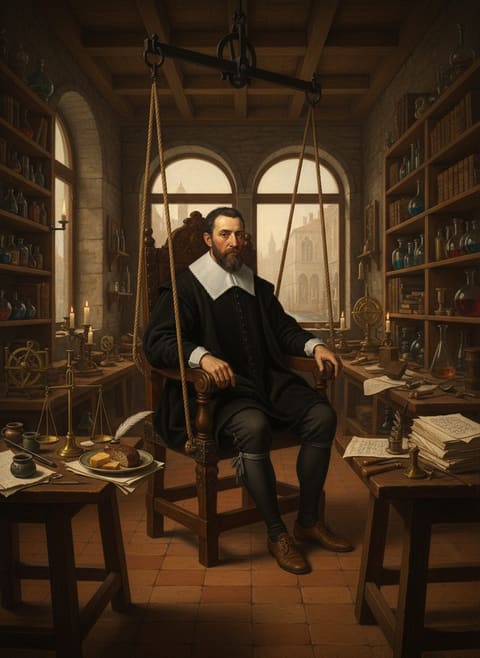
1576. A brisk wind swept across the island of Hven, rustling the leaves in a soft chorus. In the midst of this serene Nordic landscape, an ambitious construction project was underway that would reshape the cosmos itself. Here, Tycho Brahe, a Danish nobleman with an unwavering commitment to the study of the heavens, laid the foundation for Uraniborg, the greatest observatory of its time.
The Noble Astronomer’s Vision
Tycho Brahe, born into Danish nobility in 1546, stood out not just for his aristocratic background, but for his insatiable curiosity about the stars. At a time when the skies were still navigated by myth and conjecture, Tycho saw an opportunity for clarity—a quest to unravel the exact positions of celestial bodies by mere naked-eye observation.
His journey began under dramatic circumstances in 1572, when he observed a dazzling new star in the constellation Cassiopeia. Known today as supernova SN 1572, its unexpected brilliance contradicted the long-held Aristotelian belief in an unchanging universe. Tycho's dedicated observations revealed that this "stella nova" was far beyond any known planetary boundaries, setting a precedent that celestial events were neither fixed nor ephemeral as previously assumed.
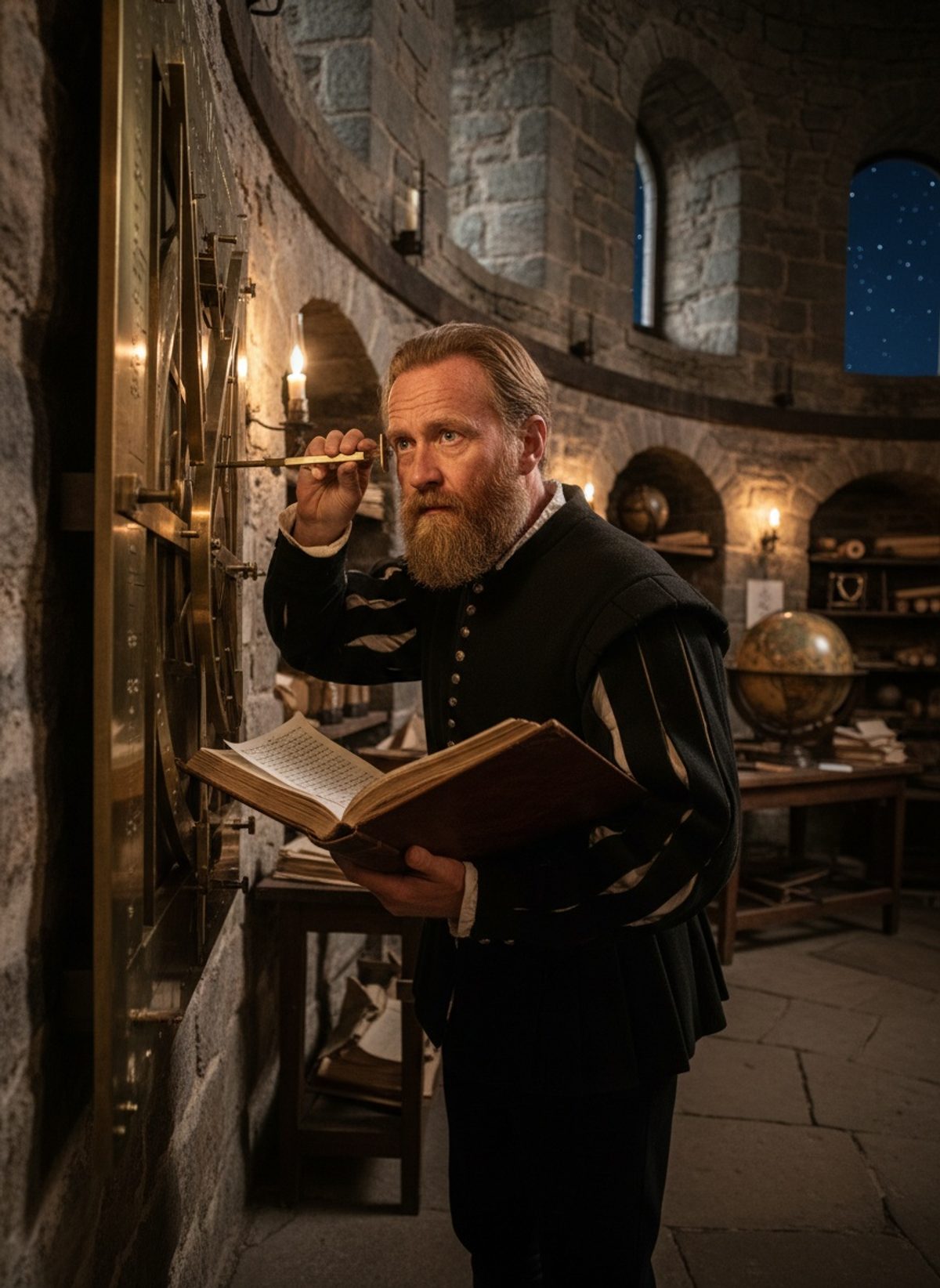
With backing from King Frederick II of Denmark, Tycho was granted the far-flung island of Hven. Here, he crafted a celestial palace, Uraniborg. Built with grandeur and precision, it housed the most accurate astronomical instruments of the age. His instruments included massive quadrants and armillary spheres, ingeniously crafted to minimize observational error. Tycho meticulously measured stellar positions, painstakingly noting the smallest of angular differences, with a precision at least ten times greater than his predecessors.
Read next: Huang Daopo Brought Cotton-Weaving Technology to China in 1295
But Tycho was not just an astronomer marooned in an ivory tower. His observations were public records, demonstrating that the heavens could be quantified and understood. His establishment of Uraniborg marked a profound shift, suggesting that science, not unbridled imagination, could map the uncharted skies.
The Silent Revolution of Stjerneborg
Uraniborg was more than an observatory—it was a community of scholars and craftsmen working in concert to advance the precision of celestial mapping. However, Tycho soon realized the limitations of his creations. The instruments, exposed to the elements atop Uraniborg, were swayed by even the slightest gusts, calling for innovative solutions.
Thus, Tycho descended underground to construct Stjerneborg, an observatory nestled into the earth for stability. Here, beneath layers of soil, Tycho devised mounted instruments shielded from the disturbances of wind and weather. This subterranean sanctuary secured his unparalleled accuracy, allowing him to refine his astronomical data to an unprecedented degree.
Though at a glance it seemed a modest adjunct to Uraniborg, Stjerneborg's contributions were monumental. It enabled Tycho to meticulously document stars and chart the paths of planets across the heavens. Each line in his observational journals told a story of tireless nights and the cold scrutiny of the cosmos, forging a bridge between mythic tales of celestial movements and their mathematical realities.
Over two decades, these observations would grow into a catalog of phenomenal detail, illustrating that even without the yet-to-be-born telescope, the universe could still be comprehended in striking clarity. His observational fortress, quiet and unassuming nestled below Hven's surface, laid the groundwork for a friendship that would eventually rewrite the textbooks—his collaboration with Johannes Kepler.
From Data to Discovery — Kepler’s Laws in Motion
In 1597, political tides shifted, and a discord with the new King, Christian IV, prompted Tycho to leave Denmark. He soon found a new patron in the Holy Roman Emperor Rudolf II, setting up his final study in Prague. There, he was joined by a promising mathematician, Johannes Kepler.
Tycho’s precisely amassed data awaited a theoretician’s touch, and Kepler was the right match. Despite their initial differences—Tycho being a nobleman and Kepler a commoner—their collaboration was fortuitous. Tycho’s detailed records provided Kepler with the raw material to formulate three groundbreaking laws of planetary motion, proving definitively that planets orbit the sun in ellipses, not circles.
Read next: Andreas Vesalius Dissected a Human Body and Rewrote Medicine
The implications of their work were transformative. It dismantled the long-standing Ptolemaic model, challenging not only scientific understanding but also philosophical and theological beliefs rooted in the celestial perfection of circles. Through Kepler, Tycho’s observations transcended their humble origins, becoming fundamental constructs in the architecture of modern astronomy.
Though Tycho passed away in 1601, just a year into their collaboration, his legacy endured. His ingenuity and commitment to empirical evidence fundamentally altered humanity's perspective on the cosmos. In a world soon to be dominated by telescopic revelations, Tycho Brahe, with his naked-eye brilliance, laid the cornerstone for a scientific rationale that dared to question and quantify the furthest reaches of space.
Tycho Brahe's life transcends that of a noble astronomer tinkering with celestial maps. It illuminates a time when the night sky held secrets finally within reach, unlocked not by advanced instruments or technology, but by human perseverance, intellect, and a vision unclouded by the confines of conventional wisdom.
Such celestial insights turned the page in the history of science, setting the stage for the adroit calculations and cosmic dialogs that followed, leading us ever closer to understanding our place in the universe.