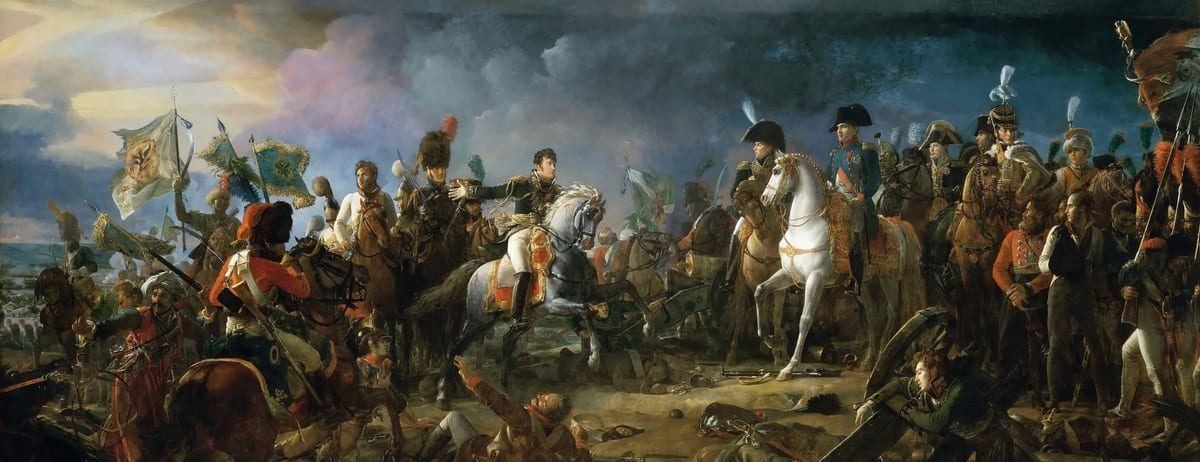
On 2 December 1805, in the country west of Austerlitz in Moravia, Napoleon defeated a combined Austrian and Russian army. The village is now Slavkov u Brna, in the Czech Republic. The fight was known at the time as the Battle of the Three Emperors, after the three monarchs present on the field: Napoleon, Tsar Alexander of Russia, and the Emperor Francis.
The Emperor Francis was Francis II, Holy Roman Emperor, who later signed the Peace of Pressburg.
It fell a year to the day after Napoleon's coronation. On 2 December 1804, at Notre-Dame in Paris, he crowned himself Emperor of the French.
The plan on the Pratzen Heights
The most important fighting, according to the 1911 Britannica, was on the Pratzen plateau. Napoleon fell back before the allied advance from Olmütz, now Olomouc, and took up a position west of the Goldbach stream. The allies formed to the east of the heights.
Read next: Washington Died. His Enemies Mourned Him Loudest.
The 1911 account records his own words on the eve of the battle: "Whilst they march to turn my right, they present me their flank."
Modern accounts describe him as abandoning the dominant heights and weakening his right, in order to draw the allies into an attack there. The New International Encyclopaedia, published in 1905, gives the same design: he would let the enemy gain a temporary success against his right, then break their weakened centre.
The allied plan, drawn up by the Austrian general Weyrother, was to attack Napoleon's right and cut him off from Vienna. Before dawn on 2 December the first columns moved down from their bivouacs behind the Pratzen plateau towards Telnitz and Sokolnitz.
The counterstroke
Davout's corps arrived on the field late on the night of 1 December, after a heavy march from Vienna. With a division of Soult's corps it held the French right, on ground the 1911 Britannica describes as marshy and full of obstacles. The contest there was long and doubtful. Meanwhile Soult's corps struck the Pratzen Heights, against the allied centre.
Historians do not agree on the exact size of the two armies, or on the number of dead and wounded. The New International Encyclopaedia, published in 1905, gives about 84,000 allies against 70,000 French. Those figures are given here only as one account, not as a settled count.
Read next: He Had No Orders. He Charged Anyway. Britain Won.
Later stories of Russian troops drowned when French guns broke the ice on ponds south of the field appear in some older accounts. Sources differ on what happened there, and the 1911 Britannica notes that the famous lakes were artificial ponds, later drained. This article does not treat the drowning story as a fact.
Peace at Pressburg
On 26 December 1805 France and Austria signed the Peace of Pressburg (Presburg in the 1911 spelling; the town is now Bratislava). Austria left the war and the Third Coalition. By the treaty Austria was compelled to recognise the recent changes in Italy, and to cede Venetia, Istria and Dalmatia to the new kingdom of Italy.
The Swabian lands of the Habsburgs went to Napoleon's South German allies, and Bavaria received Tyrol and Vorarlberg. The 1911 Britannica says the results led up to a new cycle of wars. Later accounts also hold that the settlement did not establish a lasting peace on the continent.
The painting with this article is François Gérard's The Battle of Austerlitz, 2 December 1805, completed in 1810 and now at the Palace of Versailles. It is a later studio picture, not a sketch made on the field, and is in the public domain.