On 1 December 1420, King Henry V of England rode into Paris beside King Charles VI of France and the Duke of Burgundy. He did not enter as a guest. Under a treaty sealed that May at Troyes, he was named heir to the French crown, and regent while Charles still lived. The date comes from the Journal d'un Bourgeois de Paris, and is used by the Dictionary of National Biography.
Henry had been King of England since 1413. On 25 October 1415, at Agincourt, he won the battle that Westminster Abbey records as falling on St Crispin's Day. In the years that followed he took much of Normandy. That conquest, and the alliance with Burgundy, made the settlement at Troyes possible.
The treaty at Troyes
Henry reached Troyes on 20 May 1420 with his brothers, the Dukes of Clarence and Gloucester, and, according to the Dictionary of National Biography, a force of seven thousand men. The treaty was formally ratified the next day, 21 May. By its terms he was recognised as heir to the French kingdom on the death of Charles VI, and as regent during the king's life.
He was to govern with the aid of a council of natives, and to preserve the ancient customs of France. Normandy was to remain in his sovereignty until he inherited the French throne, when it would be rejoined to France.
Read next: Joe Simpson Crawled Five Miles to Camp on a Shattered Leg
During Charles's lifetime his title was to be King of England and Heir of France, in the Latin of the treaty, Henricus rex Angliae et haeres Franciae. The treaty disinherited Charles's son, the Dauphin Charles. His party did not accept it.
Henry and Catherine of Valois were married at Troyes on 2 June 1420, a date given by Westminster Abbey. The war did not end with the wedding. Melun, which still held for the Dauphin, resisted until 18 November.
Into Paris, and home again
Henry then joined the French court at Corbeil, and on 1 December entered Paris in triumph, accompanied by Charles and Burgundy. In the days that followed, the French estates met in the city. The Dictionary of National Biography says the treaty was publicly ratified before them, and Henry was acknowledged as heir.
He kept Christmas at the Louvre in great state, and on 27 December left with his queen for England, after an urgent request from the English commons.
Read next: Blood Swept Lands: 888,246 Poppies Filled the Tower of London's Moat
Heir, but never king of France
Henry never wore the crown of France. He died at Vincennes on 31 August 1422, still only the heir, as Westminster Abbey records. His body was embalmed and, after resting for a time in Rouen Cathedral, was brought back to England for burial at Westminster Abbey.
Charles VI died in Paris on 21 October 1422, a date given in the 1911 Encyclopaedia Britannica. Henry's infant son, Henry VI, became King of England and, under the treaty, was also to be King of France. The Dauphin also claimed the throne, and was later crowned as Charles VII. In the later stages of the Hundred Years' War that arrangement fell apart.
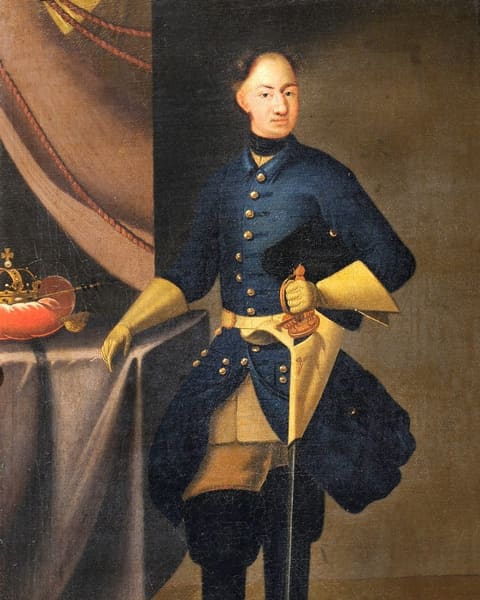
The portrait of Henry V now in the National Portrait Gallery in London was painted in the late sixteenth or early seventeenth century. It is a later likeness, not a picture from life. It is, all the same, the face later generations came to know.