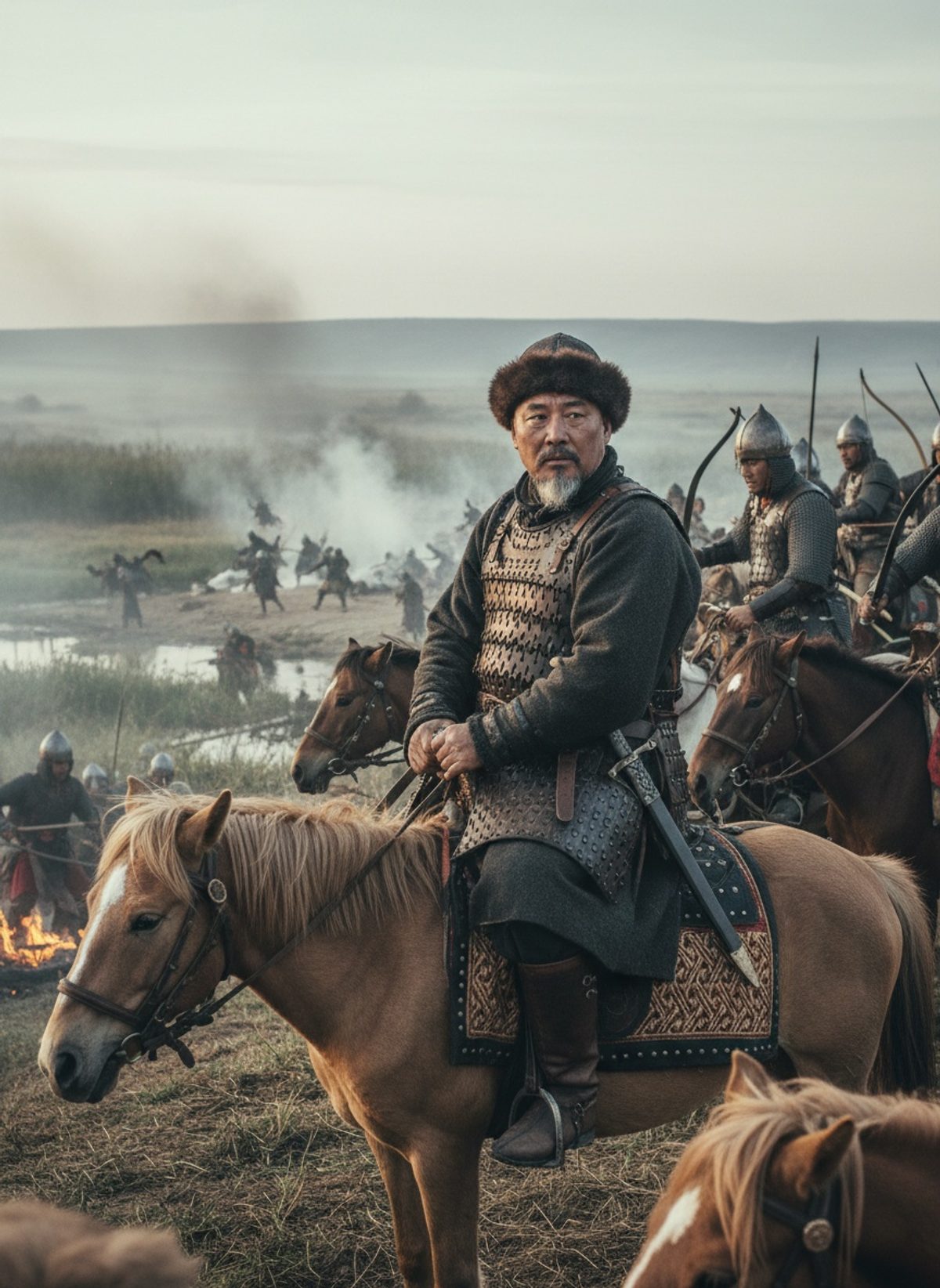
The dawn light crept over the rolling plains of Hungary, caressing the tents and the dormant forms of soldiers at the Sajó River. The air was thick with the scent of morning dew, and a cacophony of bird song filled the chilled, still air.
The quiet, almost serene atmosphere belied the tension simmering beneath the surface, for the land was simmering on the precipice of violence. Unbeknownst to the Hungarian knights resting fitfully in their tents, the seasoned Mongol general Subutai was orchestrating a masterstroke of military strategy from hundreds of miles away, dictating plans that would bring devastation upon the finest cavalry in Christendom.
The Unforgiving Mastermind
Subutai, the formidable strategist who served under Genghis Khan and Ögedei Khan, was a mastermind like no other. Born around 1175 near the upper Onon River, he rose from modest beginnings—allegedly the son of a blacksmith—to become a key architect of the Mongol Empire's military prowess.
Renowned for his ability to coordinate army movements over vast distances, Subutai played a pivotal role in expanding the empire's borders. It was a feat that required not just military acumen but also a deep understanding of terrain, politics, and human psychology.
Read next: Yi Sun-sin Built a Turtle Ship and Broke Japan's Armada
By the spring of 1241, European armies, blissfully ignorant of the genius maneuvering behind the Mongol onslaught, assumed these nomadic invaders were nothing more than a scattered horde of warriors. They had yet to grasp that the seemingly disjointed Mongol forces were operating under a single, cohesive plan meticulously crafted by Subutai.
This strategic oversight would soon lead to their undoing at the Sajó River, where the Hungarian army, numbering around 70,000 strong, was fated to stand against the formidable might of the Mongol military machine.
While Europe slept, thinking its walls impenetrable and armies invincible, Subutai had been hard at work, mapping every trail, ford, and potential escape route. It was a testament to the intelligence networks he had established and the precise information he commanded, skillfully applying this knowledge to devastating effect. His ability to foresee the ebb and flow of battle, to place his forces in optimum positions, and to sow confusion and fear would soon resonate through the plains of Hungary.
The Battle Unfolds
On the morning of April 11, 1241, as the Hungarian forces positioned themselves along the Sajó River, the Mongol army, under Subutai's direction, began to execute the battle plan that had been weeks, if not months, in the making. The Hungarians, led by King Béla IV, perhaps underestimated the prowess of their foes—an oversight that would cost them dearly.
By dawn, the Mongol forces had expertly maneuvered around the plain, executing a flanking move that encircled the Hungarian camp. The silent efficiency with which they moved, combined with their mastery of archery on horseback, sowed panic among the European ranks.
As the sun climbed higher, casting long shadows on the battlefield, the Mongols unleashed a barrage of arrows, which fell like deadly rain upon the Hungarian knights. The Europeans, clad in heavy armor and unaccustomed to the speed and mobility of their adversaries, struggled to adapt. The previously serene riverbanks now echoed with the sounds of clashing metal, the cries of wounded horses, and the shouted orders of frantic men trying to mount a defense.
The meticulously planned encirclement tightened further, leaving the Hungarians with little room to maneuver. At this moment, the Mongols' true mastery of warfare became painfully clear. Utilizing a pincer movement, they split their forces, creating confusion and preventing any organized retreat. Subutai's foresight, executed with devastating precision by his generals on the ground, ensured that the Hungarian forces were outmatched and outmaneuvered at every turn.
Read next: Epaminondas Broke Sparta's Phalanx With a Diagonal Line
A Legacy Etched in Blood
The Battle of Mohi, as it would come to be known, culminated in a decisive Mongol victory. The strategically engineered conflict resulted in fewer than half of the original Hungarian forces escaping, leaving the victorious Mongol troops to sweep through Eastern Europe virtually unchallenged in the aftermath. Despite the staggering loss, the battle was an important lesson in military tactics, emphasizing the importance of intelligence, preparation, and the often-underestimated power of strategic planning.
Subutai's role in orchestrating the victory from afar marked him as not just a formidable general but an innovator of military strategy. He had demonstrated that victory could indeed be secured long before the first arrow was loosed or the first blade crossed. His ability to plan from a distance, to envision the workings of a battle like a chessboard stretching across the vast European plains, set him apart from his contemporaries and ensures his lasting legacy.
Why does this story of strategy and conquest from so long ago matter today? It serves as a reminder of the power of foresight, the strength of intelligence, and the importance of detailed planning. In an age of ever-increasing technological advancements and shifting global dynamics, these lessons maintain their relevance.
Subutai's genius at the Battle of Mohi reminds us that even the mightiest armies can be undone by an unseen hand crafting their fate from afar. It's a story of strategy overpowering brute force, a testament to human ingenuity that echoes across the ages.