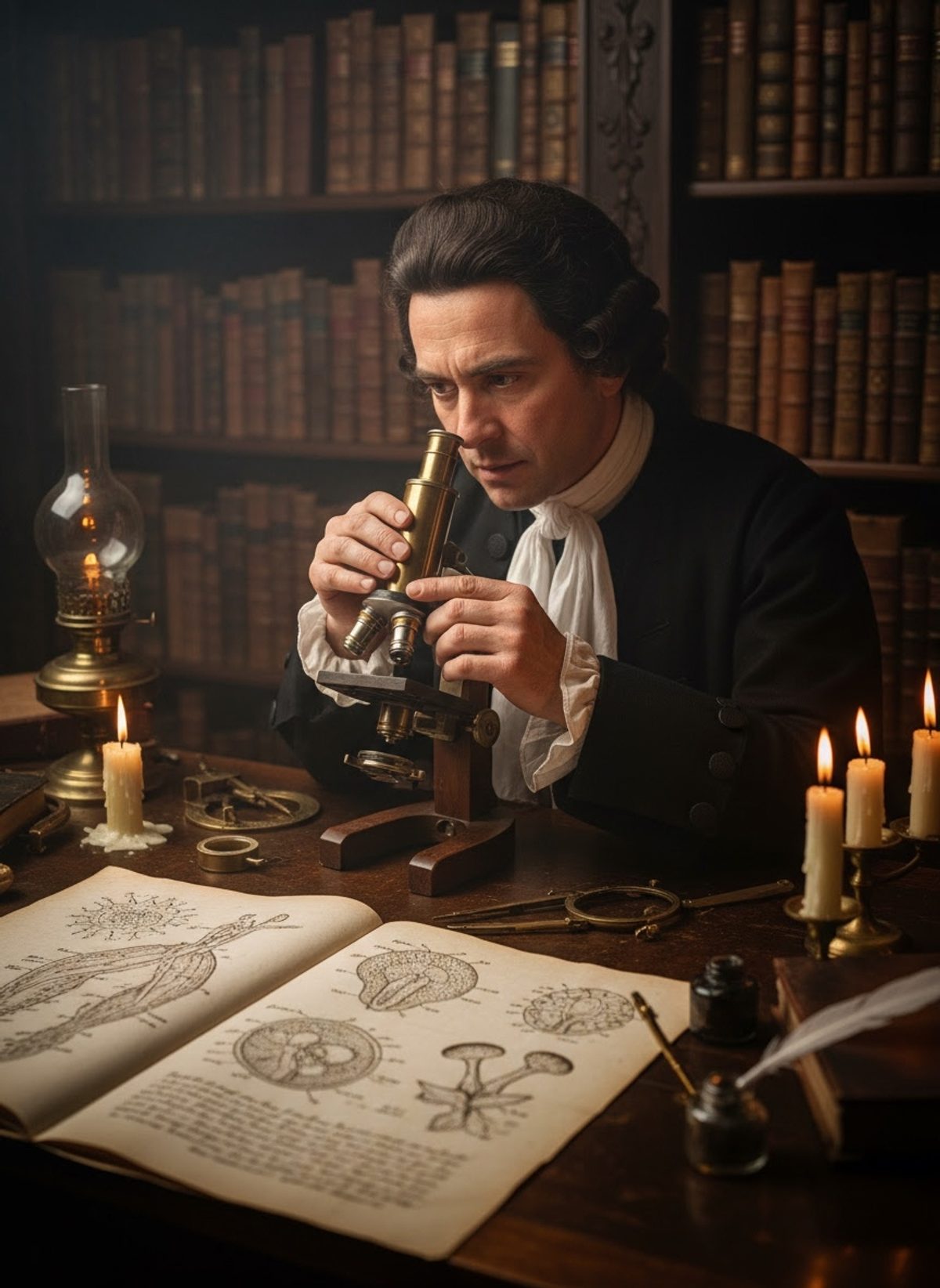
A flickering candle struggled against the cold draft seeping through the small London office. Nehemiah Grew squinted through the eyepiece of his rudimentary compound microscope, his breath barely visible in the dim light. As he inched the lens into focus, a new world burst into view.
Instead of a solid green blur, there were tiny, intricate chambers neatly stacked like bricks in a wall. Carefully, moved by the moment, Grew sketched the intricate architecture in front of him. What he saw beneath the glass heralded the birth of plant anatomy: the simple yet profound discovery of the cell.
The Curiosity of Nehemiah Grew
Long before he peered into the peculiar architecture of flora, Nehemiah Grew's path was shaped by a dedication to science that was unique among his peers. Born in 1641, by the time he reached adulthood, England was a veritable hub of scientific inquiry and innovation.
Influenced by the likes of Robert Hooke, whose own observations of cells came just a few years earlier, Grew saw an opportunity to expand the window into the plant kingdom. While others pondered grand theories, he found himself enamored by the minute, the details invisible to the naked eye.
Read next: Al-Idrisi Drew the World's Most Accurate Map in 1154
Armed with a modest compound microscope and an unquenchable curiosity, Grew embarked on an ambitious mission to map the unseen architecture of common plants. In the glow of candlelight that illuminated his London study, he dissected and studied plant stems with precision. It wasn't just about observation; Grew meticulously documented his findings in incredible detail. His drawings, painstakingly created by hand, mirrored the natural beauty and complexity hidden within leaves and branches.
Published in 1682 in his seminal work, Anatomy of Plants, these illustrations provided an unparalleled view of the natural world. They revealed the cellular network of plants so vividly depicted that they remained unmatched in accuracy and detail for nearly a century. For Grew, who wrote extensively about the parallels between plants and animals, it wasn’t just a new scientific understanding. It was an exploration of how nature’s designs echoed a grand, universal architecture.
The World Under the Microscope
The transformative discoveries bubbling out of 17th-century Europe were rooted in meticulous observation, and Grew's work was no exception. His revelations about plant cells stemmed from a dogged pursuit of understanding through hands-on exploration. He pioneered an observational technique that required both patience and precision, slicing stems into wafer-thin sections just so they could fit under the diminutive lens of his microscope.
Once there, these seemingly mundane bits of nature unveiled their secrets. Grew peered into them and saw, not mere organic matter, but a complex web of life, each cell an architectural wonder.
His detailed observations on how cells formed the very essence of plant life laid the groundwork for what would later become the field of plant physiology. Moreover, the term “cell,” originally denoting these enclosed, chamber-like structures, was likely both a literal and metaphorical playground for Grew, drawing parallels to monastic cells he knew from religious studies.
In addition to contributing to the taxonomy of plant structures, Grew proposed that flowers, with their intricate designs and systems, were the sexual organs of plants. This challenged long-held beliefs and would later influence prominent botanists like Carl Linnaeus. But for now, in his small, solitary world beneath the microscope, Grew was unraveling the mysteries of life through one tiny cell at a time.
Read next: Mary Anning Found an Ichthyosaur Skull at Age 12 in 1811
The Legacy of a Revolutionary Vision
Nehemiah Grew's work quietly but significantly reshaped botanical science. By sketching these cellular formations, he illuminated a path for future scientists to tread upon — a path that led to an understanding of the microscopic world as we understand it today. A century after his groundbreaking work, figures across the Enlightenment acknowledged his foundational contributions to what would become modern cell theory and plant biology.
Yet, Grew himself remained largely a ghost outside scientific circles, with his name seldom gracing general discussions about the history of science. Much like the cells he defined, his work formed the unseen framework of botanical knowledge. His quiet revelations offered answers to questions no one had thought to ask and posed new mysteries yet unexplored.
In a world teetering on the cusp of the scientific revolution, Grew's work was a beacon of knowledge in the still-dark corners of the unknown. Now, in an age where microscopy and cellular biology propel us to frontiers unimaginable in his time, Grew’s sketches remind us of the humble beginnings from which great scientific truths emerge.
His story stands not as a mere footnote in dusty tomes but as an exemplar of curiosity, patience, and the profound impact one person can make by choosing to look closer and wonder why.