
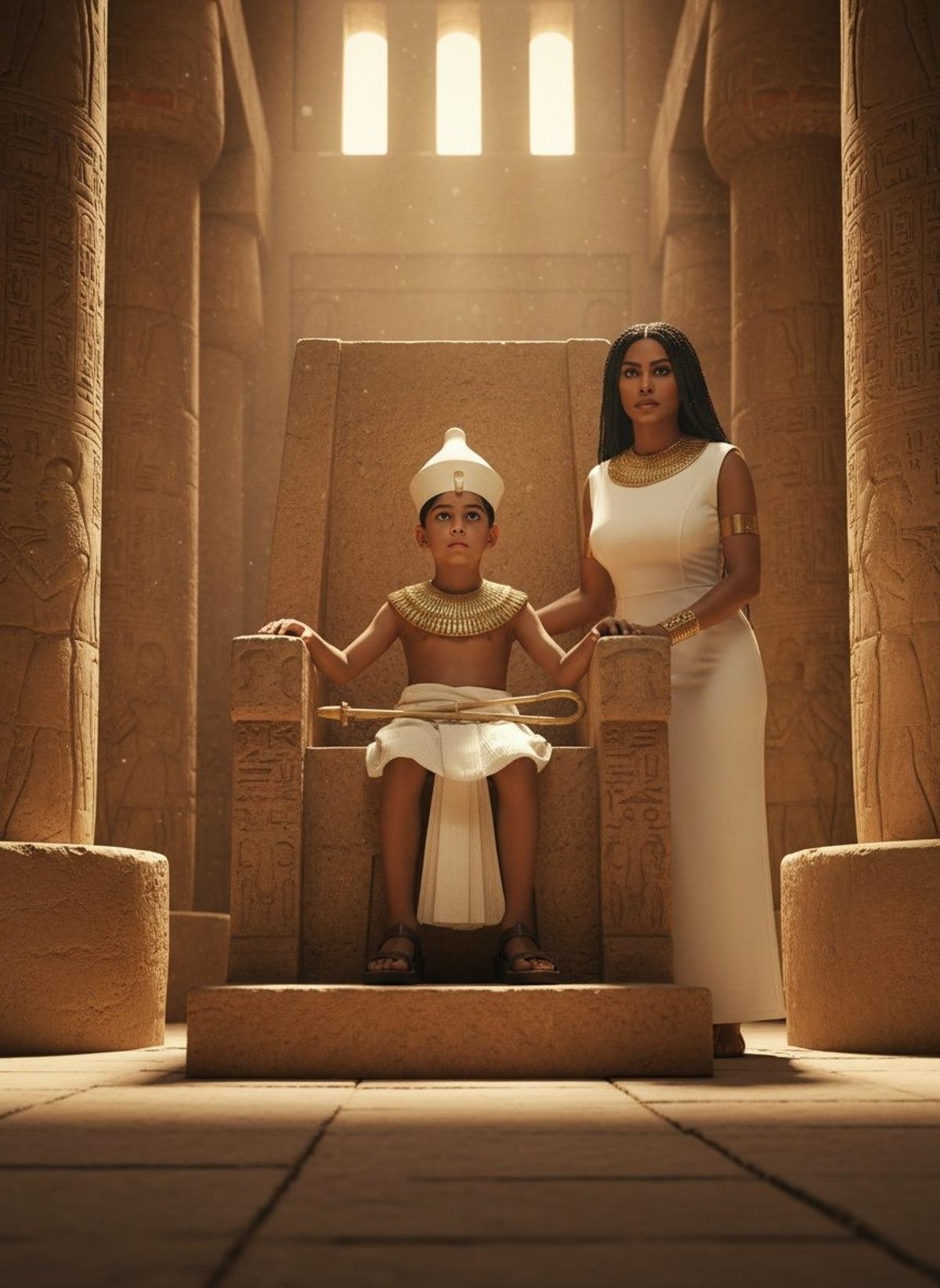
The air was thick with anticipation under a cloudless Egyptian sky, the sun casting its relentless glare across the opulent sandstone architecture of Memphis. The scent of incense mingled with the dust from the gathered crowd, their wide eyes focused intently on the royal dais. A hush fell over the assembly as the sacred double crown was carefully placed upon the head of a child, no older than six. His small frame seemed almost engulfed by the regal garments. Yet, young Pepi II sat tall, staring down at the sea of his new subjects, the future of an empire resting on his tiny shoulders.
In that pivotal moment, as the Nile lazily meandered beyond the palace corridors, its ancient waters whispering secrets of rulers past, Egypt entered a new chapter. It was an age both unprecedented in its abundance and bewildering in its challenges. The death of Pharaoh Merenre I had brought the unexpected coronation of his son, and with it, the uncertainties of a kingdom led by a child. It seemed implausible that the reign commencing under such juvenile eyes would stretch into the twilight of one of the longest chapters in the annals of human history.
Pepi II's ascent was shrouded in the warmth and protective embrace of his mother, Queen Ankhesenpepi II, whose role as regent was both maternal and political. In his formative years, as the sconces flickered across the stone-carved walls of the palace, it was her decree that guided the ebb and flow of governmental affairs. Rank and file ministers, seasoned by years of service, preserved continuity as the young pharaoh’s education endeavored to catch pace with the vast tapestry of governance unfurling before him.
The Sixth Dynasty of Egypt, with Memphis as its pulsating heart, was an era that rode on the crest of monumental architectural endeavors and administrative innovation. Under Pepi's juvenile reign, the land maintained its adherence to the astonishing scale of pyramid-building, each stone a testament to both the ambition and the devout spirituality that marked Ancient Egyptian society. The pyramids stood as silent sentinels, watching over the evolving landscape that mirrored the young king’s journey from a child to a ruler.
Read next: Sennefer Walked Into the Tomb. He Left a Garden.
But the passage of time, stones, and sands shifted in both rise and fall. As Pepi matured, so too did his grasp on the complexities of leadership. The pharaoh embodied the divine connection between the gods and the mortal realm, a belief as ingrained as the mud-brick temples that dotted the Nile's fertile banks. His decision-making now reflected a growing understanding of diplomacy and social harmony as he balanced powers and placated regional leaders.
Throughout his unprecedented ninety-four-year reign, the sun rose and set over Egypt a staggering 34,310 times, marking the sovereign's longevity as both a blessing and a harbinger of eventual decline. Beyond Memphis, the first stirrings of unrest began to rumble, the ancient equivalent of modern geopolitical shifts that would sow seeds of future discord. Droughts and pressured agricultural cycles highlighted an overreliance on centralized administration at a time when the kingdom's once-formidable wealth began to exhibit signs of strain.
Nonetheless, Pepi's extended rule fostered periods of remarkable stability, allowing culture and the arts to flourish. The coronation anniversary celebrations became a grand affair of music and reverie, intended both as homage to the pharaoh and a reminder of his uninterrupted reign. Combined with an era that saw relative peace with neighboring Nubian lands, this longevity also engendered a unique societal rhythm dictated by the predictable will of one ruler.
By the time the Pharaoh Pepi II, now a venerable fixture of Egyptian life, neared his own sunset, the kingdom he shepherded was teetering, its foundations weakening under the weight of internal fractures and the inexorable turn of historical cycles. His death marked the conclusion of Egypt’s Old Kingdom, a time colloquially known as the "Age of the Pyramids." The years that followed his death brought discord and fragmentation, as regional governors grew in power and esteem, their authority long overshadowed by Pepi's enduring presence.
Pepi II's formidable reign, remarkable for its unrivaled length, carries reverberations that echo through history. It serves as an unforgettable vestige of ephemeral balance—an epoch when unity and fragmentation danced in tandem beneath a relentless sun, each shaping a nation's destiny within mighty empires and the whispered stories enshrined in stone. Such is the paradox of history: an enduring reminder that even the mightiest reigns are bound by time, tasked with shaping a legacy that outstrips mere rule. Pepi II’s story is an odyssey through time, a narrative of a child king whose long journey from innocence to antiquity remains etched in the grand narrative of human endeavor.