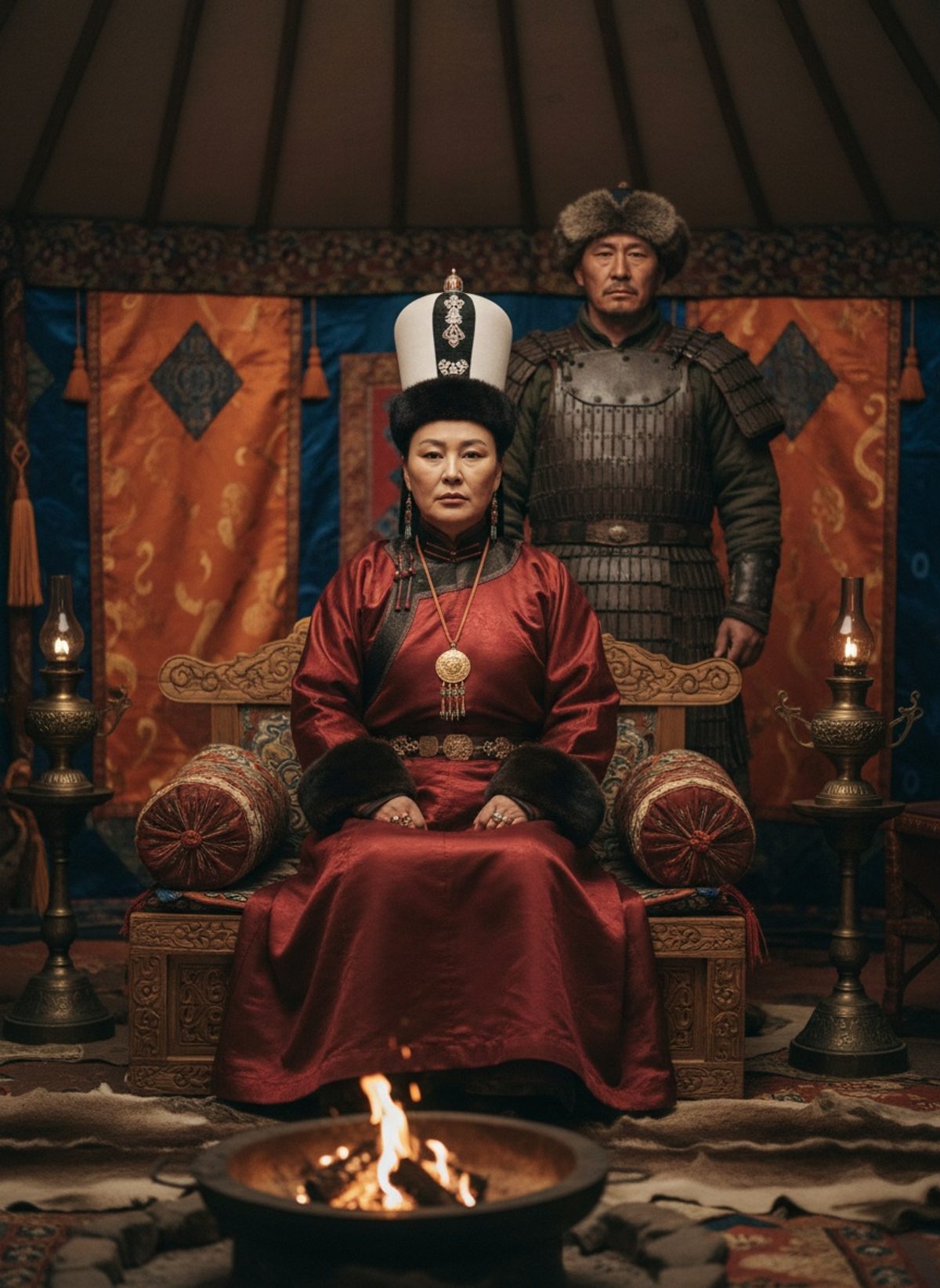
The air was crisp in the Central Asian steppes of 1260, with the cold wind sweeping across the plains to carry whispers of ambition and deceit. Under the vast, endless sky, tents dotted the landscape, filled with warriors whose eyes never strayed far from the horizon or the dagger at their waist. It was a land where power shifted like the sands beneath the horses' hooves, and survival belonged to those who could outwit their foes and wield influence from the shadows. Within the heart of this tumultuous realm stood the tent of Sorghaghtani Beki, a woman seemingly outside the siege of power, yet who navigated the storm with unparalleled savvy. Against all odds, this widow of a once-great khan crafted a destiny for her sons amidst warlords eager to see her fall.
The Woman Behind the Veil of Power
In the male-dominated world of the Mongol Empire, where might often outplayed strategy, Sorghaghtani Beki emerged as an adept tactician whose influence transcended the traditional confines of gender. When her husband, Tolui, passed away, most would have expected her to retreat into obscurity. But Sorghaghtani did not fade; she wove her identity into the very fabric of the empire’s future. Her grace was a façade, her intellect her weapon. She spoke multiple languages and understood the nuances of political survival, tutoring her sons not just in warfare but in governance, philosophy, and the art of leadership. Sorghaghtani’s presence in the court was like the subtle wind: invisible but always felt.
Her influence was profound, yet she didn’t seek the throne for herself. Instead, she prepared her sons—Möngke, Kublai, Hulagu, and Ariq Böke—for positions that would eventually tether the fate of multiple continents to their ambitions. She selected their tutors with an acumen that ensured each son's education was a potent blend of military prowess and intellectual breadth, cultivating leaders rather than conquerors.
The Politics of Survival
Among the Mongol aristocracy, life was a dangerous game of chess where the pieces were living beings, often sacrifices on the altar of power. Sorghaghtani played this game with an unmatched strategy. She formed alliances not through marriage, but by fostering loyalty and respect. Key allies sprang from unexpected quarters, as she leveraged her own status and insight to form alliances that would safeguard her sons from rivals thirsting for control.
Read next: Ibn Fadlan Stood Before the Viking Chief. He Wrote It Down.
Rumors of her sons being potential threats could have sparked their demise in an empire fraught with familial betrayals. Yet, Sorghaghtani maneuvered the political labyrinth with quiet precision. Her alliance with Batu Khan, a pivotal figure on the western fringe of the Mongol territories, was testament to her foresight. This connection not only protected her family but also amassed an army of supporters ready to follow her sons.
The Dawn of a New Mongol Order
Amidst the dissolution of old power structures in 1260, Sorghaghtani’s vision for her sons began to materialize. Möngke ascended as the Great Khan, a position that rehabilitated the Mongol Empire’s fractured authority. Under his reign, and that of his siblings, the empire adapted and expanded, renewing the might that once extended from Korea to Eastern Europe.
Kublai, with his astute balance of Eastern philosophies and Western military tactics, carved out his dominion in what is now China. His administrative prowess laid the groundwork for what would later become the Yuan Dynasty, profoundly impacting Chinese history. Meanwhile, Hulagu led campaigns that forever altered the Middle Eastern landscape, shifting the power dynamics of the Islamic world.
Their quests were not merely expansionist but transformative, setting the stage for a Mongol era defined by trade, cultural exchanges, and unprecedented interactions between distant civilizations. Each brother carried with him the legacy of their mother’s wisdom, tempering their expansion with the governance and cultural assimilation that Sorghaghtani had dreamt of in their upbringing.
Whispers of The Forgotten Queen
Though her sons’ conquests reverberate through history, Sorghaghtani Beki’s name is barely echoed in the annals of time. It is as though history chose to veil her achievements behind the more illustrious deeds of her progeny. Yet, her mark on history is indelible, sketched not through battles won but through the foundation she built in her children's reigns.
Her story is one of strategic humility and unparalleled foresight, a reminder of the often unrecorded influence that women wielded behind Mongol greatness. Sorghaghtani’s ability to transcend the limitations imposed by her era redefined the power dynamics traditionally observed in warrior societies. Her role as a mother and influencer in one of history's largest empires may not be carved in stone, but it is deeply etched in the transformation of an empire from a collection of warring tribes into a beacon of medieval prowess.
Although the winds of the steppes have long since erased her footprints, Sorghaghtani Beki’s legacy persists—a testament to the sophisticated intersection of intelligence, power, and maternal ambition. Her talent for orchestrating an empire’s future from behind the curtains reminds us that history's curtain-raisers often stand quietly in the wings, yet command the drama that unfolds on its grandest stages.