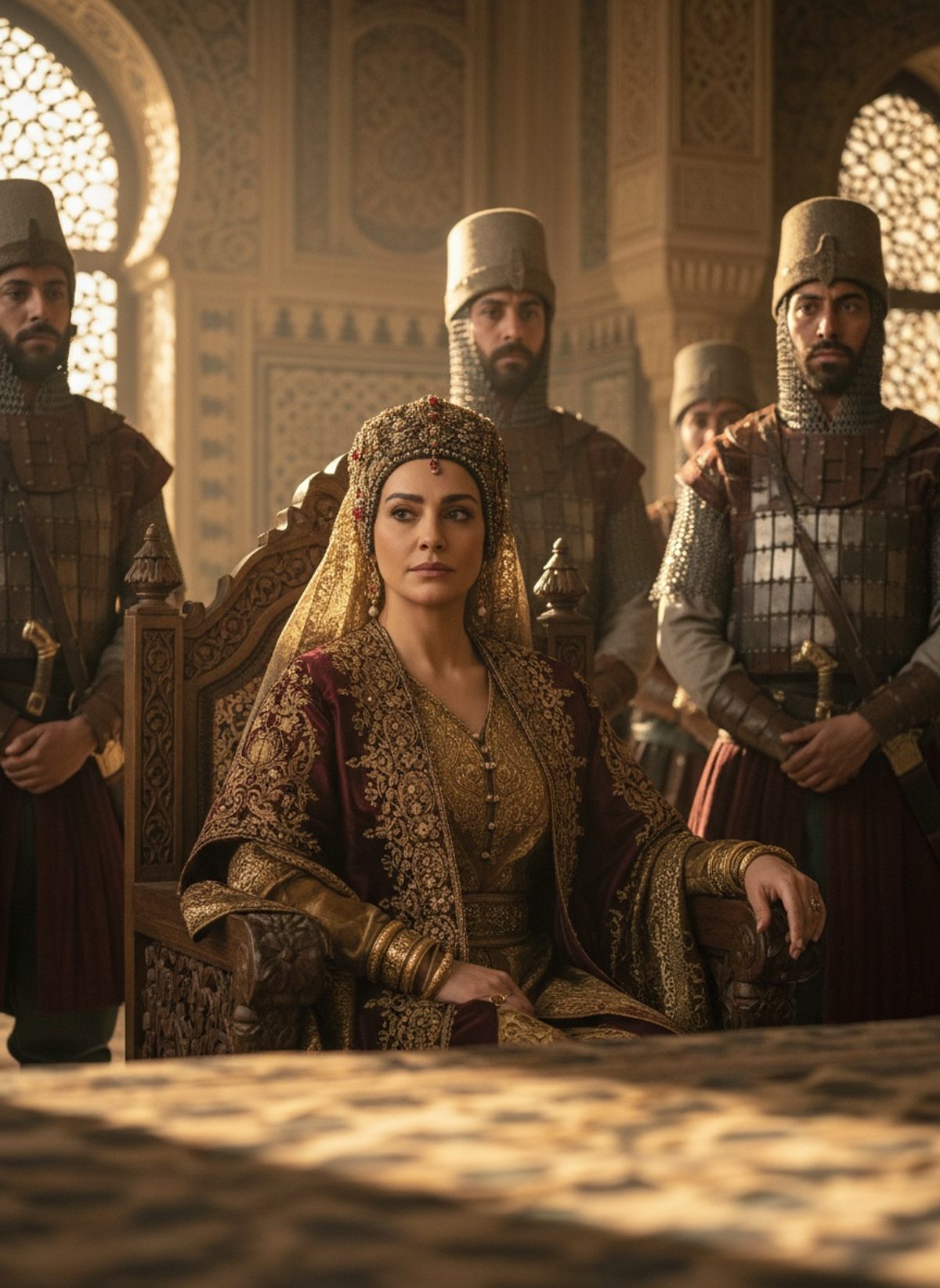
1250 AD. The sun-drenched court of Cairo lay silent amidst the whispers of uncertainty.
The Woman Who Stood Alone
The bustling streets of Cairo in 1250 were alive with the scent of spices and the hum of merchants, but a fog of uncertainty lingered in the air. The Mamluk soldiers, fierce and unyielding, had just claimed the life of the last Crusader king, leaving the kingdom of Egypt in a precarious position. Rising from this tapestry of turmoil and intrigue was an extraordinary figure—a former slave who would become not just a ruler but a sovereign leader at the core of one of the medieval world's most potent empires.
Shajar al-Durr’s rise defied every notion of possibility in a male-dominated society crafted to sideline women. Her journey began not in the cushioned halls of wealth, but in the harsh confines of a slave's quarters. As a concubine within the Sultan's harem, she was privy to the palace's inner workings, a silent observer to the symphonies and cacophonies of power dynamics. But when Sultan as-Salih Ayyub lay on his deathbed, Egypt stood on the precipice of crisis.
With the sultan's weakening grip, a vacuum of power formed, a chasm that could have swallowed a lesser person. However, Shajar al-Durr was not just any courtier's companion. When as-Salih Ayyub died amidst the chaos of the Crusader siege, she shielded his death, a secret known only to those most loyal. The absence of a leader could have spelled doom, but Shajar al-Durr, guided by a deep resolve, took the helm, managing Egypt's affairs not publicly as the sultan but as a knowledgeable regent. She issued orders over his seal, a hidden regency, and commanded the loyalty of the very Mamluks who had turned the tide against the Crusaders in the Nile Delta. Her act of delicate statecraft and survival allowed the nation's pulse to steady—an astounding feat that brought quiet admiration and hushed judgments.
Read next: Jadwiga Gave Up the Man She Loved. Poland Never Forgot It.
The Sultan Beyond the Veil
Navigating through the labyrinth of medieval politics, Shajar al-Durr found herself in the rarest of positions—as a woman who was formally declared Sultan of Egypt. The implications were monumental. Since the reign of Cleopatra, Egypt had not known a woman at its helm, and within the vast Muslim world, such an occurrence was nearly unthinkable. Yet, thinking outside the constraints of convention was precisely where Shajar al-Durr excelled.
Her coronation as sultan was not a mere symbol of power; it was a radical statement of agency and competence. Under her rule, she addressed herself to the concerns of a nation beleaguered by both internal and external threats. Her first task was to secure a fragile peace. She understood the formidable strength of the Crusader armies and negotiated a treaty to safeguard her kingdom. This was an act not borne out of weakness but strategic calculation; a pause in warfare to strengthen defenses, to gather resources, and to stabilize a nation threatened by chaos.
Shajar al-Durr's ascension did not silence her dissenters. Traditionalists balked at the audacity of a woman ruling in Islamic Cairo. Her reign, however, embodied a tenacity that turned uncertainty into a firm footing—a testament to her skills in diplomacy. As sultan, she issued coinage bearing her name, an assertive declaration of authority within an era when such tributes were nearly solely the privilege of male rulers. Her reign, brief yet impactful, demonstrated the exceptional capacity of a ruler capable of strategic innovation.
Legacy Filled with Complexity
Shajar al-Durr's reign was not destined to last until her natural end. Political rivalries intensified, and internal strife became too overwhelming. Her marriage to Aybak, a Mamluk general, was intended to secure her position, but ultimately led to her downfall, a tragic tale of ambition clashing with betrayal. Her assassination was as shocking as her rise, a violent reminder of the vulnerabilities that unchecked ambition and surrounded trust can breed.
Nevertheless, the legacy she sowed was not entirely subsumed by her demise. Shajar al-Durr had achieved the unthinkable—she ruled, albeit briefly, as a sultan, proving her capability across the spectrum of leadership, from military strategy to diplomacy. Her story is a potent reminder that the annals of history too often understated the presence and power of women. Shajar al-Durr defied the norms and scripted a narrative of authority from threads of resilience and intellect.
When we revisit history, it's crucial to delve beyond surface narratives and acknowledge the disruption figures like Shajar al-Durr brought to established structures. Her reign was more than an anomaly; it was a demonstration that competence knows no gender, even in an age when such ideas were dismissed outright. Her influence echoes through the halls of history as a singular reminder of the unyielding power of perseverance, assertiveness, and thought that goes against the grain.