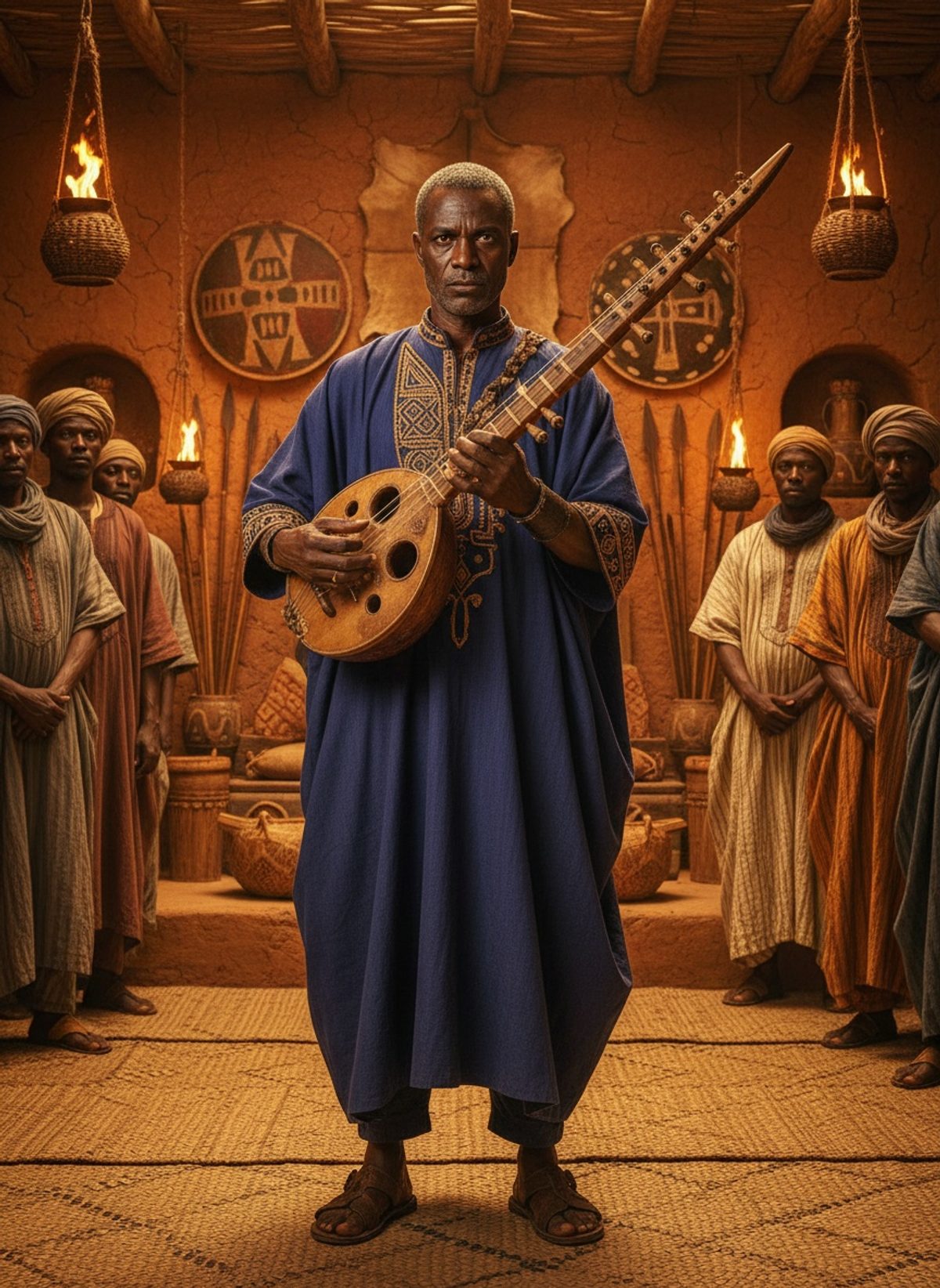
The torch’s flame flickered wildly as the captured griot Balla Fasséké stood defiantly before the tyrant's court. Outside, a stark Saharan wind howled, battering the tent like the fate that seemed to close in around him. Yet inside that makeshift palace, it was Balla Fasséké's voice that dared rival the storm.
The Captive's Resolve
Before the assembled nobles and warriors of the fearsome Sumanguru Kanté, Balla Fasséké was expected to sing. Not any song, but one that would forever bind him to the despotic ruler’s cause—a demand as heavy as the links of a chain. The mood weighed down with oppressive silence as Sumanguru, notorious for both his tyranny and his occult prowess, watched the griot intently. Surrounding him were the spoils of conquest—ornamental relics and subdued figures of power who had bowed to his iron fist.
Balla Fasséké, however, raised his voice in song not of praise but of dreams. He began weaving a melody that he had carried across parched deserts and perilous dawns, a song destined for Sundiata Keita, the exiled prince. His words painted aspirations of a homeland free from oppression, a vision flickering in the perilous shadows, threatening to awaken the very spirit of a fractured empire. His defiance was a lone flame against the darkness, illuminating the path for a prince, destined to reclaim his birthright.
Echoes of the Past
In the growing Mali Empire of the early 13th century, Balla Fasséké's song echoed with the weight of tradition. The griots—custodians of oral history and ancestral wisdom—were revered as much as kings. They were the voices of memory and promise, holding the pulsing heart of the people in verses of legacy and hope. The instrument of their power was not a sword, but language—a cultural anchorage in tempestuous seas.
Read next: Sophonisba Was Given as a Trophy. She Refused.
Sumanguru, once the usurper who had scattered Sundiata and his loyal followers into exile, could command whole armies, but he could not conscript the griot's narrative. Balla Fasséké's unwavering spirit was a reminder of the invisible ties that bound Mali's history and future. Each tone of resistance vowed allegiance not just to Sundiata, but to the collective memory of a people who knew justice was not merely imagined but spoken into being.
The Prophecy's Pull
Even as Balla's voice defied the present, it invoked an ancient prophecy—the prediction of a "lame lion" who would one day rise to deliver the kingdom. The mystics and seers had long whispered of Sundiata, the prince born crippled and cast aside, as the destined savior against the tyrannical spirits that shadowed Mali. This one song, delivered with potent conviction, possessed the power to stir the prophecy from its slumber.
In the unforgiving world outside, tales passed ear to ear, crossing families and tribes, evolving from mere words into a swelling tide of momentum. Warriors paused, villagers listened, and allies stirred in the farthest reaches of the savanna, spurred by dreams of unity, justice, and prosperity. Balla Fasséké's song was the spark in the tinder that had smoldered silently, waiting for the rallying cry of the rightful heir.
The Battle of Return
And so, urged by the griot’s song that carried his name over the deserts and an empire’s yearning over the horizon, Sundiata set forth. The exiled prince gathered allies from lands far and wide, each voice adding to the clamorous crescendo rising against Sumanguru's rule. When he moved across the plains, it was not only with warriors, but with the spirit of a people ready to reclaim their land from despotism.
The decisive confrontation came in 1235 AD at the Battle of Kirina. Here, as the dust whirled beneath the sun’s relentless blaze, Sundiata's forces clashed with those of Sumanguru in a fervent storm of sword and spear. Amidst the chaos, Balla Fasséké’s melody lingered as an inaudible anchor, guiding Sundiata through the storms of conflict. With prowess and strategy, the prince of prophecies overcame, unifying Mali under a banner of harmony and justice.
An Empire Resurrected
Sundiata’s victory was not merely a triumph of arms but a testament to the enduring power of a song and the unbreakable bonds of cultural heritage. It was a restoration not just of territory but of identity, infused with the echoes of ancestral wisdom that Balla Fasséké had dared to sing in defiance. The griot’s voice was the bridge between Mali’s past and its future—a reminder that even the mightiest of leaders are shaped by the stories that frame their reigns.
This saga serves as a vivid reminder of how music and memory can douse even the fiercest flames of tyranny, and how narratives nurture the resilience of a culture. Balla Fasséké's relentless spirit and courageous defiance resonate through history as a reminder that sometimes the strongest stand is taken not with might, but with song. In a way, Balla Fasséké showed that while kings might conquer by force, true power lies in the steadfast narration of truth, guiding the soul of a nation towards a future it can call its own.