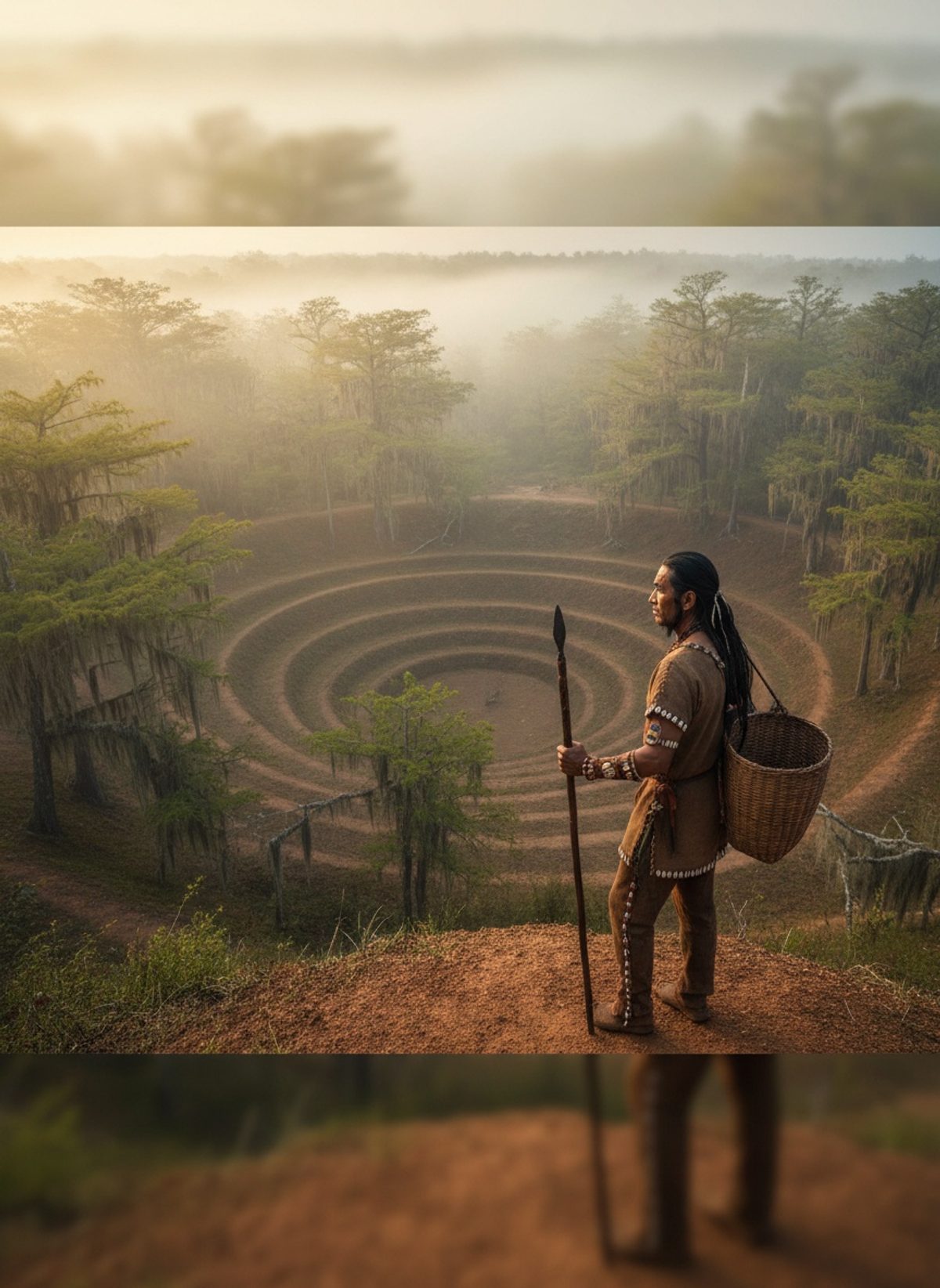
Poverty Point is a city no one remembers. It stands as a silent testament to a forgotten civilisation. Nestled in the lowlands of northeastern Louisiana, the monumental site challenges everything we assume about early North American societies. Generations of people, without the convenience of agriculture or writing, transformed a landscape spanning 345 acres with their bare hands. Here, amid six vast, concentric ridges and towering earthen mounds, ancient people carved out a thriving cultural hub some 3,700 years ago.
The Mysterious Builders
Amidst the rolling earthworks of Poverty Point, you can almost hear the rustle of a society full of life and energy, enthusiastic about their vision. These weren't the farmers or pottery-makers from your history textbooks. Instead, they were exceptional hunter-gatherers who thrived without agriculture. With ingenuity that defies modern understanding, they organised tens of thousands of individuals to shape nearly five million cubic feet of earth into a sprawling complex.
The magnitude of their achievement is staggering. The earthworks include six concentric C-shaped ridges, cleverly designed and laboriously constructed by hand. Radiocarbon dating suggests their efforts began around 1700 BCE, continuing until approximately 1100 BCE. These builders managed to create a human-engineered landscape without the basic tools other civilisations relied upon. Surrounded by dense forests and flowing waterways, they moved mountains of soil using only rudimentary methods.
Remarkably, these builders sourced materials from astonishing distances—over 100 miles laterally through the Mississippi Delta and potentially even further southward to the Gulf Coast, possibly reflecting a vast network of trade or communication. Tokens of this trade include materials from distant places like the Rocky Mountains, evidence of a society that rested at the heart of a gigantic exchange network. These disparate pieces come together to depict an advanced society, rich in culture and significance yet enigmatic in its disappearance.
Read next: Tiwanaku: The City at 13,000 Feet That Fed a Million People
Purpose Among the Ridges
Standing within this ancient earthwork, you might wonder about its purpose. The complexity and scale of Poverty Point suggest a central role in its builders' lives. Yet, without written records, archaeologists have had to piece together the story piece by piece. Speculations abound, suggesting Poverty Point may have served as a settlement, a trading powerhouse, and perhaps even a ceremonial or religious center.
The towering mounds and ridges, rising boldly above the adjacent swales, hint at a place of significant ritual or gathering. The layout, including broad adjoining plazas and aisles engraved in the earth during its construction, proposes a vivid interaction space. Meanwhile, the concentric rings seem to speak of visionary planning, their shapes and scales preserved first through aerial surveys taken in modern times. This suggests a far-reaching vision by its builders, one that likely held cultural or spiritual significance.
The scene is vivid: families gathered around communal fires, sharing news from far-off lands while traders laid out precious materials gathered from great distances. Rituals, ceremonies, and stories might have echoed through the site, transitioning over generations as the earthworks stood watch. This dynamic hub of interaction paints a picture of a historically significant crossroads in North American prehistory—both vibrant and mysterious, thriving on the keys of migration, community, and communication.
An Enigma Yet to Unravel
The living community of Poverty Point eventually faded, retreating into the shadowy corridors of history. As swiftly as it rose to prominence, within generations, it dwindled to obscurity. The reasons remain speculative. Did environmental changes alter the balance that this site had achieved? Or did societal transformations spur migration or dissolution?
Read next: Göbekli Tepe: Hunters Built a Temple Before Farming Existed
Despite the mystery, one key aspect of Poverty Point's legacy persists—its ability to disrupt conventional understandings of early American history. It stands as a rebuke to the simplistic narrative that complex societies must rely on agriculture and written language to thrive. The ingenuity and drive of these unnamed builders resonate across millennia, urging us to reconsider the strands of human achievement and resilience.
In the silence of its remaining mounds and ridges, Poverty Point offers a potent reminder of what we can achieve when faced with limitations. It is a call to recognize the strength of the human spirit, driving innovation amid necessity.
As we peer into the mystery of this ancient civilization, we confront the echoes of ambition that still resonate today. Like the concentric ridges that define its place in history, the complexity of Poverty Point challenges us to see the past not as a series of answers but as endless questions waiting to be explored.