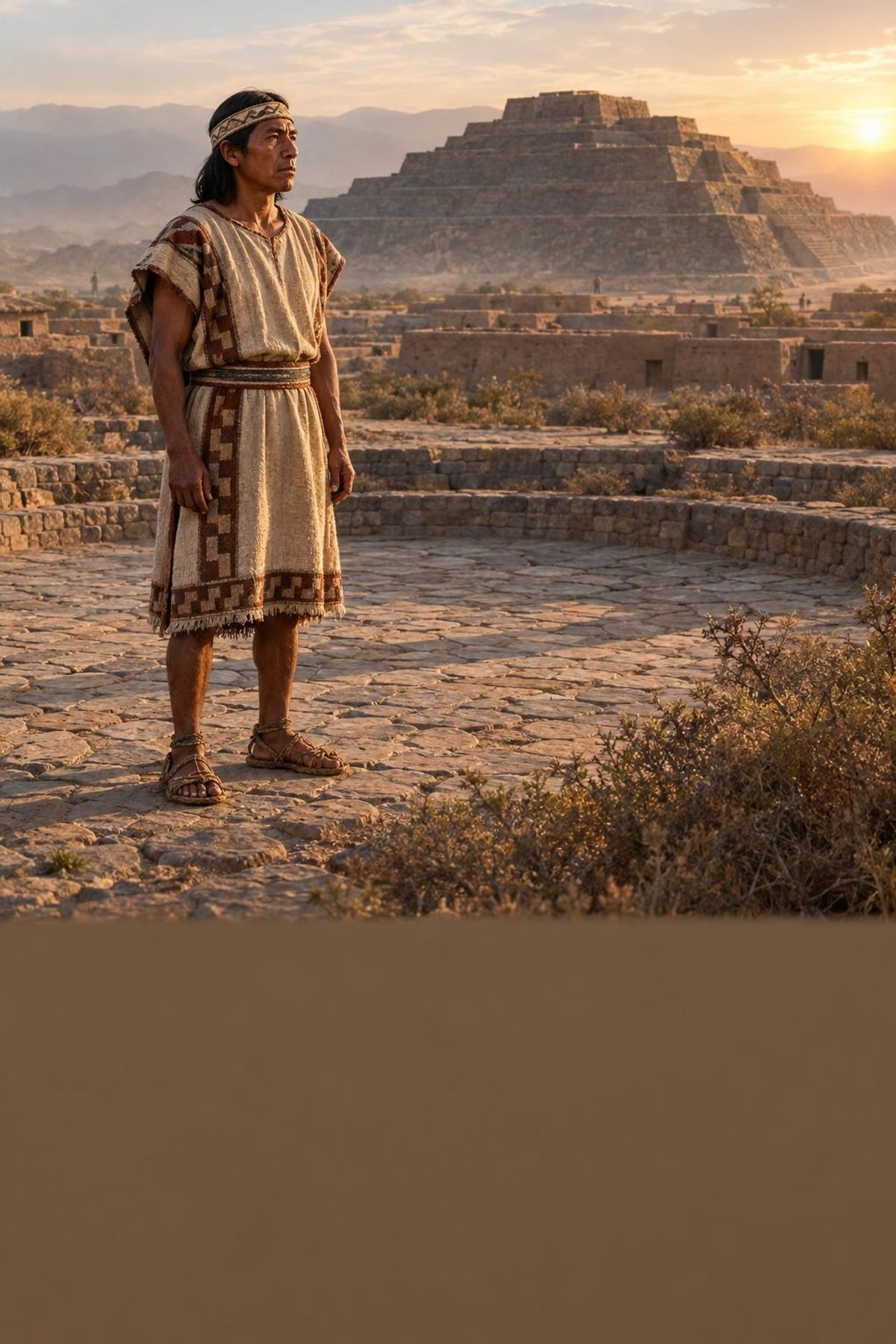
The sun rises over the Paracas Desert, its first light casting a golden hue across the Supe Valley's arid expanse. A gentle breeze stirs the sparse vegetation and carries the distant murmur of waves crashing against the Peruvian coast, just 23 kilometers away. Amidst this barren landscape, shrouded in the enduring mystery of time, lies Caral — a city that quietly flourished 5,000 years ago as one of the oldest urban centers in the world. While ancient Egyptians were perfecting the art of pyramid building, a similar yet distinct architectural wonder rose here, leaving behind ruins that whispered of a long-forgotten civilization.
Caral, often referred to as the Sacred City of Caral-Supe, was inhabited from around 2600 BCE to 2000 BCE, and in its time, its urban landscape sprawled over more than 60 hectares of what is now northern Peru's Supe District. This settlement didn't just spring from the desert sands; it was the result of a society built on trade, agriculture, and, surprisingly, harmony. Even as its Egyptian contemporaries were advancing through war and conquest, Caral developed in peace. Remarkably, archaeological excavations have yet to reveal any signs of warfare — no fortifications, no weaponry, just well-planned urbanization dedicated to the rituals of daily life and spiritual observance.
Walking through the remnants of Caral today, one is greeted by intricate terraced pyramids, spacious plazas, and an array of residential buildings. These monumental structures, which have survived millennia, hint at the organizational prowess of the Caral civilization. Ruth Shady, the Peruvian archaeologist who spent decades unearthing Caral's secrets, suggests that this city represents a blueprint for the urban designs adopted by successive Andean civilizations. The architectural knowledge embodied in these constructions speaks of a population skilled in engineering and labor organization, qualities that also characterized the great Old World civilizations.
One can't help but marvel at the sheer scope of Caral's central pyramid, towering 18 meters high and encompassing a four-tiered platform. This grand structure, along with an amphitheater and several sunken circular plazas, suggests that the city served both ceremonial and administrative functions. At its height, Caral accommodated over 3,000 inhabitants, supported by complex irrigation systems that seamlessly integrated agricultural pursuits with daily urban life. It was a hub of cultural and economic exchange, indispensable to the development of this enigmatic society.
Read next: Al-Biruni Calculated the Earth's Radius From a Hilltop
Far from being isolated, Caral was part of a network of coastal and inland societies, engaging in trade that reached well beyond the Supe Valley. Evidence of this has come to light through artifacts such as seashells, found far inland, and practical items made from non-local materials. The products of their agriculture, including cotton, were likely traded away for fish and other marine resources from Áspero, an early fishing settlement at the mouth of the Supe River. This exchange created a sophisticated economic system that underpinned the city's prosperity.
Yet, it is within the cultural artifacts that the most remarkable aspects of Caral's society seem to be captured. Among the debris of everyday life, excavators found a considerable number of musical instruments — flutes crafted from pelican and condor bones. These instruments suggest that music played an integral part in the social and ceremonial life of Caral. The prevalence of music, as opposed to martial relics, hints at a culture centered on communal harmony and shared experiences, speaking volumes about the societal values of this pioneering civilization.
Read next: Sima Guang Defied the Emperor. He Did It in Writing.
One of the most compelling stories to emerge from Caral is that it developed independently of the influences that drove similar Old World cities. Whereas other ancient civilizations, like those of Mesopotamia and the Nile River, relied heavily on domesticated animals for labor and transportation, Caral's people innovated differently, cultivating plants and organizing communal labor to build their society's infrastructure. The significance of these achievements in isolation challenges our understanding of early urban development and suggests that the desire to create cities was a common human impulse, transcending continents and conditions.
In 1905, Max Uhle stumbled upon Caral during a survey of ancient Peruvian sites, yet failed to realize the age-old significance of the mounds he crossed paths with. It wasn't until decades later, in 1948, that Paul Kosok would bring more scholarly focus to Caral, challenging the prevailing beliefs about its timeline. But skepticism ruled until the late 20th century when Ruth Shady's extensive research solidified Caral's standing as a cornerstone of ancient American history. Despite being recognized as the cradle of civilization in the Americas by international bodies like UNESCO, widespread public awareness of Caral has lagged behind the revelations.
As archaeologists continue to pore over the site's enduring mysteries, Caral reminds us that the roots of human society run deep and varied. In drawing back the curtain on this prehistoric world, we gain invaluable insights into our collective past, unraveling the myriad ways people have come together to build the complex structures we now take for granted. As the winds of the Paracas Desert sweep across the remnants of those ancient plazas, we are left to ponder Caral not just as an archaeological wonder, but as a testament to humanity's persistent quest to build, connect, and create civilizations without ever lifting a sword. Such is the legacy woven through Caral's sun-baked stones—an enduring lesson that peace, not war, can also be the foundation of great societies.