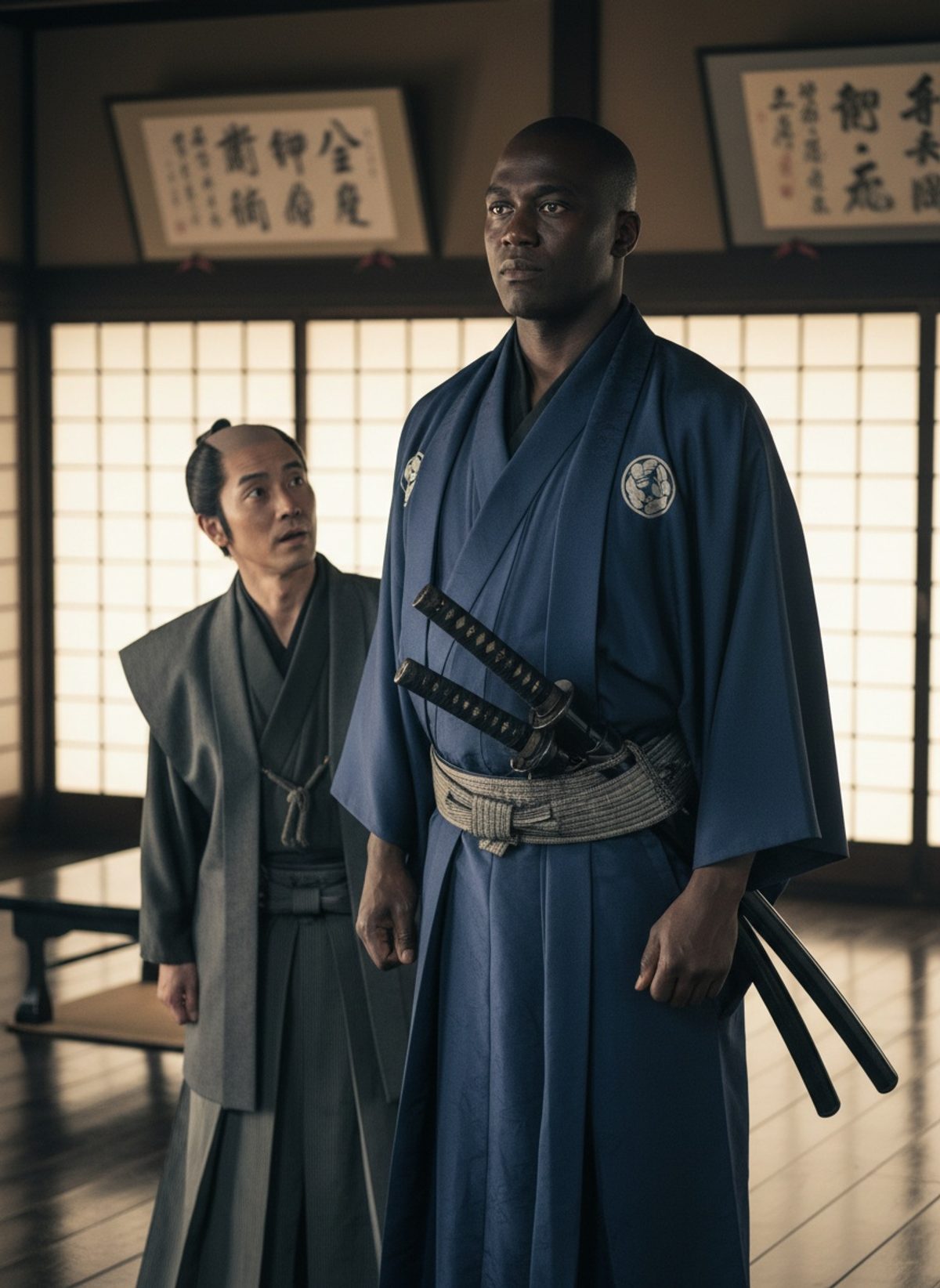
On a cool spring day in 1581, the bustling streets of Kyoto were a strange, chaotic orchestra of life. Merchants called out their wares, the solid click of wooden sandals echoed against paved roads, and the cherry blossoms swayed gently, their petals catching the afternoon sunlight as it filtered through the soft clouds. This was the Japan of legend - feudal, fractious, and steeped in the rituals of honor and lineage. Within these winding streets and high walls lay an encounter that would defy all expectations, an event that was less a footnote in history and more a transformative moment in a land bound by its own traditions.
The arrival of Yasuke, an African man who stood over six feet tall in a country where the average man was significantly shorter, was akin to the sudden crash of cymbals in an ongoing symphony. Accompanying the Jesuit missionary Alessandro Valignano, Yasuke inadvertently mesmerized the local populace of Kyoto. People clamored for a look at him, driven by curiosity and bewilderment. Such was their fascination that onlookers risked life and limb, pushing and jostling through the crowd, resulting in injuries and even deaths in the mad scramble to see this foreign spectacle—something so alien to their familiar world.
His audience with Oda Nobunaga was one that has been immortalized in the annals of history. Nobunaga, the unyielding warlord with aspirations to unify Japan, was known for his strategic brilliance and ruthless efficiency, as well as his openness to the novel and the new. Sitting within his grand castle, a piece of architecture with sloping roofs that extended like the spread wings of an avian giant, Nobunaga was at first skeptical of this peculiar arrival. It was not Yasuke’s towering height or imposing stature but his skin color that was most bewildering. Nobunaga, a man who accorded belief to empirical evidence, reportedly ordered that Yasuke’s skin be scrubbed, suspecting that the dark color was ink.
What Nobunaga discovered was not subterfuge but fact; Yasuke’s skin remained unchanged. This immediate confrontation with diversity opened doors rather than shut them. Yasuke was not just taken aback into the relative obscurity of a foreigner tagging along with a missionary, but he became an invited presence at Nobunaga's table. Within months, Yasuke transformed from a curious spectacle into a warrior persona in the intensely disciplined and hierarchical society of samurai Japan. Nobunaga conferred upon him samurai status, granting him the prestigious privileges that came with it—a stipend, a house, and, notably, a katana that signified his new role both in function and honor.
Read next: Elvis Entered a Lookalike Contest. He Came Last.
To visualize Yasuke within the multi-faceted landscape of feudal Japan is to see an individual uniquely situated amid deep-seated cultural interaction. His mere presence disrupts preconceived notions about cultural encounters in the age of European exploration and colonization. Residing in a land where foreigners were still regarded with a mix of suspicion and fascination, Yasuke walked the halls of power, an iconoclastic figure in the flesh. He carried Nobunaga’s weapons and, in doing so, bore the weight of an intersection between different worlds — each with its own traditions of battle, honor, and spirituality.
Yasuke’s relationship with Nobunaga was not merely an accident of history but a page from the broader Jesuit agenda. The Jesuits, led by visionaries like Alessandro Valignano, sought to spread Christianity across Asia, ideally by ingratiating themselves with local rulers. Yasuke's presence could leverage diplomatic allegiance between the East and the Jesuit missionaries, highlighting Japan’s emerging awareness of a wider world beyond its shores. His origin was shrouded in a mix of fact and conjecture, with hypotheses ranging from Yasuke hailing from the lands of Ethiopia to him possibly being of the Dinka people of South Sudan, and later acquired somewhere through Portuguese trade from Mozambique.
When Nobunaga fell during the infamous Honnō-ji Incident in 1582, Yasuke stood resolutely by, wielding his sword alongside his master. At that moment, his presence was more than symbolic—it was participatory, his allegiance demonstrated through action, loyalty forging a path through the chaos of betrayal and battle. After Nobunaga’s death, Yasuke’s trajectory bent back towards anonymity. The records taper off, leaving historians and storytellers with the unfinished symphony of his life. He was returned to the Jesuits, possibly seen as an outsider despite his integration, once again an actor in a story beyond any single narrative.
Why does the story of Yasuke matter? It's because it reminds us of the varying layers and textures of history. It breaks the monolithic view of historical progressions and cultural interactions. Yasuke’s life serves to highlight the complexities and surprises of human events and movement—that identity is rarely confined but continually reshaped by experience and encounter. Yasuke, standing tall in the samurai ranks of a world where he was both insider and outsider, challenges us to reconsider our definitions of belonging and otherness. Through him, history shows that even in the most structured of societies, extraordinary individual paths can create ripples that defy history’s broader currents, inspiring curiosity and awe through centuries.