
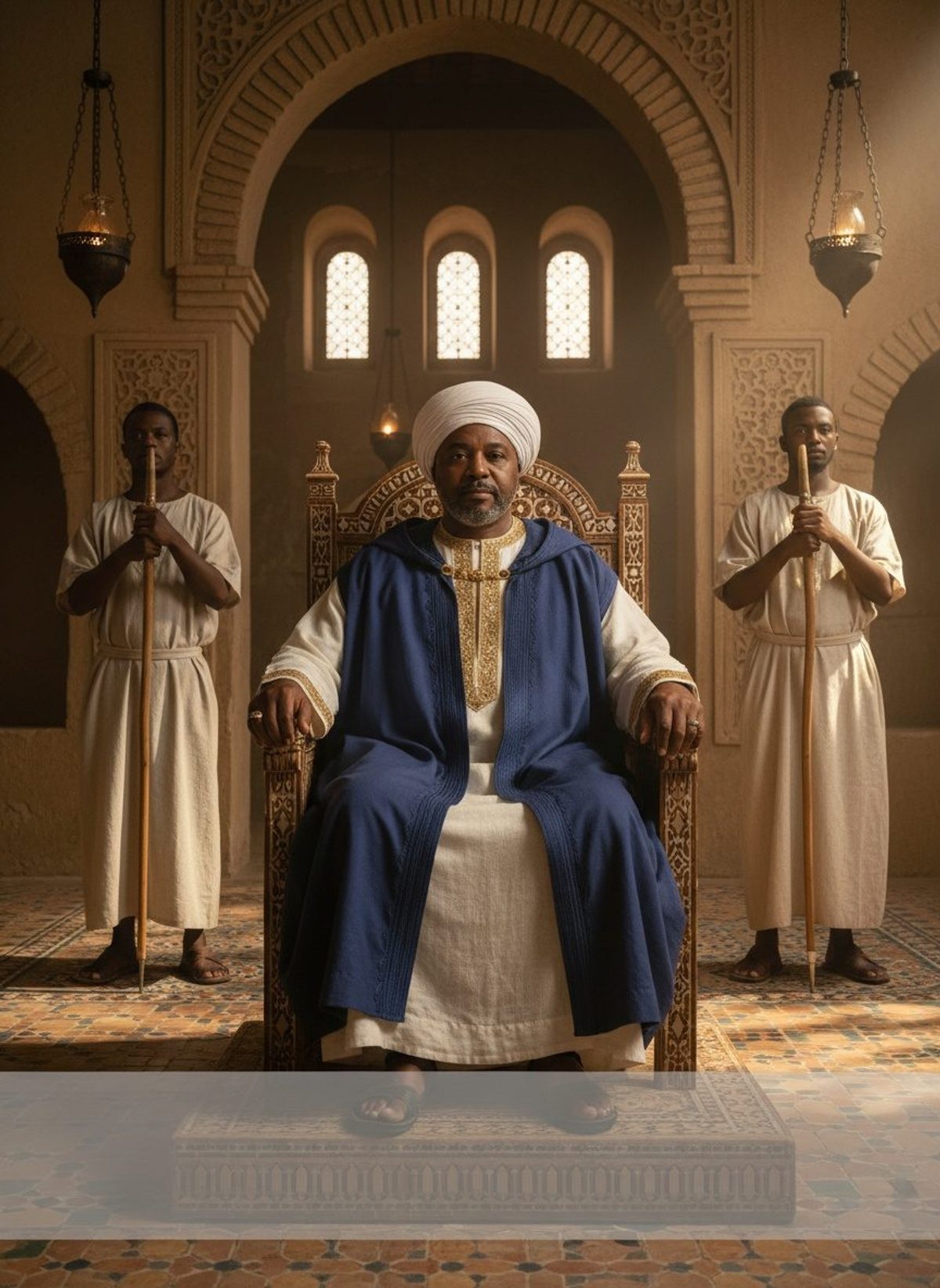
The clang of chains echoed across the stone halls of Egypt, a metallic symphony marking the arrival of one who was purchased for a meager sum, yet quietly held the potential to command an empire. Shadows danced across the flickering torchlight, casting a silhouette of a figure whose journey from shackles to sovereignty would defy the conventions of the time. Here stood Kafur al-Ikhshidi, a once nameless and powerless slave, now poised at the cusp of a remarkable ascent to power. The year was 945 AD, and as he approached the heart of Egyptian governance, whispers of his competence and charisma began to ripple through the corridors of power.
From Chains to Command
When Kafur first set foot on Egyptian soil, he was far from royalty. Purchased for less than the price of a horse, his introduction to this ancient land was under the harsh conditions of servitude. Brought into a world that defined him only by his servile status, Kafur's early years were overshadowed by the weight of chains and the indifference of an empire that saw him as nothing more than a eunuch slave. Yet, within this stark reality, Kafur harbored an intellect and a tenacity that would soon challenge the very foundations of his status.
The era of the Fatimid Caliphate saw political currents shifting like the desert sands, and amidst these changes emerged Kafur al-Ikhshidi, whose aptitude for diplomacy and governance soon came to light. The young eunuch caught the discerning eye of Muhammad ibn Tughj, the then-ruler of Egypt, who recognized Kafur’s potential beyond his station. Under ibn Tughj’s tutelage, Kafur’s role evolved from that of a simple court servant to a key player in the political sphere. Tactics and governance became his forte, and in a climate teeming with rival factions and external threats, his counsel became indispensable.
Despite his initial entrance into Egypt being dictated by the misfortunes of slavery, Kafur quickly mastered the complex mechanisms of power. His strategies were not merely about survival; they aimed at reshaping the very nature of leadership in Egypt. Where others saw a eunuch, ibn Tughj perceived a future statesman, investing time to cultivate his skills in administration and military strategy. Through careful study and practice, Kafur mastered these arts, eventually earning the unwavering loyalty of the Egyptian army and the trust of its upper echelons.
Read next: Ahmad Baba Was Dragged in Chains. He Taught Anyway.
The Rule of the Slave
The true test of Kafur's leadership came upon the passing of Muhammad ibn Tughj in 946 AD. It was a time when power could easily slip through one's fingers, but Kafur deftly navigated the tumultuous politics of the region. Though legally barred from ruling outright due to his status as a eunuch, Kafur assumed the de facto control of Egypt, serving as the regent for ibn Tughj’s young sons. His hold on power was anything but tenuous; it was fortified by the deep respect he commanded among the military and the nobility.
In an era where political loyalties shifted as quickly as the Nile’s currents, Kafur's leadership brought stability to Egypt during uncertain times. He ruled with a blend of pragmatism and diplomacy, ensuring the continuity of the state amid the threats of internal rebellions and external attacks. His governance was marked by fairness and integrity, steering Egypt through crises with a steady hand. Courts of law operated more efficiently, and the treasury flourished under his astute management, a testament to his prowess in administration.
The great poet al-Mutanabbi’s journey from Baghdad to Egypt was, in itself, an acknowledgment of Kafur's remarkable influence. Though primarily arriving with intentions to secure patronage, the poet’s verses immortalized the transformative leader. Al-Mutanabbi, renowned for his sharp tongue and poetic genius, found himself inspired by Kafur’s story—an acknowledgment that transcended the boundaries of social status and celebrated the unexpected rise of a man once bound by the chains of servitude.
A Legacy Beyond Chains
Kafur’s tenure as one of Egypt’s most powerful figures continued until his death in 968 AD, spanning a remarkable twenty-two years. His time in power left an indelible mark on the land he governed. Not only did he repudiate traditional views of leadership and succession, but his rule also signified a fundamental change in how authority could be acquired and maintained. Kafur embodied a paradox; he was an outsider, yet no one questioned his place at the forefront of Egyptian governance.
His story, though rooted in a past where the lines between enslaved and sovereign were rigidly drawn, serves as a rich tapestry interwoven with themes of perseverance, adaptability, and the unpredictable nature of destiny. Here was a man whose rise defied the limitations the world imposed upon him—a narrative echoing even today in the pursuit of equality and self-determination.
As students of history, we often seek the stories untold, the narratives that challenge our understanding of who holds power and why. Kafur’s life compels us to question the rigid boundaries of status and identity that societies often create. He reminds us that power is not always inherited or dictated by birth but can emerge from the most unlikely of places, forged in the crucible of adversity and shaped by the will to lead with justice and vision. In remembering Kafur al-Ikhshidi, we do not only recall a ruler of the past but also embrace the timeless possibility that history is filled with unexpected ascensions that encourage and inspire future generations.