The Battle of Varna marked a horrific rout for Christian Europe. It was all too human made so.
November 10, 1444, was meant to be a day of triumph for Władysław III, the young king who wore two crowns: that of Poland and Hungary. Upon the plains of Varna, within a tapestry of military form and color, the confident king of just twenty years found an opportunity, or so he believed, to immortalize himself as the crusading paladin who would push back the tides of the Ottoman Empire. Arrayed before him, vast and formidable, stood the armies of Sultan Murad II. The stage was set for an encounter that could have rewritten history. Instead, it ended in a tragedy that silenced Christian hopes in the Balkans for decades.
This tumultuous chapter in European history was influenced by more than the simple clash of two armies. It was rooted deep within Władysław's rise to power amid political turmoil. His life was no stranger to struggle. Having come to power in 1434 at the delicate age of ten following the death of his father, Władysław II Jagiełło, the boy king was thrust into a world rife with conflicts and ambitions not his own. Regents and councils led by Cardinal Zbigniew Oleśnicki initially held the reins of power, while Władysław matured amid shifting allegiances and the quelling of uprisings like the one that had culminated in the Battle of Grotniki in 1439, where Spytko III of Melsztyn, a proponent of Czech Hussite sympathies, met his end. Such was the monarch's introduction to the ruthless politics of late medieval Europe.
To the southeast, the thunderclouds of war gathered. The Ottoman Empire, an ever-growing behemoth under Sultan Murad II, pressed its advantage into Europe. Those lands of southeastern and central Europe that formed Władysław's newly acquired domain of Hungary were perennially at risk. The election in 1440 of the young king to the Hungarian and Croatian throne had not occurred without fanfare and fierce opposition. Albert II of Germany’s passing had left another young contender, Ladislaus the Posthumous, championed by Habsburg interests and his mother Elizabeth of Luxembourg. However, it was Władysław who emerged as the legitimate claimant, his rule cemented by Elizabeth's death amidst the backdrop of escalating Ottoman threats.
Read next: He Walked Into the Mongol Camp. He Left With a City.
As a bulwark against the Ottoman tide, Władysław’s reign was not one of idle admiration of princely tapestries; it was one of immediate confrontation. The successive wars his father initiated with the Teutonic Knights had taught him the necessity of fortified frontiers and the critical role of decisive action. By December 1435, he had pressed the Peace of Brześć Kujawski onto the Teutonic State, hobbling their sway in Eastern-Central Europe. But by 1444, no peace treaty could suffice when the stakes encompassed not only sprawling territories but faith, life, and legacy itself.
The young king needed allies, and the opportunity arose under the grand banner of the Crusade of Varna, a campaign emboldened by initial Christian triumphs between 1437 and 1442 against their Turkish adversaries. Urged on by Papal legate Julian Cesarini, the war ventured onwards, marked by heady moments of anticipation overrated by optimistic clerics and kings. However, the formidable size of Murad II’s army was a stark reminder of the challenges ahead. Beneath an autumn sky, the Christian coalition, although buoyed by previous victories, was nevertheless aware of the formidable force amassed against them.
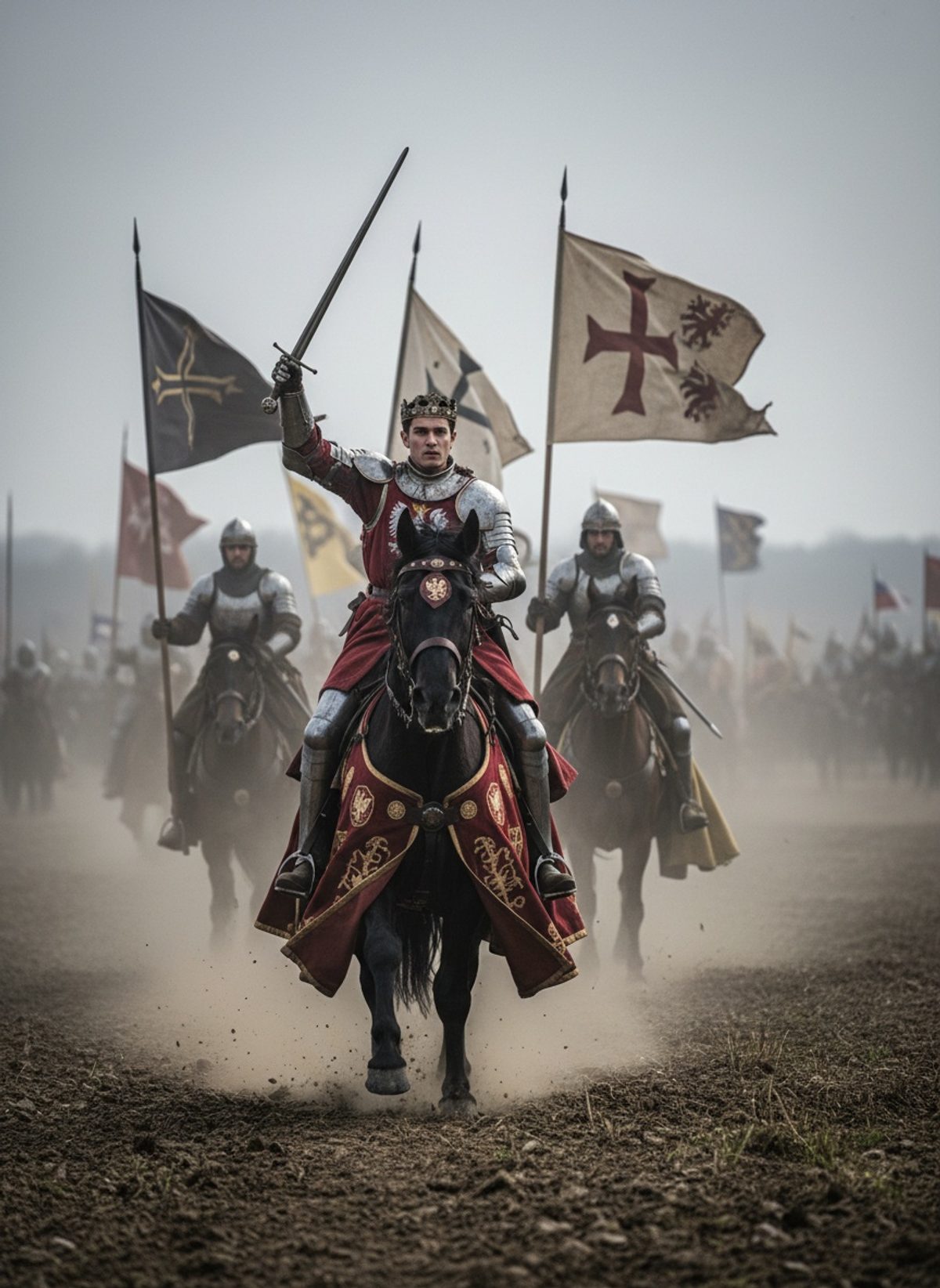
As the sun rose on November 10, an air of stillness belied the coming storm. On the plain of Varna, echoes of a thousand drums mingled with the metallic clatter of arms and the somber prayers whispered into the wind. Władysław III stood amongst his men, a figure of youthful determination framed by the silvered rail of sabers held high in resolute salute. The king, animated perhaps by his own boldness and the heedless courage of youthful certainty, could scarcely ignore the chance—his charge!—to shatter the enemy's core and steal glory from the clutches of fate.
The clash was furious, as was common in those days when the advent of cannon smokes had not yet fully eclipsed the horrors of close combat. Noble banners entangled, hooves drummed a relentless rhythm, and blades sang with a grim purpose. But the king’s intended purgation of the foe’s center was mired in catastrophe. Alone and outstripping his guard, Władysław galloped into the maelstrom of the Ottoman elite guard. While his men watched, their hearts sinking like stones, the king vanished amongst a sea of foes. His solitary charge was reckless bravery distilled into its purest form, but it was folly at its most calamitous.
Read next: He Walked Into the Emperor's Hall. He Named His Price.
What followed was the sharp stab of despair; those who witnessed it saw the young king swallowed by the fight, never to return. As did many others, Władysław died—presumably slain amidst the furious melee—his sword no match for the javelins and scimitars that cut his bright life short. It was whispered that his severed head was raised high upon a pike by Ottoman soldiers, a ghastly standard for the sultan’s triumphant host. Yet his body was lost to time, obscured by the dust of battle and secrets of the defeated.
The battle's conclusion resounded far beyond the battlefields of Varna. The Ottomans, exulting in their victory and bearing the scars of the encounter, retained their will and strength to expand westward, while the dreams of stemming the Turkish tide were cruelly dashed for decades to come. In Poland and Hungary, the narrative meandered from despair to amazement—accounts of survival theorized; legends of an abiding king arise as rumors whispered of his escape, their absurdity no match for the burden of loss.
Władysław's younger brother, Casimir IV, assumed Poland’s throne, while Hungary knit the broken strands of its destiny in vainglorious hopes under his erstwhile rival, Ladislaus V the Posthumous. As time marched inexorably forward, Władysław’s legacy found resonance across lands cloaked in the long umbra of Ottoman dominion. In Bulgaria and beyond, this fallen king, Ladislaus of Varna, was remembered not merely for what he achieved but for the promise of what he might have had fortune favored the bold.
In the annals of historical what-ifs, Władysław's charge exhibits a tragic grandeur that underscores the complexity of leadership and the caprice of war. As a young monarch who dared to strive against the forces of darkness upon Europe’s very threshold, he embodied both the aspirations and the impulses that carved the chronicles of his time. It serves as a somber reminder that history’s tapestry is woven with the threads of personal valor and folly intertwined, forming patterns whose hues often serve as lessons for posterity, lest we forget them.