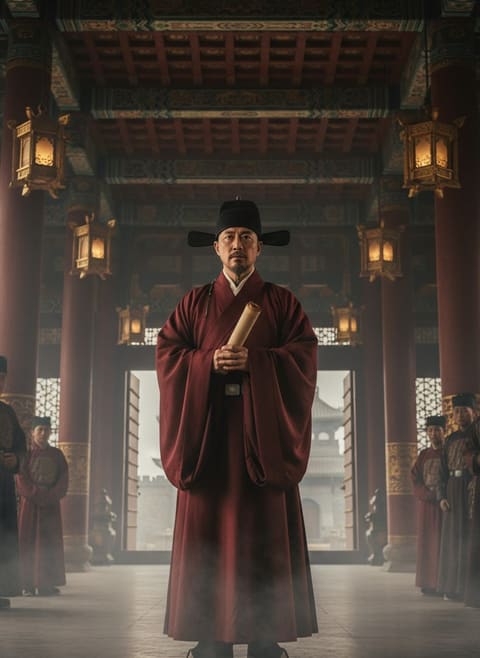
1088 AD. The sun warmed the city of Kaifeng, casting long shadows over the bustling streets.
The Tower that Touched the Sky
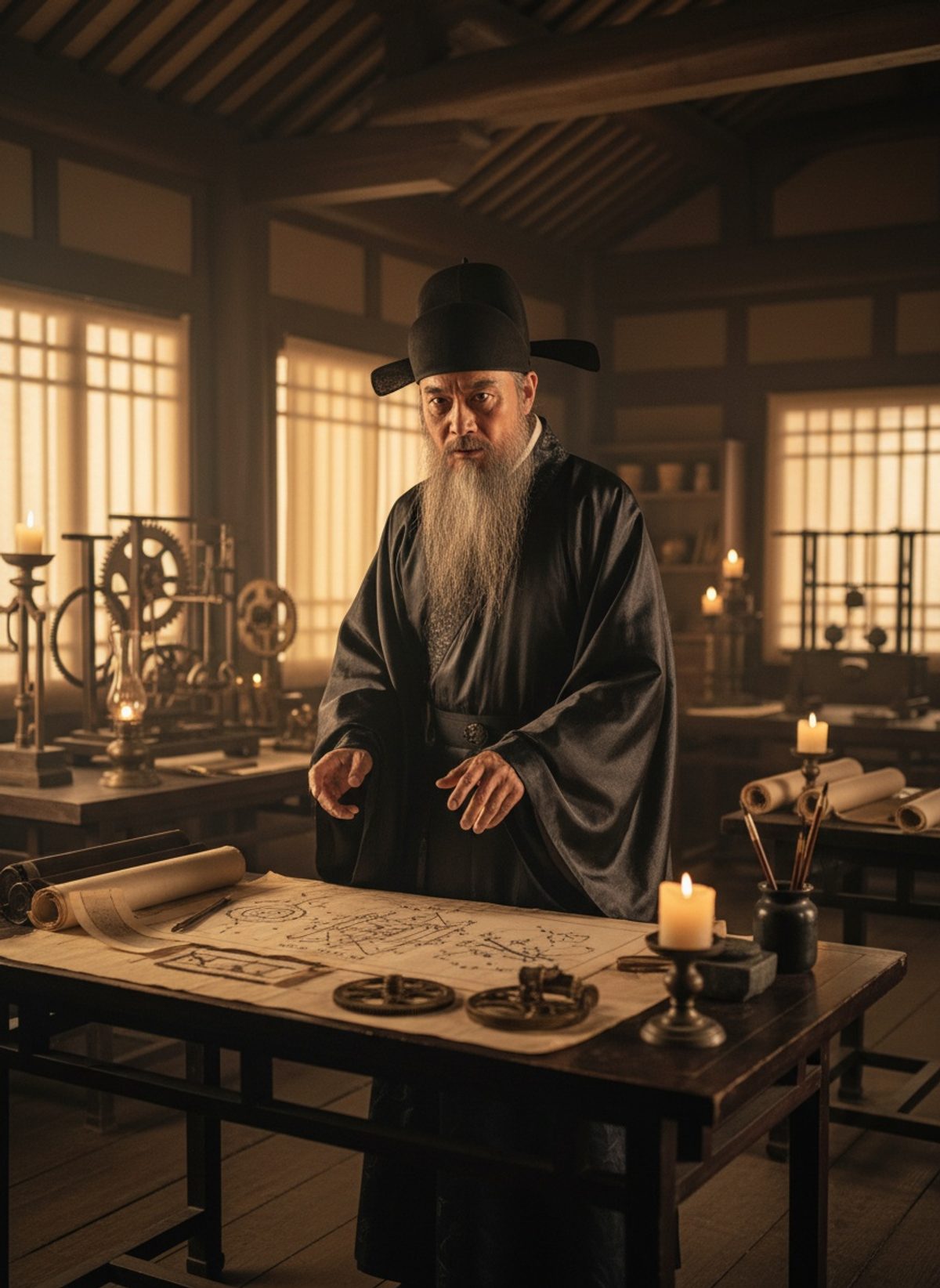
In the heart of Song Dynasty China, the clamor of Kaifeng's streets gave way to an extraordinary sight: a thirty-foot tall marvel of engineering that astonished all who beheld it. This was no mere clock tower; it was a harmonious symphony of bronze and water, a structure that breathed with the rhythm of the heavens. Su Song, a polymath of unrivaled genius, had crafted this mechanical wonder—a hydro-mechanical astronomical clock tower capable of mapping the night sky with remarkable precision.
The vision behind this tower stemmed from Su Song's deep-seated passion for astronomy. He was a scholar and statesman whose mastery of fields such as mathematics, cartography, and mechanical engineering allowed him to design a device centuries ahead of its time. The clock tower was perched in Kaifeng, then the capital under the Northern Song Dynasty, a cultural and political hub that drew scholars and artists from all over China. Despite a lifetime spent amidst administrative duties, Su Song's enduring fascination with the cosmos led him to create this mechanical celestial observatory.
At the core of this clock tower lay a revolutionary component: the water-driven escapement mechanism. Although the escapement concept was first developed by the Buddhist monk Yi Xing and the government official Liang Lingzan in 725 AD, Su Song ingeniously integrated it with a mechanical clock drive. The escapement regulated the flow of water, enabling the consistent and precise rotation of wheels that turned an armillary sphere and a celestial globe. This mechanism ensured the tower moved autonomously, a feat European engineers would not achieve for another five centuries.
Read next: Khosrow I Built a Free Hospital That Treated Anyone, Free
Beyond timekeeping, the clock tower was a holistic experience, designed to engage senses and intellect alike. The tower's mechanical rotating armillary sphere and celestial globe showed the positions of the stars, while a parade of 133 clock jacks punctuated the passage of each hour through a chorus of bells, playing notes that resonated across the city. It embodied not only the empirical precision of Song Dynasty science but also the cultural richness of an era where art and science were inseparable.
The Polymath’s Passion
Born in 1020 in the modern-day Fujian province, Su Song displayed an early affinity for the sciences, excelling in calendrical studies. A youth spent mastering provincial exams set Su on the path of the scholar-official, a trusted servant of the state in various capacities, including Ambassador and President of the Ministry of Personnel. His rise within the bureaucratic structure was mirrored by his intellectual achievements, which transcended the constraints of his governmental duties.
Despite the demands of his official roles, Su Song's inquisitive mind never drifted far from the mysteries of the natural world. His spare moments were dedicated to poetry and the collection of art from previous dynasties, activities that deepened his appreciation for both the tangible and intangible. Additionally, his work extended to pharmacology, where he penned treatises encompassing mineralogy, zoology, botany, and metallurgy, underscoring the breadth of his polymathic insight.
In 1063, Su Song took on the role of distinguished editor at the Academy of Scholarly Worthies, where he edited the classic *Huainanzi* text, carving a niche as a mediator of knowledge from eras past. His intellectual curiosity and dedication placed him beside contemporaries such as Shen Kuo, distinguishing them as luminaries in the cultural renaissance of the Song Dynasty. This milieu of intellectual vibrancy provided the perfect backdrop for Su Song's ambitious project in Kaifeng.
In 1092, Su Song recorded his horological innovation in the treatise *Xinyi Xiangfayao*, which was officially published in 1094. This work not only documented the technical details of the clock tower but also unveiled the endless power-transmitting chain drive—an invention known as the *tian ti* or "celestial ladder." The treatise became a seminal reference for both his contemporaries and future generations aiming to decode the complexities of astronomical timekeeping.
Read next: The Phaistos Disc: 4,000-Year-Old Script No One Can Read
A Legacy in Motion
As history unfolded, Su Song's clock tower faced challenges of its own. In 1127 AD, during a period of political upheaval, it was dismantled and intended for relocation to Beijing. However, despite attempts to reassemble this intricate masterpiece, the tower never regained its former glory, and Su Song's creation stood as a fleeting monument to a golden era of innovation.
The spirit of Su Song's invention lives on as a symbol of the Song Dynasty's intellectual achievements. His ability to integrate technical prowess with the imagination required to capture the essence of the universe left an indelible mark on scientific history. The clock tower not only displayed time but also mapped humanity's unending quest to order the cosmos—a desire that transcends epochs and nations.
Today, Su Song’s legacy prompts reflection on the nature of innovation itself. The clock tower was not merely a display of technical ingenuity but a testament to a civilization that harmonized art, science, and statecraft. Its story beckons us to recall the towering achievements of antiquity that inspire the present, urging modern societies to value interdisciplinary exploration and creative synergy.
Su Song's journey from the celestial dreams of a passionate astronomer to the tangible realization of Kaifeng's clock tower reveals much about human aspirations. Even as the mechanized bronze sleeps silent in history’s corridors, its echoes remind us of the potential that resides within the symbiosis of inspired vision and determination.