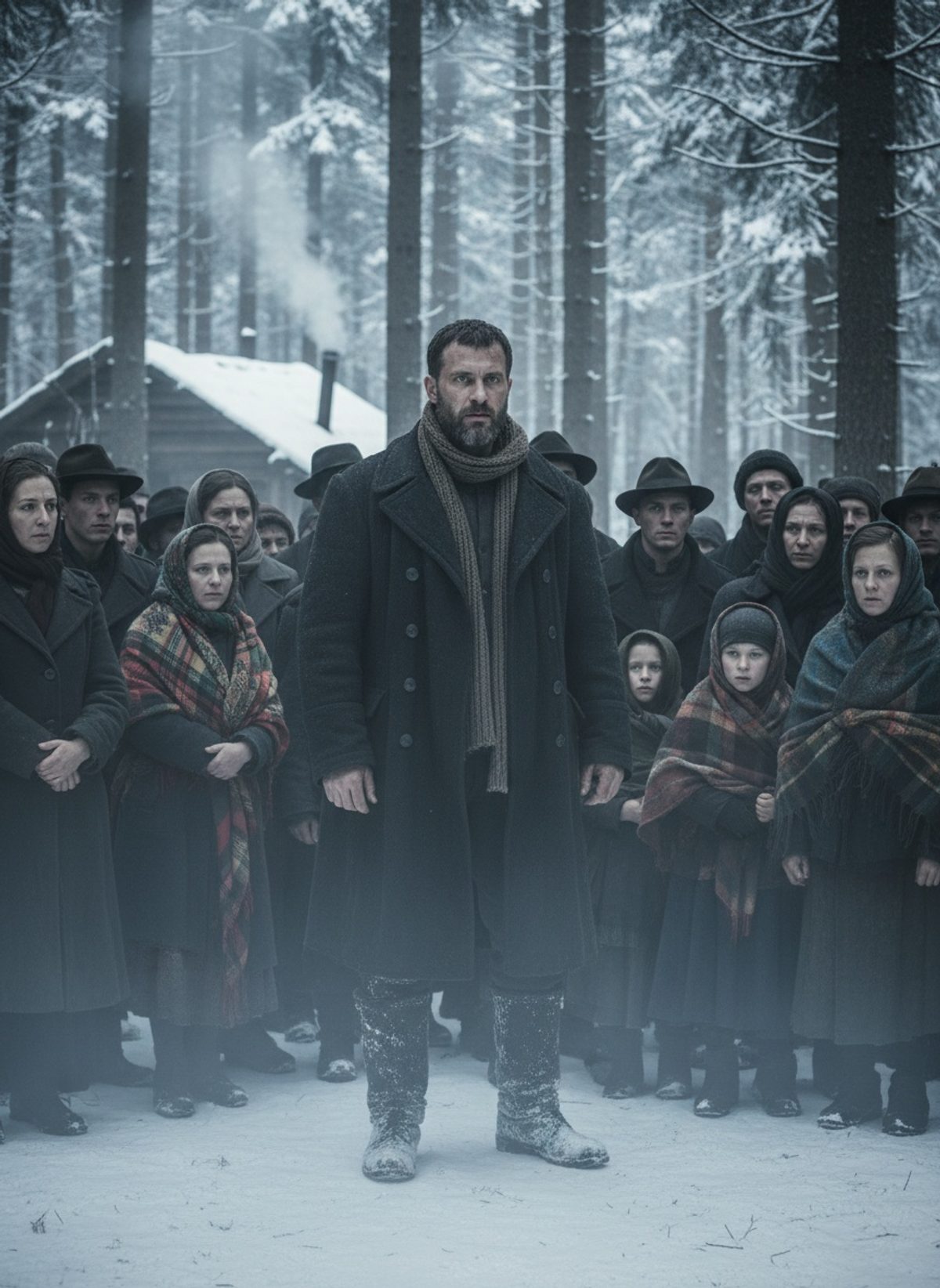
The crack of twigs underfoot echoed through the dense forest, as Tuvia Bielski, a shadow among shadows, led his followers deeper into the heart of Naliboki. Whispers of the wind through the pines mingled with the hushed reassurances exchanged among the huddled refugees. Every sound, every movement was a reminder that survival here was as much a matter of silence as it was of steel.
Forged in the Fires of Loss
In the haunting days of early July 1941, the Bielski family's world disintegrated. German forces had swiftly tightened their grip on Eastern Europe, and their savage occupation of Belarus included herding Jewish communities into ghettos. Tuvia Bielski, along with his brothers Zus, Asael, and Aron, barely escaped the fate that claimed their parents and two of their brothers. Their daring escape into the forests of their homeland marked the first step toward a defiant fight against annihilation.
The forests of Belarus became both sanctuary and fortress. Surrounded by towering trees, the Bielski brothers avoided merely surviving — they began building. The objective was simple yet extraordinary for the times: instead of focusing on fighting the enemy directly, they prioritized saving Jewish lives. Tuvia was resolute: no one seeking refuge would be turned away, and every able hand could contribute to the community’s resilience.
Tuvia’s deep connections to the local landscape and people played a significant role. The forest was both a physical shield and a psychological one. From the ashes of despair, the Bielski family forged a society of their own, complete with a school, a synagogue, and even a rudimentary hospital.
Read next: Epaminondas Broke Sparta's Phalanx With a Diagonal Line
The daring raids they conducted into ghettos saved people, adding to the growing numbers in their forest camp. Each rescue was a defiant stand against the oppressors, a flicker of hope amidst overwhelming darkness.
A City in Hiding
By 1944, the Bielski camp had become an extraordinary underground world. Amid the dense foliage, a makeshift city thrived, housing over 1,200 Jewish survivors. Structures formed from logs and branches provided rudimentary shelter but also symbolized defiance. Every person, young or old, had a role — whether in baking, teaching, or guarding their hidden haven.
In a remarkable testament to their leader's military acumen, the camp operated under strict security protocols. Trails leading to their hideouts were obscured, carefully crafted false trails misled potential intruders, and sentinels constantly scanned the horizon for threats. Tuvia’s military background, sharpened in the Polish army, was indispensable. His strategic mind transformed the forest into an impenetrable fortress, standing resilient against Nazi reconnaissance patrols determined to uproot them.
Living in the forest also required adjusting to nature's whims. Rains turned paths to mud, chilling winds pierced poorly clad refugees, and food was perpetually scarce. Foraging was crucial: mushrooms, berries, and the occasional game provided sustenance. Periodic excursions into surrounding villages to trade or stealthily acquire supplies proved both necessary and perilous.
Tuvia’s leadership extended beyond strategy. His charismatic presence inspired hope and courage among the weary. He maintained morale by ensuring that life continued even within the shadow of death. Indeed, the presence of a synagogue, a place of learning, and even art among the community were powerful assertions of cultural and spiritual endurance.
The Evacuation to Freedom
As the spring of 1944 approached, the rumble of the Soviet advance grew louder. The war’s tides were turning, and the oppressive Nazi grip on Eastern Europe began to lax. For Tuvia and his followers, the advancement of the Red Army was both a harbinger of hope and a new beginning. On the horizon loomed the possibility of liberation, yet it carried its own set of uncertainties and perils.
Read next: Scipio Africanus Turned Captured Numidian Riders Into Rome's Cavalry
Tuvia orchestrated a complex set of maneuvers to prepare the group for what lay ahead. The relocation of his people was not simply an exodus to safety but the culmination of years of resilience and silent defiance. The transition required navigation through a perilous landscape littered with landmines and Nazi patrols. Every step taken was measured, every decision fraught with risk.
Emerging from the forest in the summer of 1944, the Bielski group stepped into the light of a world they had not seen for years. Though scarred by loss, they were a testament to survival against odds that had seemed insurmountable. Theirs was one of the few stories of Holocaust resistance where survival itself was the victory.
Tuvia Bielski’s later years were spent in New York, working as a truck driver, an unsung hero who carried the quiet burden of his past until his death on June 12, 1987.
In the annals of history, the Bielski Partisans stand as a resolute reminder that even amid the greatest darkness, the spark of humanity can ignite profound acts of courage and resistance. It is through their story that we understand the strength found in unity and the relentless pursuit of justice and dignity for all human beings.