Most have never heard of Santorio Santorio. Yet, his work reshaped medicine as we know it.
The Weight of an Idea
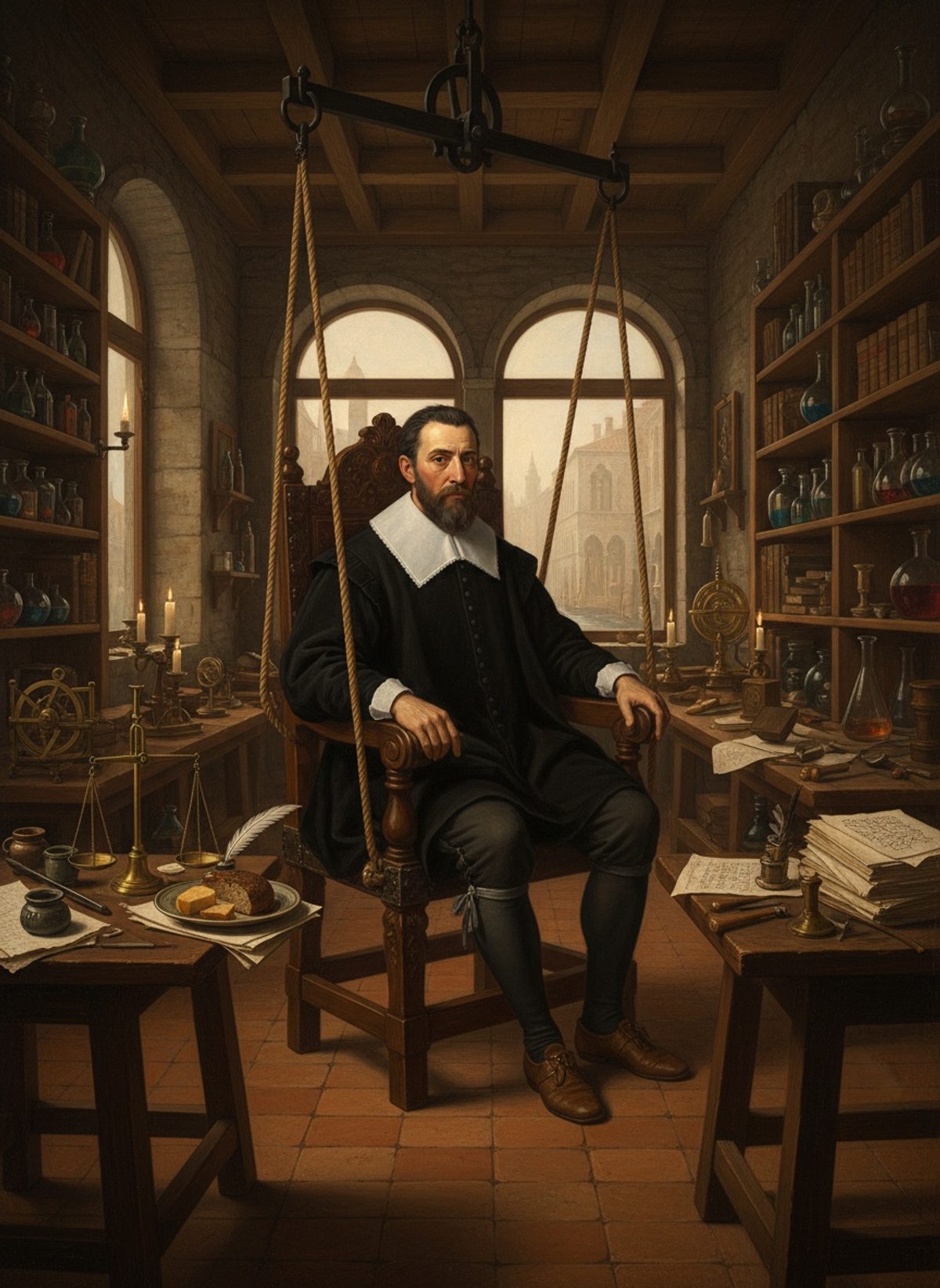
Picture a man from Renaissance Italy, meticulously preparing himself for a meal. But before succumbing to the pleasures of Venetian cuisine, he performs an unusual ritual: climbing into a large chair suspended by a balance beam, carefully noting his weight. This man was Santorio Santorio, a visionary who revolutionized how we understand the human body. Born on 29 March 1561, in Capodistria, Santorio was driven by a singular obsession with precision, and for three decades, he documented every meal, sleep, and bodily function. His goal? To unravel the mysteries of "insensible perspiration" – the idea that the body continuously loses weight in ways imperceptible to the eye.
Santorio's fascination with quantification began during his studies at the University of Padua, from which he graduated as a physician in 1585. But it wasn't until he became the chair of theoretical medicine there in 1611 that his groundbreaking experiments took flight. Venice, the city of canals and commerce, where Santorio returned to practice medicine after his resignation in 1624, served as a backdrop for this medical odyssey. Here, he constructed a special weighing chair – the sella Sanctorii – that allowed him to document the body's inexorable weight changes with each breath and bite.
Exploration of the Invisible
What drove Santorio to such lengths? In an era when scientific inquiry was nascent, and superstition often prevailed over reason, Santorio was drawn to the unexplored frontiers of the human body. By weighing himself before and after every conceivable activity, he identified a phenomenon that was previously unknown: invisible weight loss, or insensible perspiration. This discovery was elegantly simple yet profoundly transformative. Santorio discovered that while food and drink contributed to weight gain, there was an unaccounted loss occurring – a loss that mirrored the balance between intake and waste.
Read next: Cai Lun Pressed Bark and Rags Into the First True Paper
This revelation laid the groundwork for modern concepts of metabolism. By introducing quantitative methods to the life sciences, Santorio paved the way for a more scientific approach to physiology. He documented his findings in his landmark work, De Statica Medicina, first published in 1614. This collection of observations and experiments made insensible perspiration the focus and sparked curiosity across Europe. Physicians began to ponder the body's invisible processes, prompting a shift in how health and disease were perceived.
Instruments of Change
Santorio's contributions extended beyond his weighing chair. In a time when medical instruments were rudimentary at best, he introduced several devices destined to leave an indelible mark on science. Among them was the pulsilogium – a tool to measure the pulse rate – which may have been history's first precision medical instrument. This device allowed Santorio to quantify the pulse, laying the foundations for future studies in cardiology. His thermoscope, an early attempt to measure temperature changes, demonstrated the potential of using technology to understand physiological processes better. These inventions predated similar designs by his contemporaries Galileo Galilei and Giovanni Francesco Sagredo, underscoring Santorio's inventive genius.
Read next: Hesy-Ra: The First Named Physician in All of History
These devices were not mere curiosities but crucial in standardizing medical observations, moving away from anecdotal evidence and intuitive guesses to precise, measurable data. Santorio's drive to quantify paved the way for future pioneers seeking to decode the mysteries of the human body through objective analysis and experimentation. As one of the first to advocate precision instruments in medicine, his legacy is woven into the fabric of contemporary physiological research.
The Breath of Life
Renaissance Italy was a crucible of innovation and discovery – a place where the old world collided with new ideas. Santorio Santorio's diligent pursuit of knowledge epitomized that epoch's spirit. Despite resistance and skepticism, his relentless commitment to understanding the human body on its terms resonated through the centuries. His death in Venice on 25 February 1636 marked the end of an era but left a vibrant legacy for generations of scientists and physicians who followed.
Why does Santorio's story matter today? Beyond the historical novelty of a man spending thirty years in a weighing chair, his legacy lies in his courage to challenge the status quo. By embracing experimentation and measurement, he laid a cornerstone for modern medical science. In an age when we grapple with understanding the complexities of human health, Santorio’s work reminds us that the answers often lie hidden beneath the surface, waiting to be uncovered by those who dare to look closely.