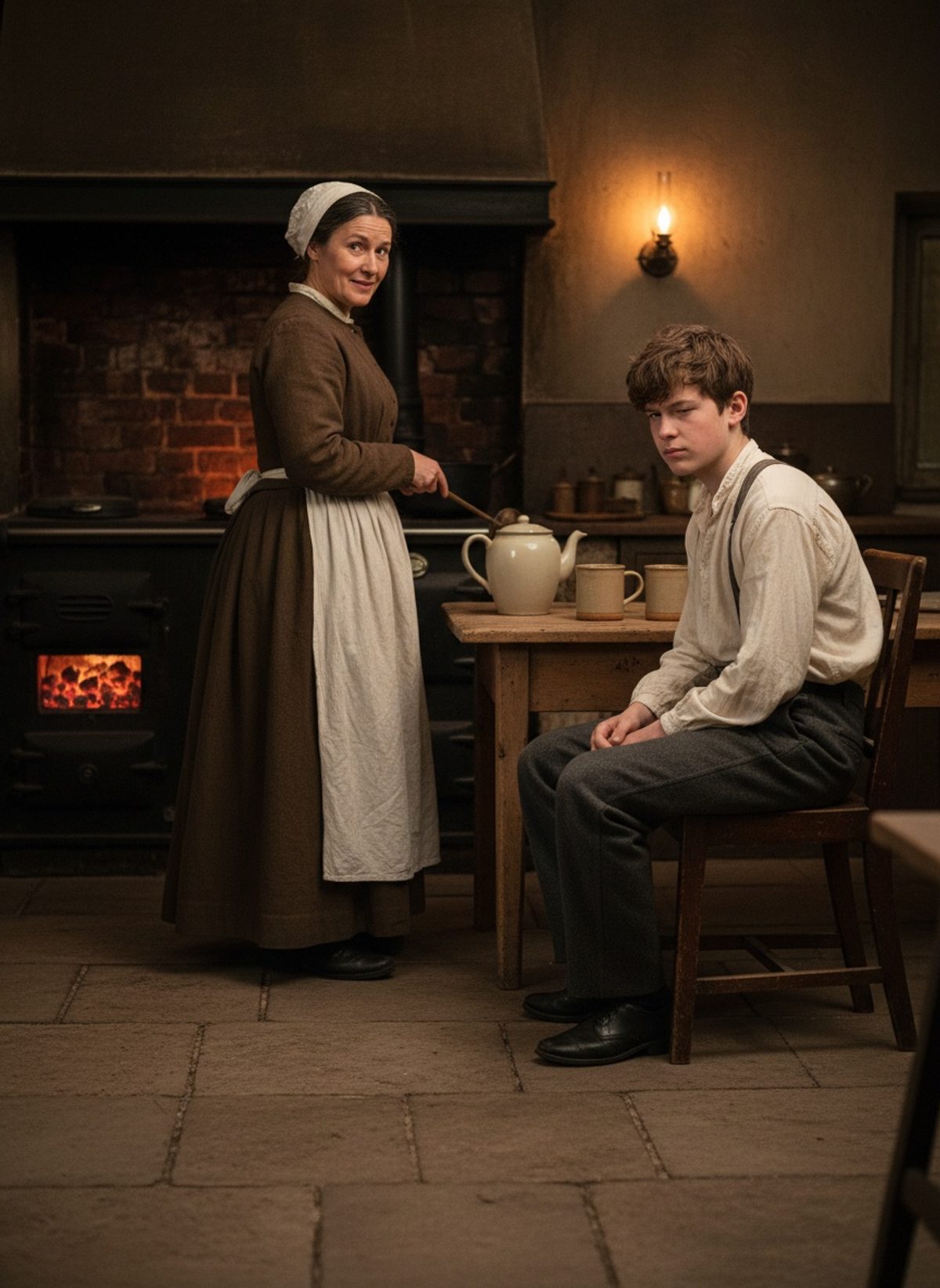
Some say history belongs to those who make it legendary. They might not have met a Scottish mother.
The Quiet Colossus
As the clock ticked steadily towards the industrial triumphs of the Victorian era, Scottish families were caught at the crux of change. In tenements woven into the heart of Glasgow or amidst the windswept crofts of the Highlands, life was an intricate dance between endurance and explosion. With every hardship faced, mothers wielded an arsenal of sayings, pithy enough to cut through the gales. These phrases were more than mere musings; they were fortified time capsules, each echoing with the weight of generational wisdom.
To a Scottish mother, a saying like "What's for you won't go by you" wasn’t just comforting wordplay. It was a firm belief in the stoic philosophy required to survive the roller-coaster of Victorian life. It reminded the weary that destiny, however twisted, had its plan — a plan these mothers countered with practicality and perseverance. This was wisdom spun not from books, but from the fires of life’s forge. A young girl learning her first weaving at the foot of her grandmother would hear such phrases and later pass them on at her own loom, a reminder that survival was as much a craft as weaving itself.
The severity of the 19th-century Scottish landscape was echoed in these quotes. The Highland Clearances, for all their brutality, left behind resilience woven into the very fibre of society. When families were torn from their lands, propelled into urban centres or faraway colonies, it was this sagely advice — "Every mickle maks a muckle" — that advised them on saving resources to make ends meet. Such sayings became beacons in the smoke-filled company towns, where factory lights pierced through the tenebrous haze, guiding families through the thickets of industrialisation.
Read next: The Day a Scots Judge Set Every Slave in Scotland Free
The Hearth as History
The kitchen table was more than an assembly ground for meals; it was the hearth of history — where traditions simmered alongside porridge and lentil soup. Here, Scottish mothers taught lessons not found in scrolls or stone, but on well-worn tabletops scarred by the passage of time. They were oracles of their own kind, sharing insights forged from their mothers and grandmothers, whose own years were marked by the ebbs and flows of Scotland's fortunes.
Each utterance carried an authority sharp as the Highland breeze. Statements like "Dinnae fash yersel" held more than soothing intent; they prompted vigilance against weariness that could cloud judgment or disrupt repose. These adages enshrined a deep-seated wisdom, tempered through eras of agrarian labour and wartime separation, where loves were tested and alliances forged across nations.
In Edinburgh’s bustling Cowgate or the rolling expanse of Ayrshire fields, children grew beneath the steady narrative of their lineage. Mothers would dispense their maxims over the clatter of pans, amidst the very pulse of family life, distilling creativity with constraint. From "Guid gear comes in sma' bulk" — a reflection on the understated luxury — to whispered assurances engraved with conviction, each saying was a talisman against the chaos lurking beyond the doorstep.
Many a child rolled their eyes at these sayings, yet beneath the mockery lay a recognition of their timelessness. As immigrants ventured far, from America to the antipodes, they carried these sayings like cherished relics, binding them to family roots, however distant the soil beneath their feet. Words that outlasted the Empire were not bounded by geography, nor could they be confined by time or distance.
A Whisper Across the Generations
An empire on which the sun never set might have presided over countless transformations, scratching borders into the atlas, but it was the daily liturgies of the kitchen table that whispered of genuine legacy. By the close of the 19th century, titles and tyrannies faded, yet motherly idioms remained as reliable as the eternal hills of the Caledonian expanse.
Through revolutions and restorations, the tales woven into Scottish homilies stood resilient. These sayings—rich tapestries in their brevity—refined themselves through fire and ice. When children left home for factories or foreign lands, they carried songs of perseverance and hope bound within quips like "The cream rises to the top," imparting an intrinsic value beyond tangible wealth.
Consider this: as pages turn, and chapters close, few things remain as steadfast as the gentle admonitions and affirmations of those who shielded hearth and home. Their endurance speaks volumes, resonating with practicality and poetic cadence alike—a reminder that the real victor of history may be the quiet philosopher at the kitchen sink, crafting history with the whispers of ancient sayings.
In an era ravenous for progress, it is enlightening to pause and recount the wisdom of those whose voices brushed silently against the cataclysm of change. It is not only the conquerors or reformists who shape our myths, but those who, with words, chip willingly away at the bedrock of our existence, that we might, one phrase at a time, uncover what truly binds us across ages and oceans.