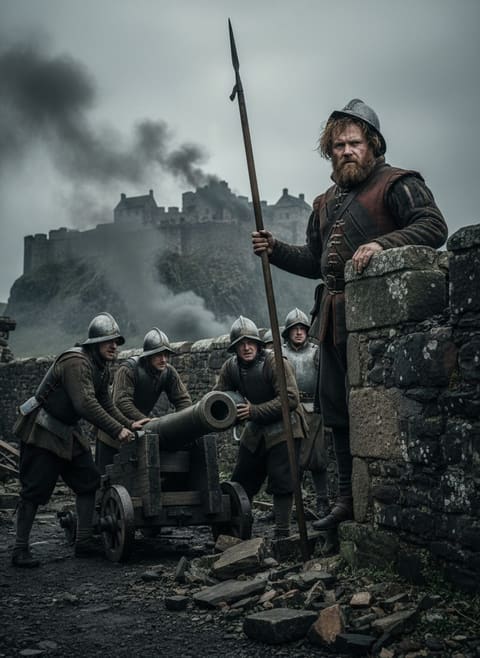
February 14, 1372. The River Dee flowed cold and relentless around an isolated islet.
Here, the chill of Scottish air embraced Archibald Douglas, known to history as Archibald the Grim. Yet as the river surged, it was not the current that interested him but the fortress rising from the land—a bastion of stone that would mark his power and legacy. Threave Castle, a mighty fortress built upon the island, was more than just a structure: it was a declaration.
Archibald, son of the Notorious James “Black Douglas” who had been a fierce supporter of Robert the Bruce, knew that true power was carved from both legacy and the land. As each stone was set, the legend of the Black Douglases scaled new heights, casting long shadows over medieval Scotland.
The Rise of the Black Douglases
Born in 1328 to illustrious beginnings, Archibald the Grim was more than the heir of a storied name. In his era, the Douglases were already figures of lore, with roots reaching back to the Wars of Scottish Independence. Archibald's father stood beside Robert the Bruce at Bannockburn; now, it was Archibald's time to leave his mark. He earned "The Grim" for his fierce demeanor and the dark fate that awaited those who dared oppose him.
Read next: The Highland Regiment Born From a King's Broken Promise
By the time he became Lord of Galloway in 1369, Archibald had carved out a dominion so vast that it rivaled even royal holdings. Yet, Archibald's ambitions were not easily quelled, and his strategic mind turned to the advantages of architecture. Threave Castle wasn't merely for defense or administration—it embodied dominance. Its location was shrewd: encircled by water, approachable only by boat, it was immune to traditional siege tactics.
The construction of Threave reflected two critical facets of Archibald's vision: strategic unassailability and psychological intimidation. Military strength was declared not just through battles won but through the indomitable presence of one's castle. Such dominance made the Black Douglases a name of reverential fear across the land, their loyalty both sought and suspect. Even the ruling monarchs, such as the young King James II, were wary of the family's powerful influence.
In truth, the Douglases' influence extended beyond daunting fortresses. They commanded respect, controlled armies, and stewarded vast stretches of Lowland territory. Educational and administrative reforms implemented by Archibald in Galloway showcased a sophisticated statesman capable of ruling with a firm yet pragmatic hand. As the 14th century waned, the House of Douglas seemed impregnable—its name, synonymous with the fate of Scotland itself.
The Clash with the Crown
By the mid-15th century, the enduring might of the Black Douglases proved too substantial for a nervous James II, who feared their reach might eclipse even his crown. The young king grew up in the shadow of Threave's towers, knowing full well he could not reign over Scotland as long as the Douglases maintained their unyielding hold on power.
The final years leading up to 1455 were tense, with the crown and the Douglases locked in a dance of power that would shape the future of Scotland. The feud reached a peak in this pivotal year when James II, recognizing only outright confrontation could dislodge the pervasive Douglas menace, resorted to an extraordinarily modern approach: artillery.
Cannons cannily acquired and strategically utilized rained down upon the fortresses that had never before faced such firepower. Threave, which had prospered so long under the stewardship of the Black Douglases, became a proving ground. The king’s forces laid siege to the castle, encircling this longevous emblem of Douglas dominance, breaching its once unforgiving walls. It was a harbinger of the changing tides of warfare as the medieval gave grudging way to the early modern period.
The siege's success heralded a decline in the once-mighty Douglas family's power—a decline fostered by explosive power, not by the sword. Other Douglas strongholds fell too, as cannon fire resonated through the king’s other campaigns against them. The end of Douglas supremacy and Threave's siege were signals that battlefields fought with swords and arrows were becoming relics of a bygone era.
Read next: The Earl Who Marched North and Never Came Home
The Legacy of Threave and the Black Douglases
The fall of the Douglas dynasty was both epic and instructive, teaching future generations that even the strongest walls, both metaphorical and literal, cannot withstand the future’s relentless march. Yet, the Black Douglases of Threave left an indelible mark upon history. As guardians and sometimes antagonists to the Scottish Crown, they bridged a great narrative—a tale of power, ambition, and the relentless pursuit of dominance.
Their tale, etched into stone, serves as a perpetual reminder of the complexities of power. In the modern age, as tourists often find themselves walking the halls of the restored Threave Castle, there's a palpable sense of history's presence. The echoes of artillery fire may have silenced the rule of the Douglases, but in the thick walls, the ghosts of former lords linger.
For us today, peering backward, the story of the Douglas clan is not just a Scottish saga but also a universal one. It hints at the inherent fragility of power, an ageless cautionary tale reflecting the grandeur and the inevitable vulnerability that accompanies dominance.
The Black Douglases, once feared and fabled, remind us how legends can grow out of great stone edifices—and how their shadows, though long gone from the rivers that swirled around them, still beckon us to listen and learn.