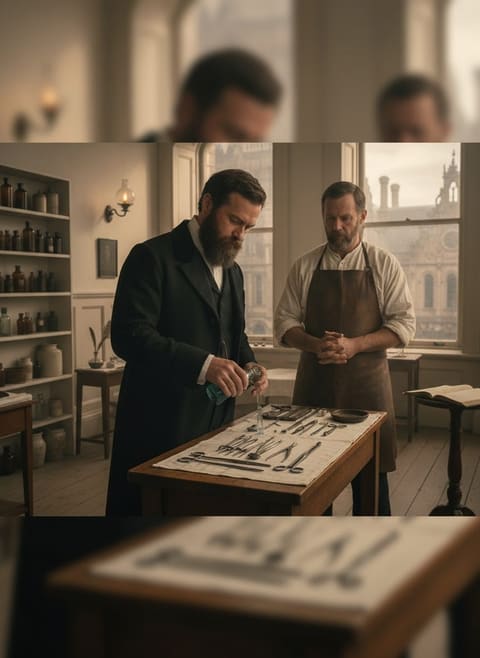
He was a quiet, meticulous man from Essex. Yet, Joseph Lister's revolutionary act was about to roar through the medical world like a storm. In the grimy, blood-stained corridors of Glasgow Royal Infirmary in 1865, the surgical theater was a chilling stage where death often took the final bow.
Surgeons, revered and sometimes feared, were shadowed by the inevitable specter of infection. The crude instruments of their trade, washed in haste and ignorance, were deadly extensions of their hands. Here, amid mortality’s thrum, Lister dared to challenge the silent killer that made surgery a game of chance.
A Surgeon’s Gamble
The wards of Glasgow Royal Infirmary were teeming with life on the brink — a vivid tableau of human struggle. Beneath the noise of bustling staff and the low moans of patients lay the persistent stench of sickness. It was here, in a world used to accepting infection as an inevitable outcome, that Joseph Lister set into motion his daring plan.
Familiar with Louis Pasteur’s germ theory, Lister hypothesized that if invisible organisms caused these deadly infections, then killing these unseen foes could save lives. His weapon of choice was carbolic acid, known then more for its role in treating sewage than human flesh.
Read next: The Day Edward Jenner Gave a Boy the World's First Vaccine
To imagine the audacity of Lister’s actions, one must picture the reality of 19th-century surgery. Blood-soaked aprons were badges of honor for seasoned surgeons, and the term "antiseptic" had yet to find meaning in the surgical lexicon. The idea of cleanliness was as yet unenlightened by modern science. Patients expected to suffer fever and often prayed to survive it. Against this grim backdrop, Lister's readiness to innovate was a gamble that many of his contemporaries deemed reckless.
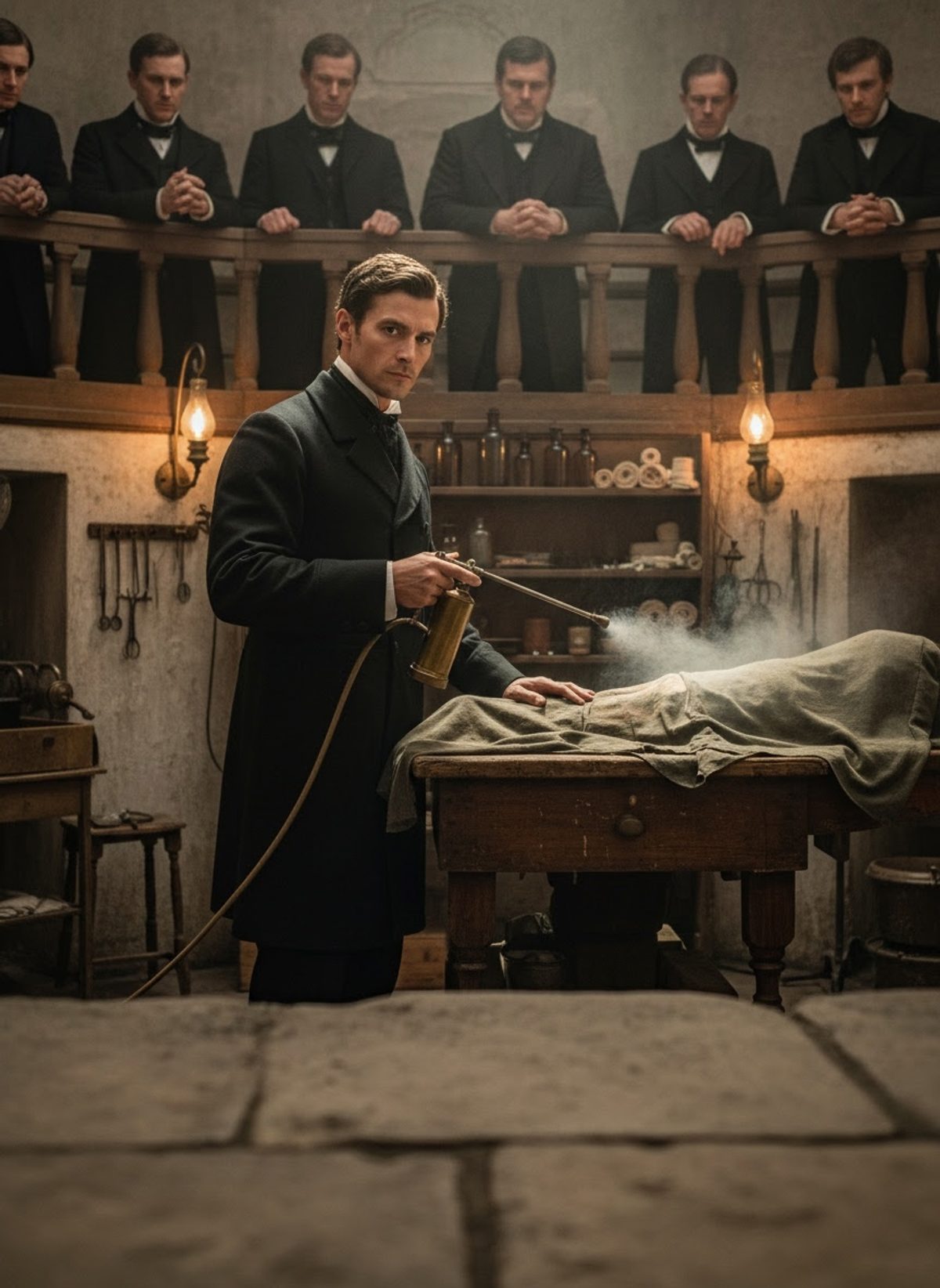
On a day that would shimmer through history, Lister prepared a patient for surgery with his signature precision. The operation itself was straightforward, but it was the aftermath that typically held peril. This time, as the final stitch was placed, Lister did something unprecedented. He sprayed a fine mist of carbolic acid directly onto the wound, a process that drew hushed disbelief from those who watched. The moment held a collective breath, weighed by uncertainty and hope in equal measure.
The Silence that Followed
In the days that unfolded after Lister’s bold step, ward gossip and medical skepticism simmered together. Teetering between doubt and the faint stirrings of belief, Lister’s peers waited for signs of infection — the fatal fever, the red-rimmed wound.
Despite the quiet bemusement his actions initially provoked, Lister’s patient confounded expectations by recovering with unusual alacrity. The ward had witnessed a glimmer of transformation. It was as if the heavy curtains of inevitability had been drawn back to reveal the sunlit possibility of survival, unmarred by the typical ominous turn.
The news circulated gradually, tempered by the skepticism inherent to the time. Surgeons were unlikely to embrace change without due evidence, yet over ensuing months, Lister persisted. His experiments with carbolic acid were not fleeting fancies but were entrenched in rigorous observation.
He recorded his findings with painstaking care, drawing out the patterns that promised life beyond the limits of current practice. His methods not only allowed the healed skin to remain free from the rot but also cleared the air of surgical spaces, adding an almost palpable purity to the air.
Though he remained a subject of criticism for many of his peers who clung to dismissive traditions, Lister’s innovative spirit planted the seeds of modern antiseptic procedure. He moved through the skepticism with an unwavering belief in scientific progress, and slowly, the silence surrounding him transformed into a quiet tide of acknowledgment. Surgery began to open its eyes to antisepsis, prompted by the incontrovertible results before them.
Read next: The Day James Watt Watched a Kettle and Changed the World
A Legacy of Sterile Resolve
As time flowed forth from that pivotal moment in 1865, Lister’s methods began to forge a new path in medicine. No longer were surgeons content to lose patients to infections that their blades unwittingly helped invite. A world that once saw surgery itself as a grim herald of death began to see possibility infused with hope. Operating rooms started to employ not just carbolic acid but a spirit of sterility and protocol that today we recognize as commonplace.
As we consider Lister’s legacy from our vantage point in the future, it is easy to forget the courage coursing through his veins as he dared to treat his patients with no more than instinct and theory to guide him.
His commitment to understanding and combating the unseen foes in our bodies not only challenged but irrevocably shifted medical paradigms. The world he helped usher into view beckons with lives saved and suffering diminished — a reflection of one man’s resolve not to bow before apathy.
Joseph Lister’s courage reshaped not just surgery but the whole of medicine, imbuing it with a pursuit of cleanliness that defended human fragility against microbial foes. His story lingers in every scrubbed-down surface and sterile instrument, speaking quietly of a time when anaesthesia’s reassuring sleep was shadowed by the grim postscript of infection. The day Lister’s carbolic spray touched an open wound was the day the future began to heal.