Most people walk past Schiehallion without a second thought. Yet in 1774, it was the centre of the universe — at least to one man and his extraordinary quest.
The Precision of Plumb Lines
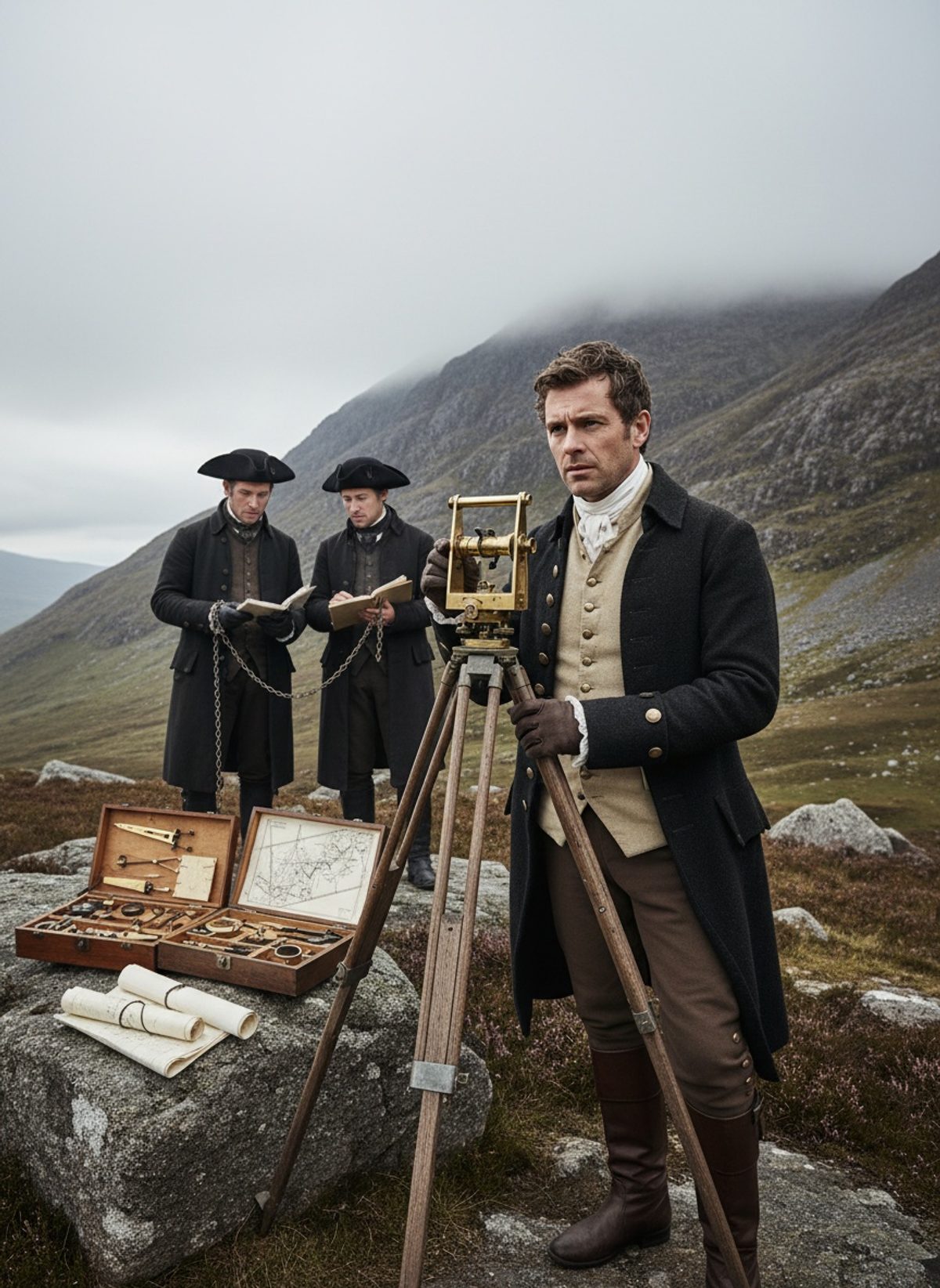
In the summer of 1774, the not-so-high peak of Schiehallion rose alone in the landscape of Perthshire. Its steep, symmetrical slopes and isolation formed the perfect stage for an astronomical experiment unparalleled in ambition. Nestled here, Nevil Maskelyne, the Astronomer Royal, intended to put Isaac Newton’s gravitational theory to a bold test. Just how much did the Earth weigh? He planned to find out, not by wandering continents but by measuring one Scottish mountain.
Maskelyne was a man defined by precision and patience. He came armed with a simple tool: a plumb line, weighted, hanging vertically to find the true vertical through the force of gravity. He knew that if a mountain exerted enough gravitational pull, it would nudge the plumb line from its straight path. If he could measure that delicate nudge, he could estimate the mountain’s mass, and by extension, the weight of the entire planet.
The selection of Schiehallion was no accident. Its symmetrical shape made calculation feasible; it was a natural pyramid in a land brimming with rugged giants. Maskelyne chose it not merely for its shape but for its solitude. Few human structures crowded its base, granting him the uninterrupted space an experiment of this nature required.
Read next: The Day a Blacksmith's Son Rewrote the Laws of the Universe
Maskelyne wasn’t alone in this endeavor. A team of surveyors, including mathematicians Charles Hutton and Reuben Burrow, joined him. It wasn't just their keen minds; they brought an array of finest instruments, each piece crucial for their challenging measurements. Their work was not just to prove gravity but to quantify it in a way no humanity had before.
The Schiehallion Experiment Unfolds
The undertaking required extraordinary persistence. Each team member scrambled up and down the slopes, mapping them with painstaking detail. Over the summer, they recorded over a thousand measurements. Each point, each degree, every calculation carved closer to the unknown figure of Earth's weight.
In harnessing the mountain's gravity, Maskelyne gathered data. The plumb line, with its pendulous and subtle swings, revealed the mountain’s gentle but telling pull. It was a game of patience, and Maskelyne had to trust calculations based on minute variations. Yet, with each sway of the plumb, he knew he was drawing nearer to Newton’s vision becoming a tactile reality.
Ironically, what Schiehallion gave Maskelyne was not simply a number. It laid bare the genius hidden in Newton’s theory of universal gravitation. With nothing but geometry and the tenacity of explorers, they turned invisible forces into tangible structures.
Charles Hutton played a vital part. His creation of contour lines — the lines of equal altitude — crafted a new kind of map, defining not just the geography but the mathematical weight of the mountain. This innovation was a bonus revelation, contributing more than just the expected results. It was from such detailed maps that the invisible truths of our world could finally be laid out clearly on paper.
Read next: The Day a Blacksmith's Son Showed Light Could Travel in Waves
From Mountain to World
Everything came together, and as the men descended Schiehallion, they carried with them not just data, but a glimpse into the universe. Maskelyne's calculations estimated Earth’s mass more accurately than ever before, unearthing a figure unimaginably immense. The numbers suggested not just the Earth’s vastness but transformed philosophical inquiry into confident realization.
This seemingly modest measurement had profound implications. The Royal Society published the results amid fascinated curiosity and widespread acclaim. Science, it seemed, was not merely speculation or theory but measurable. Humanity had weighed itself against the cosmos and found the scales in balance.
Why does this story resonate today? It’s a bold reminder of science's potential to conquer the impossible, of calm minds standing on wild peaks to pull the threads of the universe into measurable, comprehensible truths. Though nearly invisible to the naked eye, the forces of nature — like gravity — today guide satellites and underpin the entire architecture of modern physics.
Twenty-three centuries ago, Archimedes boasted that with a lever and standing point, he could move the Earth. In 1774, Nevil Maskelyne did not move it, but he measured it with the elegant simplicity of nature. His unassuming mountain declared secrets hidden in the depths of gravity, showing us that the grandest discoveries can emerge from the quietest acts of curiosity.