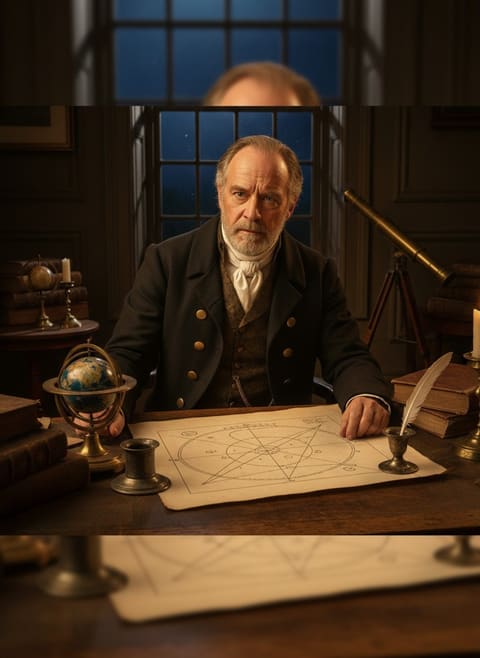
Paper rustled under Charles Babbage's hands as he unrolled his sprawling blueprints across the cluttered desktop. The dim light of London’s gas lamps snuck in through the window, casting flickering shadows over lines drawn with precision. Babbage, a man of voracious curiosity and relentless ambition, leaned over the intricate drawings with the intensity of a watchmaker.
There on the page, an engine unlike any conceived before — one of gears and levers — envisioned to simulate the human mind’s capability to calculate and store knowledge. If built, it would forever change the landscape of computation and thought. Yet, the brass components of this Analytical Engine existed only in the visionary’s mind and on these sheets, one century ahead of its time.
Gears of Brilliance
The foundations of the world’s first prototype computer were laid in the fertile imagination of a man frustrated by errors. Charles Babbage, dubbed the father of the computer, was initially driven by a desire to eradicate the inaccuracies rampant in mathematical tables of his era.
In a world where calculations could determine the success or failure of navigational ventures and engineering feats, precision was paramount. Babbage began with the Difference Engine, a simpler apparatus designed for automatic arithmetic operations. While revolutionary, it merely scratched the surface of his ambitions.
Read next: The Day James Watt Watched a Kettle and Changed the World
In 1833, Babbage stormed beyond mere computations, envisioning a machine that could solve any mathematical problem fed into it and store intermediate results for further manipulation. The design, if turned tangible, would boast a ‘mill’ (akin to a modern CPU) capable of executing programs encoded on punched cards.
Here, numbers would move and transform, etched by brass wheels and rods into undying memory. It was the first notion of a computer that could be programmed, a term and concept new to Victorian language.
Babbage’s Analytical Engine went further, conceptualizing not just number crunching, but decision-making — through control structures like loops and conditional jumps. The blueprints were a symphony of interlocking gears, each with its impeccable role, each a slave to the mathematics that guided it. It was in these seemingly esoteric and arcane drawings that a future was forged, where computation would not merely serve a single purpose but a multitude.
Despite Babbage's genius, Victorian society found his ideas far-flung. Funding was scarce, and support was tepid. His creations, more often shelved than built, remained entrapped in their two-dimensional prisons, alive only in the intricate imagination of their creator and the yellowing ink of drawings dreamed boldly ahead of their time.
The Architect of the Future
In the haze of industrial London's hustle, Babbage emerged as both a product and a critic of his society. An innovator at the cusp of modernity, yet also a recluse tangled in a net of Victorian values and fiscal constraints.
The Analytical Engine, sketched with audacity, was envisioned to bring order and logic to a world spinning with abstract calculations. The very idea that a machine could perform independent arithmetic reasoning was baffling and both dismissed and marvelled at in equal measure.
Yet, Babbage was not alone in his dreams. Ada Lovelace, a name perhaps overshadowed by the legacy of the engine itself, recognized the potential of Babbage’s machine beyond arithmetic. She saw music, words, and images transformed, long before they became bits and bytes.
Her insights offered an early glimpse into what we might now call software development. Lovelace’s notes hinted at using the engine to weave "algebraical patterns just as the Jacquard loom weaves flowers and leaves." In that metaphor lay the seeds of modern computing.
Read next: The Day a Derbyshire Mill Owner Gave the World Its Colour
As the era advanced, technology's feet dragged slower than Babbage's mind raced. Brass and steam struggled to keep up with concepts that demanded electricity and silicon. But his relentless quest for order from chaos echoed far beyond his untimely death. His work spoke of a future not yet realized, and it was this discord between vision and reality that spurred waves of innovation long after the Victorian gas lamps dimmed for good.
Turning Machines Into Ideas
Though Babbage's Analytical Engine never saw life in his time, its pages turned into foundations upon which an empire of computation was built. The moment when Babbage spread his drawings marks a turning point, a crucial step towards mechanical, and eventually digital, computation. His legacy? The very notion that machines could transcend simple arithmetic to embody dynamic thinkers, capable of thinking, calculating, and perhaps one day, learning.
Today, every computer traces its lineage back to Babbage’s unfulfilled machine. From the simplest calculator to the most profound artificial intelligence, all owe a debt to the dream once outlined on yellowing paper in a cramped London workshop. In a world where technology now writes poetry and conquers grandmaster chess players, the Analytical Engine embodies the spark — a dream of automation, calculation, and limitless potential.
The unseen impact of Babbage's ideas calls us to reflect not just on the machines themselves but on what they suggest about human endeavor and ambition. In every byte transmitted, every algorithm processed, our perpetual quest to transcend the limits of physical reality echoes.
Such stories teach us that visionaries like Babbage and Lovelace light the path forward — a path that recognizes no bounds, where ideas are not constrained by the tools to make them tangible. The foresight to imagine a thinking machine in 1833 reminds us of the profound power residing in human ingenuity, poised always at the edge of what can be and the dreams yet to unfold.