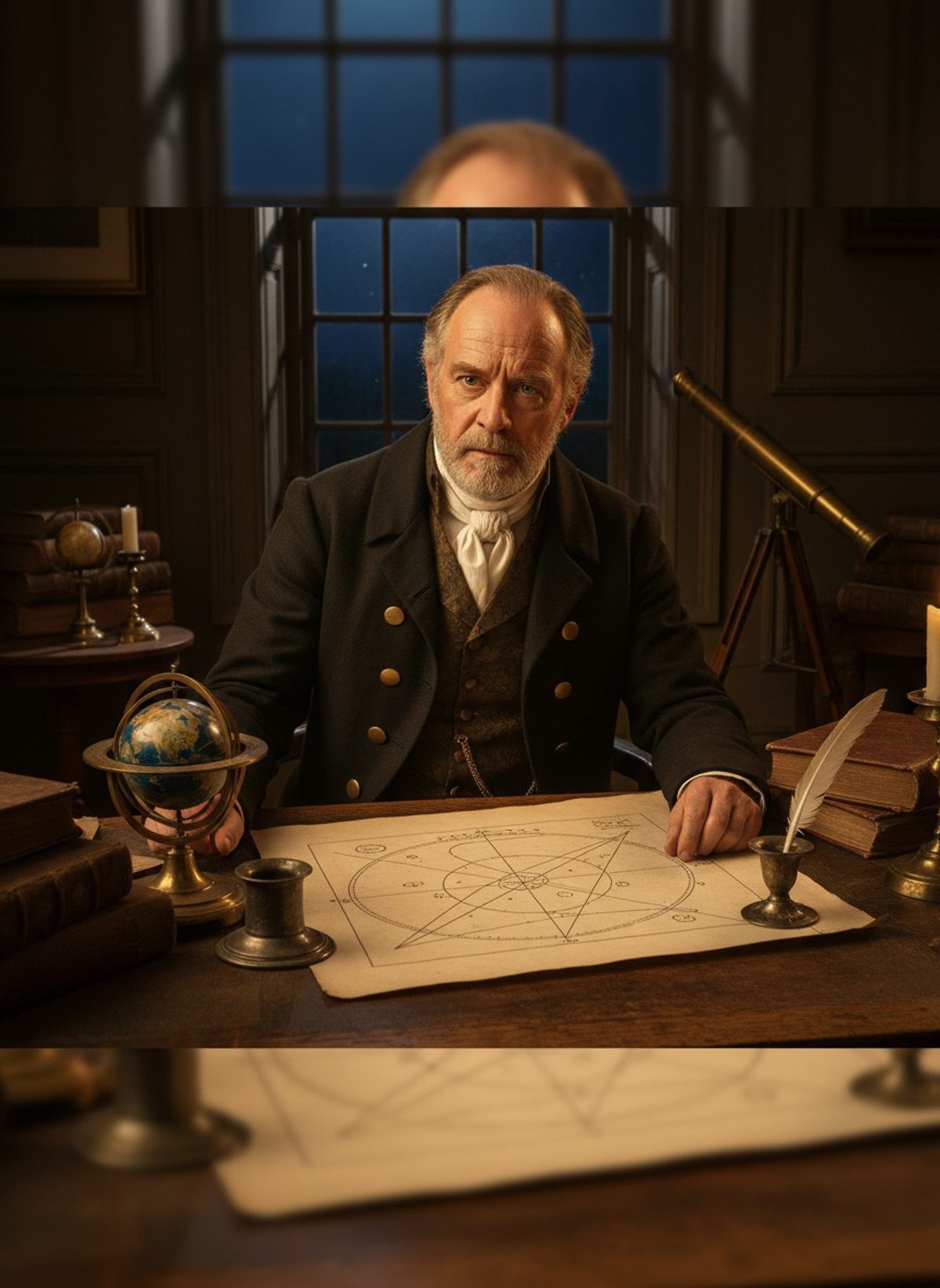
The morning air crackled with anticipation on the cusp of summer in June 1716, the serene dawn casting its golden hue on the English countryside. Birds sang in earnest as the first light spread across the modest home of Edmond Halley, a man consumed by the cosmos.
In that pale light, under the watchful gaze of the distant Sun, he worked fervently on an idea that would transcend his lifetime. His ambition? To measure the unfathomable distance from Earth to the Sun by observing the transit of Venus. In doing so, he set a challenge not for himself, but for those yet to be born.
The Provocative Prediction
Edmond Halley, best known for the comet that bears his name, had long been engrossed with celestial phenomena. On this particular June morning, surrounded by ink-stained papers and dusty tomes, he scribbled furiously. His mind was a hive of astronomical theories and mathematical postulations. He proposed that the rare transit of Venus across the Sun, if observed from multiple points on Earth, could be used to calculate our planet's distance from its life-giving star.
The mere concept of a transit was enough to stir the imaginations of astronomers across Europe. Halley knew the celestial mechanics involved but understood that he, at 60 years old, would not live to see the transit unfold. The next occurrence, set for June 1761, was nearly a half-century away. It was a gamble on the skills and curiosity of generations yet to come, and Halley was trusting them to rise to the occasion.
Read next: The Day a Blacksmith's Son Showed Britain the Invisible World
The Silent Challenge
Halley's prediction needed an equally prophetic call to action. By leveraging the parallax effect, observers in different parts of the world could measure Venus' path across the Sun against the backdrop of the stars. This small change in position could unlock the secret of the solar system's scale. Therefore, it was crucial for astronomers to time the transit with precision and communicate those observations swiftly. Halley threw down a gauntlet that would galvanize the world of astronomy.
Yet, Halley's words weren't carried on the wind; they were ensconced in journals and circulated among the learned circles of Europe. His vision eventually drew interest from the great minds of the Enlightenment. The promise of unearthing the fundamental dimensions of our cosmic neighborhood was too tantalizing to ignore. Everywhere there was talk of mobilization, eager scholars ready to accept Halley's challenge.
The Global Endeavor
Fast forward to the year 1761, the anticipation that Halley had stirred had reached a fever pitch. The world was a stage, with astronomers scattered from England to India, from Siberia to the South Seas. Expeditions were launched, and observatories established, all with the singular aim to catch a brief glimpse of Venus' passage across the Sun.
These efforts encountered myriad challenges—stormy seas that delayed sea-bound observers, wars that imperiled safe passage, and even clouds that obscured the critical moment. Despite these odds, numerous successful measurements were recorded, including one by Jeremiah Dixon and Charles Mason in South Africa. Their observations, along with others, would later be pieced together to reveal the breadth of our solar system.
Read next: The Day a Surgeon's Son Gave the World a New Kind of Vision
The Measure of Success
In the years following the 1761 transit, and another in 1769, the collected data began circulating around Europe, each calculation edging closer to the true value of the astronomical unit—the mean distance between Earth and the Sun. With continued refinement, the values drew steadily toward the figure we recognize today.
Halley's method proved sound, a testament to his genius. What began as scribbles on parchment in an English study had matured into an international collaboration. The parallax method became a template for future science endeavors that sought to quantify the cosmos. Indeed, the successful measurement of the astronomical unit fueled new theories and explorations, capturing the imaginations of those who dreamed of mapping the heavens.
The Unyielding Dream
The story of Halley's prediction and its eventual verification is a testament to human curiosity and perseverance. It reminded us that the pursuit of knowledge is an unending journey, often requiring faith in the unseen and daring leaps into the future. Even when confined by the limits of their time, the persistence of those early astronomers pushed the boundary of what was known.
As we look back, Halley's challenge is a reminder that our understanding of the universe continues to evolve, step by meticulous step. In an age where technology pushes the boundaries of space exploration, the spirit of those who timed Venus' fleeting dance across the face of the Sun continues to inspire new generations to reach for the stars.