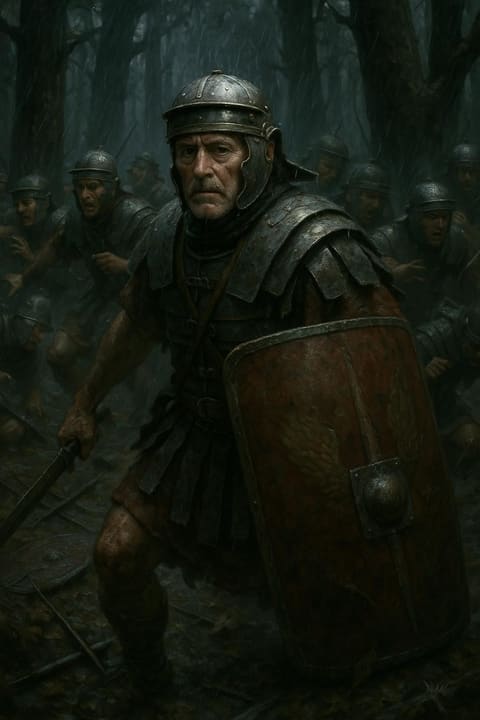
The metallic clash of swords echoed across the battlefield as the smell of fear and iron enveloped the air. Dust rose from the ground as legionaries shuffled into formation under the burning sun, sweat trickling down their brows. It was February 197 AD in the city of Lyon, and the tension was palpable. Amidst this chaos stood Decimus Clodius Albinus, a man of aristocratic bearing, whose icy complexion earned him the moniker *Albinus*. Just moments earlier, he had been a governor in the distant, misty lands of Britannia, but now he was locked in a desperate struggle to seize the ultimate prize—control of the Roman Empire.
Born around 150 AD in Hadrumetum, a coastal city in what is now modern-day Tunisia, Albinus came from noble stock. He demonstrated an early talent for leadership, joining the Roman army at a young age and quickly distinguishing himself. Marcus Aurelius, the philosopher emperor, recognized Albinus's potential, acknowledging that without his steadfastness, the legions in Bithynia might have defected during the rebellion of Avidius Cassius. Yet, this promising military career entwined him with powerful figures whose ambitions mirrored his own.
His rise to prominence saw him serve under both Marcus Aurelius and his successor Commodus. It was during this period that he navigated the unforgiving political landscape, at one point denouncing Commodus after a false rumor of the emperor’s death. Ever the tactician, Albinus realized that this might bolster his standing with the Senate, an institution yearning to reclaim its ancient glory from the hands of emperor-like despots. His intentions earned the Senate's admiration but caught the ire of Commodus, a man known for his unpredictable wrath. Despite this tension, Albinus held his command in Britain firmly, even after Commodus's eventual murder in 193 AD.
The political vacuum left by Commodus's death ignited what would come to be known as the "Year of the Five Emperors”. The imperial throne, much like the commander's crest passed through a legion in the heat of battle, became a prize for the mightiest claimant. When Pertinax, successor to Commodus, was murdered and the throne was auctioned off to the wealthy senator Didius Julianus, the empire's stability disintegrated into a tempest. Soldiers across the provinces began proclaiming new leaders: Pescennius Niger in Syria, Septimius Severus in Illyricum, and of course Albinus himself, backed by the indomitable legions of Britain and Hispania.
Read next: Spurinna Warned Caesar. Caesar Laughed. Then He Went.
Initially, Albinus allied himself with Septimius Severus, a strategic union formed from mutual need. Severus had seized Rome, and in a gesture of both alliance and calculated politics, he offered Albinus the title of Caesar—a junior partner in rule—and the seductive promise of future power. In the west, Albinus maintained control, and together they defeated their common rival, Pescennius Niger. The subsequent defeat of Niger in 194 AD, despite his fierce resistance and the pivotal fall of Byzantium, solidified Severus’s power in the East.
However, as the dust settled, the alliance began to strain. Severus, a man bent on unequivocally securing his rule, turned his strategic vision westwards. He had tasted absolute power, and relinquishing even a fraction was not part of his plan. On his side, Albinus perceived the growing threat and prepared for conflict. In 196 AD, tensions climaxed—in a bid to secure his position and expand his influence, Albinus crossed the Channel, rallying his loyal legions in a bold move to assert his claim directly against Severus.
Read next: Paulinus Had One Legion. He Chose to Fight Anyway.
The stage was set for a cataclysm, leading to the battle of Lugdunum, near Lyon. With both men commanding tens of thousands of Rome's finest soldiers, it was not merely a confrontation of military might but a clash of wills. The air was thick with the cries of men and the thud of marching feet as they met on the blood-soaked plains. In the chaos of pitched battle, Albinus’s forces were overwhelmed. Severus, through strategic prowess and perhaps sheer numerical advantage, gained the upper hand. As the sun gradually descended, casting elongated shadows over the slain, Albinus fled, wounded and desperate.
His flight, however, was short-lived. Captured and brought before Severus, the outcome was grim. On February 19, 197 AD, Decimus Clodius Albinus met his end—a tragic conclusion to a man's bid for empire. His body was left to the mercy of fate, tossed into the rushing waters of the Rhone, a silent end for a once-commanding figure. In the brutal aftermath, Severus solidified his reign over the Roman Empire, enacting widespread purges of Albinus’s supporters—a stark reminder to any who might harbor similar ambitions.
In unraveling the story of Clodius Albinus, we explore the rippling effects of imperial ambition on the crumbling order of ancient Rome. His life and dramatic end serve as a lens through which we glimpse the formidable forces of human ambition and the cost it exacts. The battle for empire encapsulates the volatile nature of power and the fleeting glory of authority, reflecting a universal human condition that echoes through history. It is a tale not just of individuals but of an entire civilization navigating the tumultuous tides of change—a poignant reminder of the fragility of human endeavors against the relentless march of time.