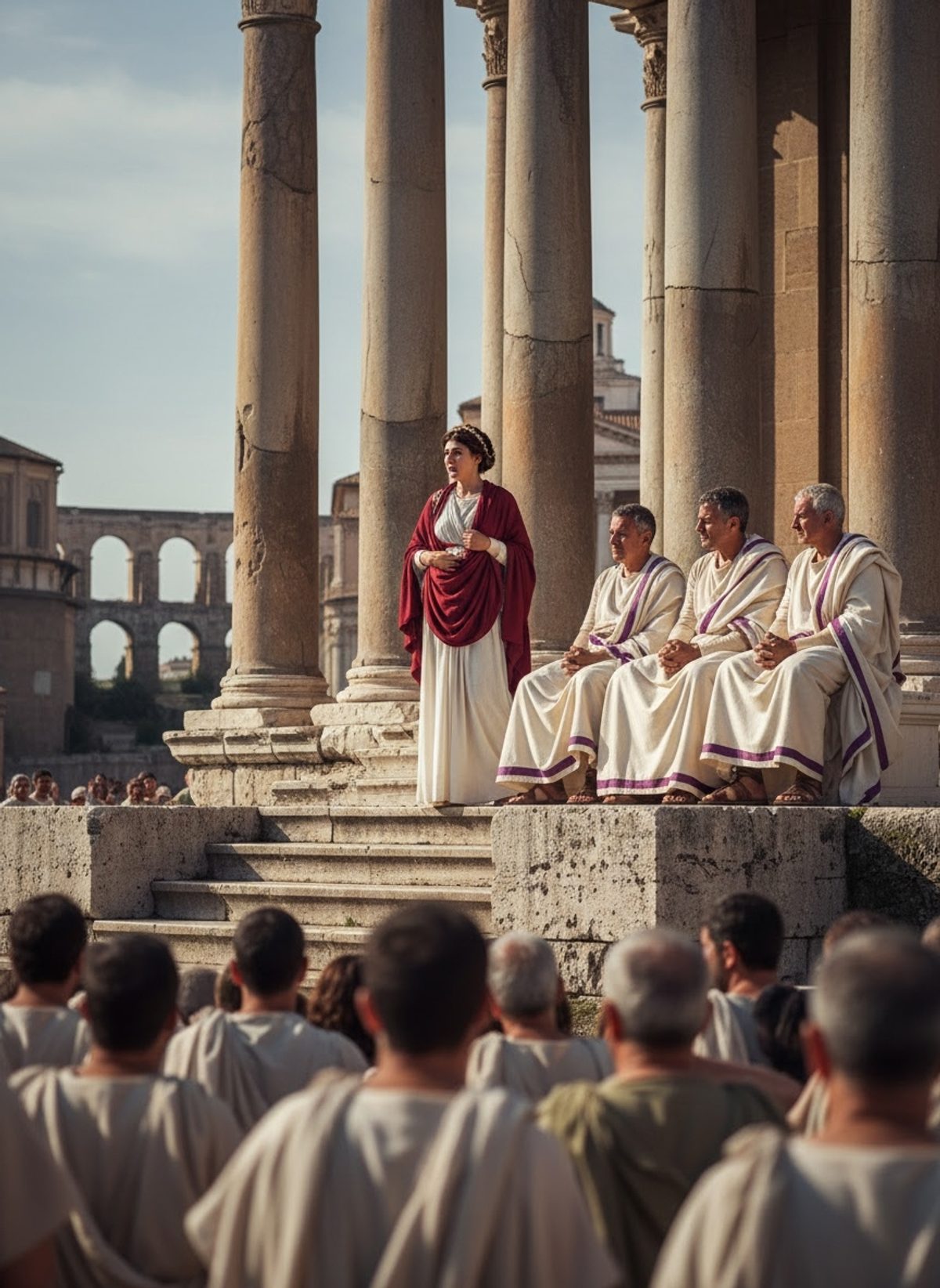
The morning light poured over Rome's Forum like liquid gold, casting long shadows off marble columns and stirring the bustling city awake. Birds flitted through the air, their songs mingling with the increasing chatter of merchants setting up their stalls.
In this heart of ancient Rome where power regularly shifted like the Tiber's current, a new conflict approached. It was 42 BCE, and the civil war had driven the Second Triumvirate to levy a unique burden: a tax aimed specifically at Rome's wealthy women to fund the war chests of Mark Antony, Lepidus, and Octavian.
The Unseen Forces of the Forum
At its peak, the Roman Republic writhed under the dictates of the Second Triumvirate, a potent alliance between three of its most ambitious men: Mark Antony, Lepidus, and Octavian. Legally sanctioned by the lex Titia in late 43 BCE, this trio wielded power that overshadowed all institutions.
In a turbulent Rome still reeling from Julius Caesar's assassination, their authority was absolute. The triumvirs divided the empire's provinces among themselves, seeking control and vengeance against Caesar's assassins, the liberatores. But financing their military might required more than audacious ambition; it required resources.
Read next: Sertorius Held Roman Spain With an Army of Exiles for Eight Years
In a bold move, the triumvirs declared a tax on 1,400 of Rome's wealthiest women. Viewed merely as purse strings to the Triumvirate's designs, the women had no voice in how these funds would fuel a war that held their interests hostage. Yet, in the face of these oppressive demands, a singular resistance formed, embodied by a woman named Hortensia. Rome's aristocratic and political elite knew her as the daughter of Quintus Hortensius Hortalus, an orator revered for his eloquence.
Hortensia: Voice of Defiance
Threatened by a tax they deemed outrageous and unfair, Rome's elite women needed a champion. They chose Hortensia. Rumors of her unmatched acumen as a speaker ran through Rome's streets and alleys. As her father had stood before the courts in defense of Roman values, Hortensia prepared to stand before power itself in defense of fairness.
The day that Hortensia approached the Forum, the sun blazed defiantly in the sky, its heat bouncing off the stone paths so fiercely that one could easily imagine a specter of war hovering in the heat waves. She was not alone; she represented the voices and hopes of her peers.
As she stepped into the Forum's embrace, adorned not with the spoils of war but with the wisdom of ages, the crowd shifted. Attire that spoke of wealth and nobility, combined with an aura of determination, marked her as a formidable opponent.
Every footfall echoed the bold resolve of Roman matriarchs drawn into public life by necessity. Addressing the Triumvirs directly, she cut through the political atmosphere like a sharp breeze slicing through the oppressive warmth. "Because we have no part in the honors, the commands, the governments for which you contend, we will not pay your impeached tax," she declared. In those words, Hortensia captured a cry for justice that resonated far beyond the Forum’s confines.
Negotiating Power: A Victory Shared
With the Forum breathing in her words and the crowd hushed with reverent attention, Hortensia used her father’s rhetorical legacy as a weapon. She argued that just as they had not been part of the decision to wage war, so should they not be the ones to finance its fires.
Read next: Publius Decius Mus Rode Into the Enemy Line to Save Rome
Her speech marked a pivotal moment where negotiation met profundity and a clear message reached the ears of those in power. The triumvirs, faced with such damning logic and collective public support, found themselves compelled to rethink their strategy.
The women of Rome were not to be ignored, nor their money plundered without cause. A resolution was swiftly reached. The arbitrary tax was cut significantly. This monumental reduction by three-quarters underscored the triumph of reason and rhetoric over raw, unbridled might.
As word of the victory spread, Hortensia’s name became synonymous with resilience and eloquence. Her speech marked not only a successful negotiation but also a symbol of the unexpected power wielded by those often relegated to the background. The triumph hammered home a simple reality: the voices perceived as silent could indeed reshape the world.
What Hortensia achieved was more than a mere reduction in tax—it was the forging of a new narrative about strength and advocacy in the face of formidable odds. Rome continued to surge forward amidst political tumult, but the tale of Hortensia—the woman who stood firm, the woman who spoke truth to authority—endures, whispered among the stones of the Forum as a testament to potential unknown until challenged.