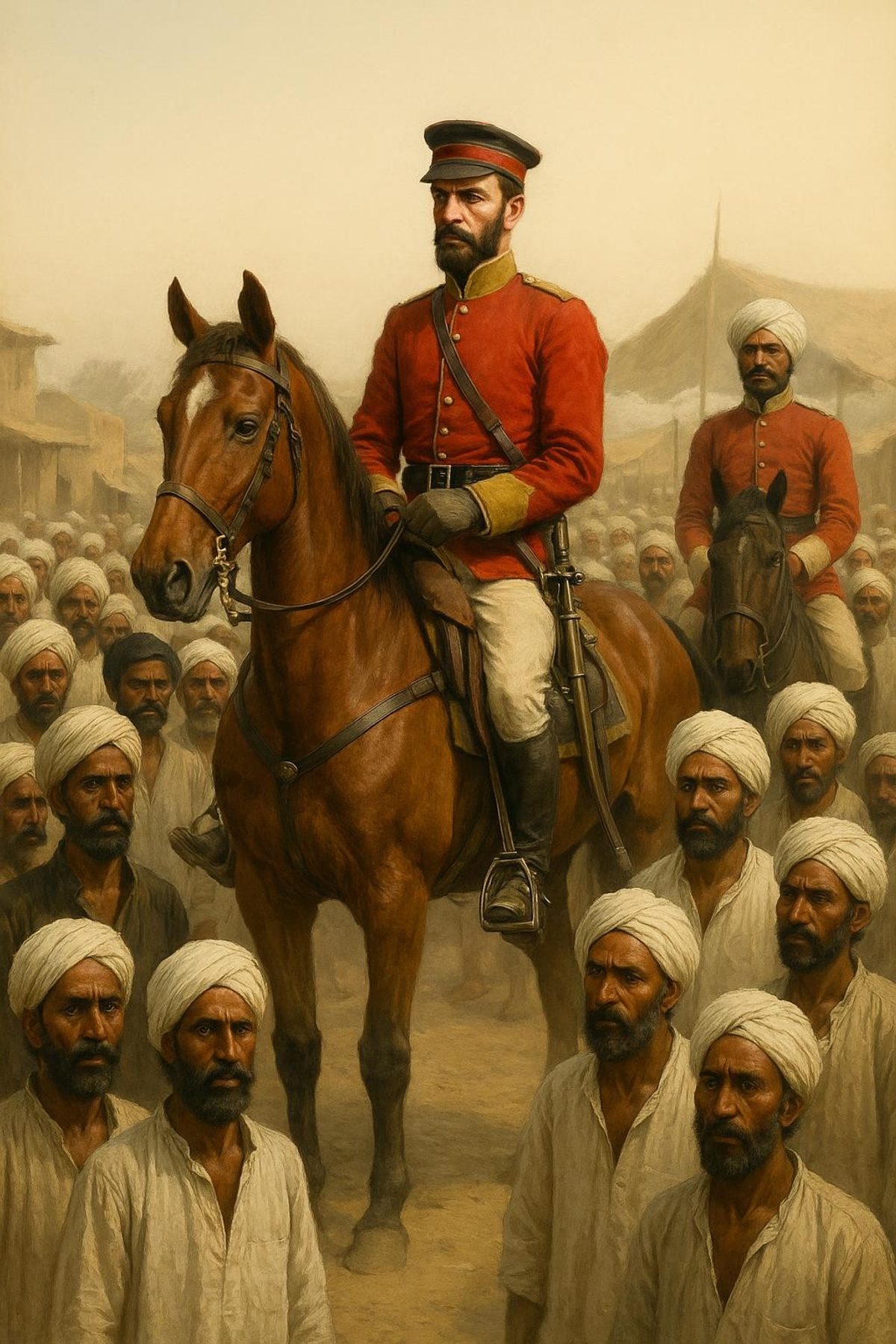
Dust clung to the sweat on William Hodson's face as he adjusted his grip on the reins, urging his exhausted horse forward. The sun lay low over the rugged encampment of thousands, casting amber hues across the vast sea of soldiers, their eyes filling with suspicion and curiosity. Every heartbeat pulsed like thunder in his ears, each breath a tangible ache—he was alone, utterly alone amidst a potential enemy that rippled with latent hostility. Hodson was a hawk in a world of sparrows, but this was no place for bravado or folly; it was the very brink of calamity or triumph.
One Man Rides Against Thousands
September 1857 was a desperate time in northern India. The Indian Mutiny had surged with fury across the subcontinent, a spontaneous combustion of resentment against British rule that threatened the very heart of Victorian imperial possession. Delhi, the symbolic nucleus of this uprising, had just fallen back into British hands, but the ancient splendor of the city masked the embers of rebellion smoldering just beyond its walls.
In this cauldron of defiance and uncertainty, William Hodson took it upon himself to ride into the eye of the storm. Though his name hardly resonates alongside other nineteenth-century Victorian officers, his actions on that fateful day in September became the stuff of daring legend, albeit wrapped in controversy. The task before him was Herculean. Three princes of the fading Mughal dynasty, the last vestiges of a lineage that had ruled India for centuries, lay ensconced among their remaining loyalists. Thousands of disaffected soldiers loomed large, weapons at the ready—a coiled spring of potential violence.
Hodson, however, was undeterred by the disproportionate odds. His was a mission to capture the princes and deliver a crippling blow to the morale of the mutineers. Tradition holds that only with the capitulation of these eminent figures could the burgeoning unrest be truly quelled. Yet Hodson was not adorned with the ceremonial veneer of official rank or stature on this solitary ride. He bore only his resolve, an unyielding demeanor that broke like a crashing wave upon the tense air of expectation. This was a gambit of historic audacity.
Read next: When Nain Singh Walked Into Lhasa and No One Knew
The Surrender of Swords
Riding into the encampment, Hodson became a singularity amidst a vast transcontinental tempest. The tangle of voices hushed, a riveting silence cleaved the atmosphere as if his arrival had strangled the breath from the world itself. Here, where men warred with the confusion of loyalties and honor thrived in the shade of mutiny, Hodson's entry was a spectacle none dared interrupt. This man's gall, unbroken by the trepidation of circumstance, commanded attention with the certainty of a thunderclap.
Hodson approached the Mughal princes with forthright precision. The young men, bastions of a bygone era, held themselves with regal dignity, even as their empire crumbled around them. The surrender he demanded was not a bargaining chip, but a definitive end. In this tense standoff, the allure of heroism bore a veneer of simple practicality: here was the impending inevitability of British restoration, personified in the lone emissary daring enough to request their submission.
To lay down their arms was more than an act of submission; it struck at the core of a dynastic pride that had withstood the test of centuries. As the swords of the princes met Hodson's outstretched hand, they signified not just a personal defeat but a symbolic collapse of a storied empire. And yet, the spectacle passed in silence—no guns discharged, no shouts rose to fracture the stillness. The crowds looked on, witnessing this handover as a solemn testament to the changing tides of power.
Exit Stage on Foot
As Hodson led the young princes out from among their followers, it seemed impossible that so simple a departure could wield such earthshaking significance. Those moments when Hodson and the defeated royalty passed through the tight ranks of onlookers, bound not by chains but by the oppressive silence of inevitability, resided beyond the realm of mere tactical maneuvering. They encased a diminishing world in amber—a relic of memory forever preserved by the act of sheer, unmitigated audacity.
Hodson's audacious act of courage did not go unchallenged in the annals of opinion. Among contemporaries and posterity alike, his actions drew both scorn and admiration. Accusations of brutality lurked in his shadows like phantoms, while others hailed him as a paragon of decisive fortitude amid the chaos of rebellion. Nevertheless, what remains indelible is the image of Hodson—a man astride the whirlwind of mutiny, remarkably unflinching against the surge of destiny.
This harrowing moment stands as a monument to the complexity of colonial narratives and the breadth of human resolve. The sepia tones of history have since diluted the immediacy of Hodson's ride, but its pulsing echo demands attention. In this lone journey against overwhelming odds, we witness a microcosm of the broader human condition—the eternal struggle between hope and despair, pride and submission, power and the inevitable passage of time. The tale whispers through the ages, urging us to explore the untold stories lurking between the lines, within the shadowed corridors of the past.